





AI Automation in ERP: Benefits and Use Cases
AI automation in ERP, benefits, and real use cases that improve efficiency, cut costs, streamline workflows, and enable smart business decisions.
Businesses implementing ERP systems are now turning to AI automation in ERP to improve operational efficiency, enhance data accuracy, and enable faster enterprise-wide decision-making. As ERP platforms manage critical functions such as finance, supply chain, HR, and procurement, integrating AI automation transforms these systems into intelligent engines that predict trends, automate complex workflows, and optimize performance in real time.
AI automation in ERP enables organizations to move beyond transactional processing toward predictive planning, operational agility, and scalable growth - all within a centralized enterprise system.
What is AI Automation?
AI automation refers to the application of artificial intelligence technologies such as machine learning, predictive analytics, natural language processing, and intelligent process automation to automate and optimize complex business processes.
Traditional automation follows predefined rules. Artificial intelligence automation analyses data patterns, learns from historical behaviour, and improves performance over time.
Key capabilities include:
-
Predictive analysis
-
Intelligent workflow execution
-
Anomaly detection
-
Data-driven recommendations
-
Continuous process optimization
Within enterprise environments, AI automation supports faster execution and more accurate outcomes across operational functions.
Role of AI Automation in ERP Systems
ERP systems manage finance, procurement, supply chain, HR, manufacturing, and customer operations. They centralize enterprise data and streamline processes.
When AI automation is embedded into ERP platforms, systems gain predictive and analytical capabilities that improve efficiency and strategic planning.
AI automation in ERP enables:
-
Real-time demand forecasting
-
Automated financial reconciliation
-
Predictive inventory management
-
Intelligent procurement decisions
-
Risk and compliance monitoring
ERP evolves from a transactional system into a strategic decision-support platform powered by intelligence.
Why Businesses Need AI Automation Solutions
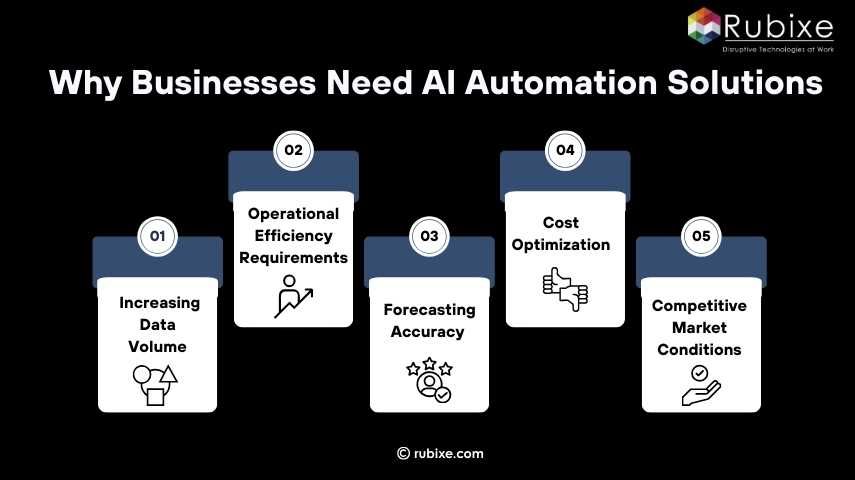
Businesses need AI automation solutions to turn operational data into faster, smarter decisions that improve efficiency and reduce process delays. By automating repetitive workflows and enhancing forecasting accuracy, AI automation helps organizations scale confidently while controlling costs.
Key drivers include:
1. Increasing Data Volume: ERP systems generate large volumes of operational data. AI automation transforms this data into actionable insights.
2. Operational Efficiency Requirements: Manual workflows slow execution. Artificial intelligence automation accelerates approvals, reconciliations, and reporting.
3. Forecasting Accuracy: Predictive models enhance demand planning, financial forecasting, and inventory management.
4. Cost Optimization: Process automation reduces repetitive manual tasks and improves resource utilization.
5. Competitive Market Conditions: Organizations adopting AI automation for business gain improved customer satisfaction and faster response cycles. It supports measurable performance improvements across enterprise functions.
Key Benefits of AI Automation in ERP
AI automation delivers tangible operational and strategic benefits when implemented with clear objectives.
-
Improved Process Efficiency: Automates repetitive tasks such as invoice matching, payroll processing, purchase approvals, and order management.
-
Data-Driven Decision-Making: Predictive analytics enhances budgeting, forecasting, and capacity planning.
-
Reduced Errors and Compliance Risks: AI identifies anomalies in transactions and financial records, strengthening governance.
-
Optimized Inventory and Supply Chain: Demand prediction and automated replenishment improve inventory turnover.
-
Scalable Growth: It adapts to increasing transaction volumes without proportional cost increases.
-
Enhanced Visibility: Real-time dashboards and predictive insights provide better control over enterprise performance.
Use Cases of AI Automation in ERP
AI automation for business applies across multiple enterprise departments.
Finance & Accounting
-
Automated invoice processing
-
Predictive cash flow forecasting
-
Fraud detection
-
Smart reconciliation
Supply Chain Management
-
Demand forecasting
-
Inventory optimization
-
Supplier performance analysis
-
Logistics planning
Procurement
-
Intelligent vendor evaluation
-
Price trend analysis
-
Automated purchase workflows
Human Resources
-
Resume screening automation
-
Workforce analytics
-
Payroll automation
-
Attrition prediction
Manufacturing & Operations
-
Predictive maintenance
-
Production scheduling optimization
-
Quality anomaly detection
These real-world use cases demonstrate how AI automation solutions for ERP create optimal improvements across enterprise systems.
How to Choose the Right AI Automation Company
Selecting an experienced AI automation company directly impacts ROI and long-term performance.
Consider the following factors:
1. Industry Expertise: Look for domain knowledge aligned with your sector and ERP ecosystem.
2. Integration Capability: Evaluate experience with ERP platforms such as SAP, Oracle, Microsoft Dynamics, or industry-specific systems.
3. Customization Approach: AI models should align with business workflows and operational objectives.
4. Data Governance & Security: Strong compliance standards and security frameworks are essential for enterprise environments.
5. Scalability: Artificial intelligence automation solutions should support future expansion and increased data complexity.
6. Performance Metrics: Clear KPIs, cost savings, efficiency improvement, accuracy enhancement, ensure measurable value.
A structured implementation roadmap ensures successful adoption and sustained results.
How to implement AI automation in business
Organizations preparing for AI automation should evaluate:
-
Data quality and readiness
-
Infrastructure compatibility
-
Change management planning
-
Pilot deployment strategies
A phased rollout with defined success metrics improves adoption and minimizes risk.
Future Outlook of AI Automation in ERP
Enterprise AI is advancing toward intelligent systems capable of real-time decision support and predictive simulations. AI automation will continue enhancing financial forecasting, supply chain intelligence, and operational planning.
Organizations investing early in AI automation for business position themselves for long-term efficiency and market leadership.
Start Your AI Automation Journey
AI automation strengthens ERP systems with intelligence, predictive insights, and process efficiency. Businesses seeking scalable growth and operational excellence are actively implementing Artificial intelligence automation solutions to modernize enterprise operations.
Partnering with an experienced AI automation company ensures structured deployment, measurable ROI, and long-term value creation.
Evaluate your ERP ecosystem, identify automation opportunities, and implement AI automation aligned with your strategic business objectives.