


















How Farmers Use AI Weather Forecasting in Agriculture
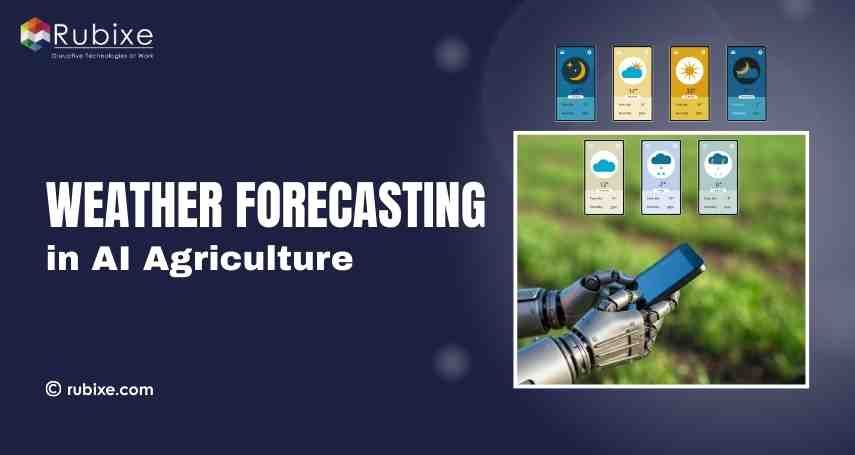
AI agriculture weather forecasting helps farmers plan sowing, irrigation, and harvest, reduce crop risks, manage resources and guide daily smart farm decisions
Many farmers say the same thing: We’ve managed so far, we know our land and understand the seasons.
And most days, that feels true. Fields are prepared. Seeds go in. Inputs are applied with care. Then the weather changes its mind, rain arrives before roots settle, heat stretches longer than expected, and a single shift quietly reshapes months of effort.
This is not about lack of experience. It is about visibility.
When decisions depend only on instinct, small miscalculations compound into real losses. That is where AI agriculture begins to matter, not as complex technology, but as a way to see weather risks earlier, plan with more confidence, and avoid blind decisions that slowly drain yield and income.
Why Weather Uncertainty Is a Growing Risk for Farmers
Weather patterns no longer follow familiar timelines. Monsoons shift. Dry spells stretch unpredictably. Local experience still matters, but it no longer covers the full picture.
Modern farming operates under tighter margins. Fertilizers, seeds, and water are becoming increasingly expensive. A poorly timed irrigation cycle or rainfall immediately after chemical application can undo weeks of planning.
Traditional forecasts often describe regional conditions. They rarely address field-level realities. This gap between forecast information and on-ground decisions creates avoidable losses. AI agriculture reduces this gap by connecting weather intelligence directly to farming operations, not just forecasts.
Current Challenges of AI in Weather Prediction
AI weather forecasting offers significant advantages, but understanding its limitations is essential to building trust and effective usage.
1. Data Availability and Quality
Many rural regions lack consistent access to reliable data.
-
Some areas have insufficient weather sensors or environmental monitoring stations.
-
Long-term historical records may be incomplete, limiting the AI model’s ability to learn accurate patterns.
-
Infrastructure constraints, such as poor connectivity, can affect real-time data flow and reduce forecast precision.
2. Interpretation of AI Insights
Forecasts provide probabilities and trends rather than simple yes/no predictions.
-
Farmers may find it challenging to translate AI outputs into actionable steps without guidance.
-
Misinterpreting insights can lead to mistimed irrigation, sowing, or crop protection measures.
-
Structured support, often delivered through AI consulting, ensures forecasts are understood and applied correctly.
3. Integration With Farm Operations
AI tools alone are not sufficient; they must align with actual farm workflows.
-
Without proper integration, forecasts risk being disconnected from operational decisions.
-
Well-designed AI Agriculture combines technology with advisory frameworks, turning data into actionable planning inputs rather than standalone outputs.
How AI Is Used in Weather Forecasting Today
AI-driven weather systems move beyond single-source predictions. They combine multiple layers of data to generate context-aware insights.
How AI Collects and Processes Weather Data
-
AI models analyze satellite images, historical climate records, real-time weather station data, and environmental sensors.
-
Machine learning algorithms detect trends that are difficult to see manually. Instead of presenting raw data, AI converts it into probability-based insights.
-
Farmers receive guidance on risk windows rather than generic temperature or rainfall values.
How AI Connects Weather Data With Farm Conditions
-
Weather does not act alone. Soil moisture, crop stage, and terrain influence outcomes equally.
-
AI integrates these factors to adjust predictions for specific plots. This localized intelligence allows Artificial Intelligence in agriculture to support decisions aligned with actual field conditions rather than regional averages.
How AI Makes Weather Predictions More Useful for Farming
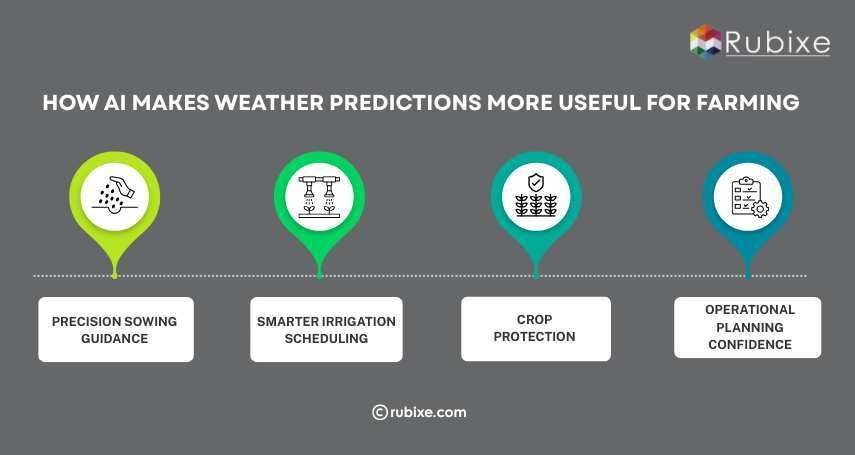 The strength of AI lies in continuous learning. Forecast models adapt based on real outcomes, improving accuracy over time.
-
Precision Sowing Guidance: AI forecasts analyze rainfall patterns, soil moisture, and crop stage to provide clear windows for sowing. Farmers can choose the optimal day to plant seeds, avoiding early or delayed sowing that reduces germination rates and yield.
-
Smarter Irrigation Scheduling: Forecast models integrate upcoming rainfall predictions with soil and crop data. Farmers receive recommendations on when and how much to irrigate, preventing water waste and protecting soil health. This ensures crops get water when they need it most.
-
Crop Protection: AI identifies periods of high risk for heat stress, frost, or excessive moisture. Farmers can take preventive measures like covering plants, adjusting greenhouse conditions, or applying protective treatments before damage occurs.
-
Operational Planning Confidence: Beyond individual tasks, AI transforms weather data into actionable planning signals. Farmers gain a higher level of confidence in sequencing daily operations, labor management, and input allocation. Weather shifts become manageable, not disruptive.
In practice, AI turns weather from an external, uncontrollable risk into a predictable and actionable part of farm management. Each insight helps farmers act early, reduce waste, and improve operational efficiency, key benefits of AI agriculture.
Weather Prediction Areas That Matter Most to Farmers
Not all weather insights carry equal weight. Farmers focus on specific triggers that influence daily operations.
-
Severe weather alerts: Early warnings help protect crops, livestock, and equipment before damage occurs.
-
Rainfall timing and intensity: Accurate timing supports sowing, irrigation scheduling, and fertilizer effectiveness.
-
Temperature extremes: Heat stress and frost warnings guide protective measures and harvesting decisions.
By prioritizing these areas, AI agriculture ensures forecasting aligns with practical farming needs instead of generic reporting.
Benefits of Using AI for Weather Forecasting in Agriculture
The value of AI-driven weather forecasting goes far beyond accuracy. Its real impact appears in how consistently farmers can plan, protect, and optimize their operations.
-
Faster weather insights: AI processes large datasets in near real time. Farmers receive alerts early enough to act, not after damage has already begun. Timing becomes a strength rather than a vulnerability.
-
More accurate local predictions: Unlike broad regional forecasts, AI adapts predictions based on local soil, crop stage, and historical patterns. This reduces decision errors caused by generalized weather reports.
-
Better input utilization: Fertilizers, pesticides, and water are applied only when conditions support effectiveness. This minimizes waste and prevents loss caused by rain, heat, or wind immediately after application.
-
Lower operational costs over time: Avoiding unnecessary irrigation cycles, re-sowing, or corrective treatments reduces recurring expenses. Small savings per operation accumulate into meaningful financial relief across seasons.
-
Reduced crop stress and yield volatility: Early warnings for heat stress, frost, or excessive moisture allow preventive action. Crops grow under more stable conditions, leading to consistent yield quality rather than unpredictable outcomes.
-
Improved labor planning: Forecast clarity helps farmers schedule labor-intensive tasks like harvesting and spraying more efficiently. This reduces last-minute adjustments and workforce strain.
-
Stronger risk management decisions: Weather forecasting becomes a planning input rather than an afterthought. Farmers can evaluate risk windows and choose safer alternatives instead of reacting to damage.
-
Greater confidence in long-term planning: Over multiple seasons, reliable forecasting builds trust in decisions. Farmers shift from short-term reaction to structured planning supported by data.
When combined with advisory frameworks and well-structured AI Services, these benefits turn weather forecasting into a dependable decision-support system rather than a standalone tool.
What Farmers Risk by Ignoring AI-Based Weather Forecasting
-
Avoiding advanced forecasting does not always lead to immediate failure. The impact is gradual.
-
Repeated exposure to avoidable weather risks erodes profitability. Water resources are mismanaged. Input costs rise without corresponding yield gains.
-
Farms that delay adoption often realize later that weather intelligence was not optional. It was a competitive necessity. AI agriculture helps prevent these slow, compounding losses by bringing visibility to risks before they escalate.
Why Weather Forecasting in AI Agriculture Works Best as Decision Support
AI does not replace farmer judgment. It strengthens it.
Forecast systems highlight risk windows, but final decisions remain human. This balance preserves autonomy while improving confidence. Farmers gain insight without surrendering control.
When supported by proper AI consulting, weather intelligence becomes easier to interpret, trust, and apply consistently across seasons.
Forecasting guided by AI agriculture helps farmers act earlier, waste less effort, and protect what they grow. This approach does not promise certainty. It brings clarity where guesswork once dominated.
With the right AI consulting, farmers can interpret forecasts correctly, make informed decisions, and fully leverage AI-driven insights. Those who adopt it early build stability into their decisions. Those who delay often realize later that weather insight was the advantage they were missing.