
















How to Set Up an AI COE for Business Success
Guide to setting up an AI Centre of Excellence to support AI strategy, governance, and implementation teams while helping businesses scale AI initiatives.

Why do many companies invest in artificial intelligence but still fail to see real business results?
Many organizations implement AI tools expecting quick improvements in productivity and decision making. However, most AI initiatives remain small experiments that never scale across the organization.
According to industry reports, more than 50% of companies use AI in at least one business function, yet only a small percentage successfully scale AI projects.
An AI Centre of Excellence provides a structured approach that helps organizations manage AI initiatives across departments. It creates a central strategy that connects technology, business goals, and data management to support long-term growth.
What Is an AI Centre of Excellence?
An AI Centre of Excellence is a dedicated team responsible for guiding artificial intelligence initiatives across an organization.
It acts as a central hub that connects technology, business strategy, and data management. This team helps companies plan, implement, and scale AI solutions effectively.
The main responsibilities include:
-
Defining the company’s AI strategy
-
Supporting AI projects across departments
-
Setting data standards and governance rules
-
Providing AI training to employees
-
Ensuring responsible and ethical AI use
Instead of every team working independently, the centre helps coordinate all AI efforts under a single strategy.
Why Businesses Need a Centralized AI Structure
Many companies start AI projects without a clear plan. As a result, they face several challenges.
1. Duplicate Efforts: Different teams may try to solve similar problems without knowing what others are doing.
2. Data Management Problems: AI models depend heavily on high-quality data. When teams manage data separately, results become inconsistent.
3. Security and Compliance Risks: Without clear governance policies, businesses may expose sensitive data or violate regulations.
4. Slow AI Adoption: Employees often struggle to understand how to use AI tools effectively.
A well-structured AI Centre of Excellence helps solve these issues by creating standards, improving collaboration, and guiding AI adoption across the organization.
Key Benefits of Building an AI COE
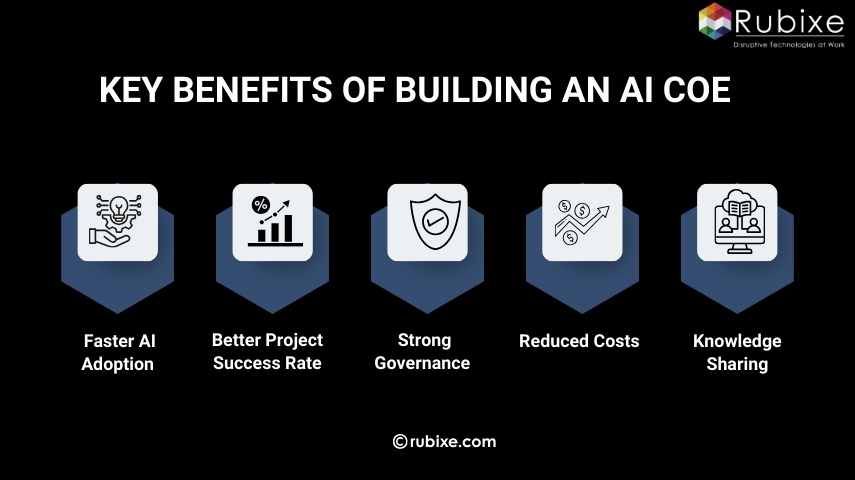 Companies that build a structured AI program often experience significant improvements in performance and efficiency.
1. Faster AI Adoption
A centralized team helps departments launch AI projects faster by providing tools, expertise, and data resources.
2. Better Project Success Rate
AI initiatives are more likely to succeed when experienced professionals evaluate and guide them from the beginning.
3. Strong Governance
Clear policies ensure AI systems follow ethical standards, security rules, and regulatory requirements.
4. Reduced Costs
Shared tools and platforms prevent teams from building duplicate solutions.
5. Knowledge Sharing
Training programs and internal documentation help employees learn how to use AI effectively.
These benefits support long-term enterprise AI adoption across the company.
Step by Step Guide to Setting Up an AI COE
Creating an effective AI program requires careful planning. Below are the key steps businesses should follow.
1. Define a Clear AI Vision
The first step is defining why the company wants to use AI.
Business leaders should identify the main problems AI can solve. This may include improving customer service, increasing operational efficiency, or enhancing decision-making.
For example:
-
Retail companies may focus on demand forecasting and personalized recommendations.
-
Manufacturing companies may prioritize predictive maintenance.
-
Financial companies may focus on fraud detection.
A clear vision ensures that the AI Centre of Excellence supports real business objectives.
2. Secure Leadership Support
AI initiatives require long-term investment in technology, talent, and infrastructure.
Without strong executive support, AI programs often lose momentum.
Leadership teams should:
-
Approve AI budgets
-
Align AI initiatives with business strategy
-
Encourage collaboration across departments
When leaders actively support AI projects, employees are more likely to adopt new technologies.
3. Build the Right AI Team
An effective AI program requires a mix of technical knowledge and business understanding. Building a strong AI implementation team ensures that projects move from ideas to real business solutions.
Typical roles include:
-
Data Scientists: They analyze large datasets and build machine learning models that generate predictions and insights.
-
AI Engineers: They develop and deploy AI systems into production environments.
-
Data Engineers: They design and manage the data pipelines required for AI models to function efficiently.
-
Business Analysts: They connect AI solutions with real business problems and operational goals.
-
Governance Specialists: They ensure responsible AI practices, data protection, and compliance with regulations.
Together, these professionals form the foundation of the AI Centre of Excellence and ensure AI initiatives deliver measurable business value.
4. Build a Strong Data Foundation
Artificial intelligence depends on high-quality data. Without reliable data systems, AI models cannot deliver accurate insights. A strong data environment supports both AI innovation and a long-term AI strategy for business growth.
Companies must establish a strong data infrastructure that includes:
-
Centralized data storage
-
Data quality management
-
Secure access control
-
Data integration tools
A strong data environment supports both AI innovation and a long-term AI strategy for business growth. When companies build reliable data systems, AI models can generate more accurate predictions and support better business decisions.
5. Establish an AI Governance Framework
Responsible AI use is becoming increasingly important. Companies must ensure their AI systems are transparent, secure, and fair.
An AI governance framework helps achieve this by setting policies for:
-
Data privacy protection
-
AI model testing and validation
-
Ethical AI usage
-
Security standards
Governance also helps businesses comply with industry regulations and maintain customer trust.
6. Start with High-Impact Use Cases
Instead of launching many projects at once, companies should start with a few strategic initiatives.
Examples of effective early use cases include:
-
Customer support chatbots
-
Sales forecasting systems
-
Fraud detection models
-
Supply chain optimization
-
Predictive maintenance
These early successes help the AI Centre of Excellence demonstrate measurable value.
7. Create Reusable AI Tools
As AI adoption grows, companies should develop reusable tools and frameworks.
Examples include:
-
Pre-built machine learning models
-
Shared data pipelines
-
AI development guidelines
-
Automation templates
These resources help departments build new AI solutions faster and reduce development costs.
The Future of AI Centres of Excellence
Artificial intelligence continues to change quickly.
In the future, AI centres will play an even larger role in business transformation.
They will focus on technologies such as:
-
Generative AI applications
-
Advanced automation systems
-
Real-time data analytics
-
AI-driven decision support
Organizations that build strong AI foundations today will be better prepared for future innovations.
Artificial intelligence offers powerful opportunities for businesses, but success requires more than just technology.
Companies must build structured systems that support long-term AI adoption.
Artificial intelligence offers powerful opportunities for businesses, but success requires more than advanced technology. Organizations need a clear strategy, strong leadership, and coordinated execution.
An AI Centre of Excellence helps businesses bring structure to their AI initiatives. By building the right teams, creating strong data systems, and establishing a clear governance framework, companies can scale AI projects across departments and achieve meaningful results.
Businesses that invest in a structured AI program today will be better prepared for future innovation. The next step is to evaluate your current AI capabilities and begin building a centralized approach that supports long-term digital growth.