







AI Strategic Consulting Roadmap for Enterprises
AI strategic consulting roadmap helps enterprises plan AI adoption, identify use cases, build data infrastructure, and scale AI across business operations.
Why Are So Many Enterprise AI Projects Failing?
Many enterprises invest heavily in artificial intelligence but still struggle to see a measurable business impact. AI tools are purchased, pilots are launched, and dashboards are built, but results remain limited.
The problem is rarely the technology itself.
The real issue is a lack of a structured AI strategy.
Without a clear plan, AI initiatives become disconnected experiments rather than business solutions. This is where an AI Consulting Company becomes valuable. Experienced consultants help enterprises design an AI strategic consulting roadmap that aligns AI adoption with business goals, operations, and measurable outcomes.
Understanding the Role of an AI Consulting Company
An AI Consulting Company helps organizations move from AI experimentation to AI-driven business transformation. Instead of focusing only on tools or algorithms, consultants focus on strategy, implementation, and long-term value creation.
Their role typically includes:
-
Identifying high-impact AI use cases
-
Evaluating data readiness and infrastructure
-
Designing an enterprise AI strategy
Building AI implementation frameworks -
Ensuring measurable ROI
For enterprises, this guidance is important because AI adoption affects multiple departments, including IT, operations, marketing, customer support, finance, and leadership.
Without a coordinated roadmap, AI initiatives often become fragmented.
What Is an AI Strategic Consulting Roadmap?
An AI strategic consulting roadmap is a structured plan that defines how an organization will adopt, implement, and scale artificial intelligence across business functions.
It typically answers critical questions such as:
-
Which business problems should AI solve first?
-
What data infrastructure is required?
-
How should AI projects be prioritized?
-
What skills and teams are required?
-
How will success be measured?
Instead of launching random AI experiments, enterprises follow a step-by-step transformation process.
Step 1: Assess Enterprise AI Readiness
The first step in any enterprise AI strategy is understanding the organization’s current capabilities. An AI Consulting Company usually performs a readiness assessment covering:
Data Infrastructure
AI systems require clean, structured, and accessible data.
Consultants analyze:
-
Data quality and availability
-
Existing databases and cloud platforms
-
Data governance policies
Technology Stack
The organization’s current technology stack is evaluated to determine whether it can support AI solutions.
Organizational Skills
AI adoption requires specialized expertise, including:
-
Data scientists
-
AI engineers
-
ML engineers
-
AI product managers
Many enterprises lack these roles, making consulting support essential.
The outcome of this stage is a clear baseline of AI maturity.
Step 2: Identify High-Impact AI Use Cases
One of the biggest mistakes enterprises make is implementing AI where it adds little value.
An experienced AI Consulting Company identifies business-driven use cases, not technology-driven ones.
Examples include:
-
Customer Support Automation
-
AI chatbots can reduce support workload and improve response times.
-
Demand Forecasting
-
Retail and manufacturing companies use AI models to predict product demand more accurately.
-
Fraud Detection
-
Financial institutions use machine learning models to identify suspicious transactions.
-
Process Automation
AI-powered automation can eliminate repetitive manual tasks across operations.
Consultants evaluate each potential use case based on:
-
Business impact
-
Implementation complexity
-
Data availability
-
Expected ROI
This helps enterprises prioritize projects effectively.
Step 3: Build an Enterprise AI Strategy
Once key opportunities are identified, consultants develop a long-term enterprise AI strategy.
This strategy includes:
AI Architecture Design
Enterprises must determine how AI will integrate with existing systems, such as:
-
CRM platforms
-
ERP systems
-
marketing tools
-
analytics platforms
Data Strategy
A strong AI ecosystem depends on high-quality data pipelines.
Consultants often recommend:
-
centralized data warehouses
-
cloud-based data platforms
-
data governance frameworks
AI Governance
Enterprises must also consider:
-
data privacy regulations
-
ethical AI usage
-
model transparency
Without governance, AI adoption can create compliance and security risks.
Step 4: Develop an AI Implementation Plan
After the strategy phase, the next step is practical execution. An AI implementation consulting framework usually includes:
Pilot Projects
Enterprises begin with small AI pilots to test feasibility and demonstrate results.
For example:
-
AI-powered sales forecasting
-
predictive maintenance models
-
intelligent document processing
Pilot projects reduce risk while validating the business case.
Technology Development
This phase involves:
-
machine learning model development
-
data pipeline creation
-
AI model training and testing
System Integration
AI solutions must integrate smoothly with existing enterprise systems.
Without proper integration, AI insights remain unused.
Step 5: Scale AI Across the Organization
Once pilot projects prove successful, enterprises move toward AI scaling.
This stage includes:
Expanding AI Use Cases
AI solutions are implemented across departments such as:
-
operations
-
marketing
-
customer experience
-
supply chain
Creating AI Centers of Excellence
Many enterprises establish AI Centers of Excellence (CoE) responsible for:
-
AI governance
-
innovation
-
cross-team collaboration
Workforce Enablement
AI adoption requires employee training to ensure teams understand how to use AI insights effectively. An experienced AI Consulting Company often provides training programs and operational frameworks.
Common Challenges Enterprises Face with AI Strategy
Even with strong intentions, enterprises often face several challenges during AI adoption.
Data Silos: Different departments store data in separate systems, making integration difficult.
Lack of Skilled Talent: AI expertise remains limited in many organizations.
Unclear ROI: Executives may struggle to justify AI investments without measurable outcomes.
Technology Complexity: Integrating AI with legacy systems can be technically challenging.
A structured AI strategic consulting roadmap helps address these challenges before they impact the project.
Enterprise AI Strategy vs Ad-Hoc AI Implementation
|
Approach |
Characteristics |
Business Impact |
|
Ad-Hoc AI Projects |
Individual teams run isolated AI experiments |
Limited impact and low scalability |
|
Strategic AI Roadmap |
Enterprise-wide AI planning with clear priorities |
Higher ROI and long-term transformation |
Enterprises that follow a structured roadmap are significantly more likely to scale AI successfully.
Practical Example of AI Strategy in Action
Consider a large retail enterprise trying to improve inventory management.
Without an AI strategy:
-
Multiple forecasting tools are used by different teams
-
Data sources are inconsistent
-
Demand predictions remain inaccurate
With guidance from an AI Consulting Company:
-
Data systems are centralized
-
AI demand forecasting models are developed
-
Inventory predictions improve
-
Supply chain decisions become data-driven
As a result, the company reduces stock shortages and improves operational efficiency.
How to Choose the Right AI Consulting Company
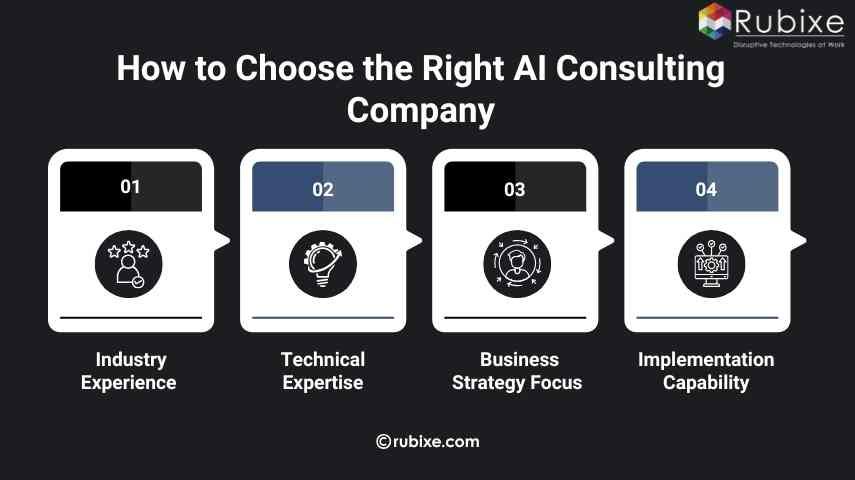
Not all consulting firms provide the same level of expertise. Enterprises should evaluate consultants based on:
1. Industry Experience: AI strategies vary significantly across industries.
2. Technical Expertise: Consultants must understand machine learning, data engineering, and AI architecture.
3. Business Strategy Focus: Technology alone is not enough. Consultants must connect AI initiatives to real business outcomes.
4. Implementation Capability: The best consulting firms support both strategy and execution.
The Future of Enterprise AI Strategy
Artificial intelligence will continue to influence every aspect of business operations.
Enterprises that develop structured AI strategies today will gain advantages in:
-
operational efficiency
-
predictive decision-making
-
customer experience
-
innovation
However, success depends on having a clear roadmap, strong data foundations, and expert guidance.
Many enterprises recognize the potential of artificial intelligence, but turning that potential into real business value requires a clear plan.
An experienced AI Consulting Company helps organizations build a structured AI strategic consulting roadmap, from readiness assessment and use case identification to implementation and enterprise wide scaling.
Instead of experimenting with isolated AI tools, enterprises can adopt a strategic approach that aligns AI with business objectives and measurable outcomes.
For organizations planning AI adoption, the next step is simple: start with a strategic roadmap before investing in technology. A well-designed AI strategy ensures that every AI initiative delivers real, measurable business value.