














How is AI Used for Fertilizer Optimization?
Boost crop yields and cut fertilizer waste with AI-driven precision farming, real-time insights, and predictive fertilizer optimization.
You’re spending too much on fertilizer, but your yields aren’t improving. What if AI could fix that?
In many farms, fertilizer accounts for a significant share of input costs, yet much of it is applied based on estimates rather than precise data.
Fertilizer application is one of the most critical factors in agriculture, directly impacting crop yield, soil health, and environmental sustainability. Yet, applying the right type and amount at the right time remains a challenge. Over-application wastes resources and pollutes ecosystems, while under-application limits crop potential.
AI for fertilizer optimization is changing this approach. By combining predictive models, field data, and real-time monitoring, it enables farmers to make more precise decisions, reducing waste while improving productivity.
Understanding Fertilizer Optimization
Fertilizer optimization refers to applying nutrients in precise amounts, at the right time, and in the most effective way to maximize crop yield and minimize environmental harm. Traditionally, this relied on soil tests, historical trends, and farmer intuition.
Today, AI in fertilizer optimization allows for dynamic, data-driven decisions. It considers multiple factors, including soil composition, crop type, weather conditions, and even satellite imagery, to recommend precise nutrient applications.
Why Conventional Methods Often Fall Short:
-
Soil tests can be infrequent, outdated, or too generalized.
-
Historical methods fail to account for changing weather patterns or soil degradation.
-
Manual estimations often lead to either excess use or nutrient deficiencies.
Integrating AI ensures that fertilizer decisions are continuous, adaptive, and precise, rather than one-off or guess-based.
Challenges in Fertilizer Optimization
Even with experience, optimizing fertilizer use is complex. Some common challenges include:
Soil Variability: Soil conditions can change drastically across fields, making blanket recommendations ineffective. This variability can also influence how nutrients interact with different soil layers, affecting absorption rates.
Weather Uncertainty: Unexpected rainfall or drought can affect nutrient absorption and crop health. Extreme weather events can further disrupt planned fertilization schedules, making real-time adjustments essential.
Over- or Under-application: Both lead to reduced yield, higher costs, and environmental harm. Misapplication can also cause long-term soil degradation, reducing fertility in future crop cycles.
Limited Data Access: Many farms lack real-time data on soil, moisture, or crop growth, making optimization guesses more than science. Without accurate monitoring, farmers may depend on outdated or generalized information, increasing inefficiency.
Predictive analytics can help overcome these challenges by forecasting soil nutrient requirements and identifying potential risks before they affect crops. It enables proactive management, helping farmers optimize inputs and safeguard both yield and sustainability.
Key Outcomes of Fertilizer Optimization
Optimizing fertilizer use is more than just saving money; it directly impacts crop productivity, environmental sustainability, and long‑term soil health.
Studies show that precision fertilizer management technologies, including data‑driven nutrient optimization, can reduce fertilizer inputs by 18–27% while increasing crop yields by 4–11% across multiple field sites, demonstrating economic and environmental benefits.
By leveraging the right strategies and technologies, farmers can achieve measurable improvements across multiple areas.
-
Increased Crop Yield: Precision application ensures crops receive the right nutrients at the right time. This targeted approach maximizes plant growth potential and improves harvest quality, leading to higher returns.
-
Cost Savings: Reduces unnecessary fertilizer use, lowering input costs. Efficient usage also minimizes waste, helping farms allocate resources more effectively across operations.
-
Sustainable Farming: Minimizes nutrient runoff into water bodies, reducing environmental impact. This practice supports eco-friendly farming and helps comply with environmental regulations, benefiting the broader ecosystem.
-
Better Soil Health: Balanced nutrient application maintains long-term soil fertility. Over time, it enhances microbial activity and soil structure, ensuring productive land for future crops.
By adopting AI in fertilizer optimization, you not only boost productivity but also safeguard natural resources, ensuring long-term viability and resilience in your farming operations.
AI-Based Fertilizer Optimization vs. Traditional Methods
Fertilizer management has traditionally depended on fixed schedules and general recommendations, often leading to inefficiencies and inconsistent results. AI-based optimization introduces a more precise, data-driven approach that adapts to real-time soil, crop, and environmental conditions.
|
Feature |
Traditional Methods |
AI-Based Optimization |
|
Decision Basis |
Soil tests, experience |
Data-driven models with real-time monitoring |
|
Adaptability |
Fixed schedules |
Dynamic recommendations based on crop and weather |
|
Accuracy |
Generalized |
Precise for micro-zones in a field |
|
Environmental Impact |
Higher risk of runoff |
Minimal waste, sustainable usage |
|
Labor & Monitoring |
Manual, labor-intensive |
Automated analysis and alerts |
AI-driven systems allow you to move beyond static routines and adopt a flexible, intelligent approach to nutrient management.
How AI is Used for Fertilizer Optimization
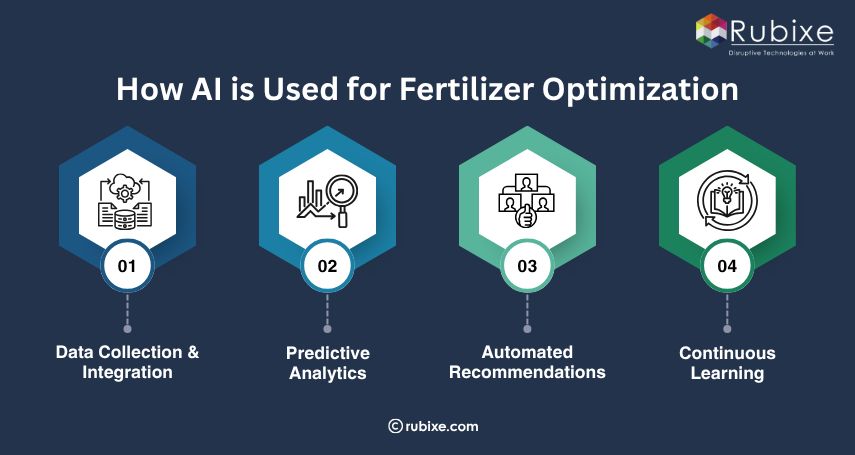
AI enables smarter fertilizer strategies through several techniques:
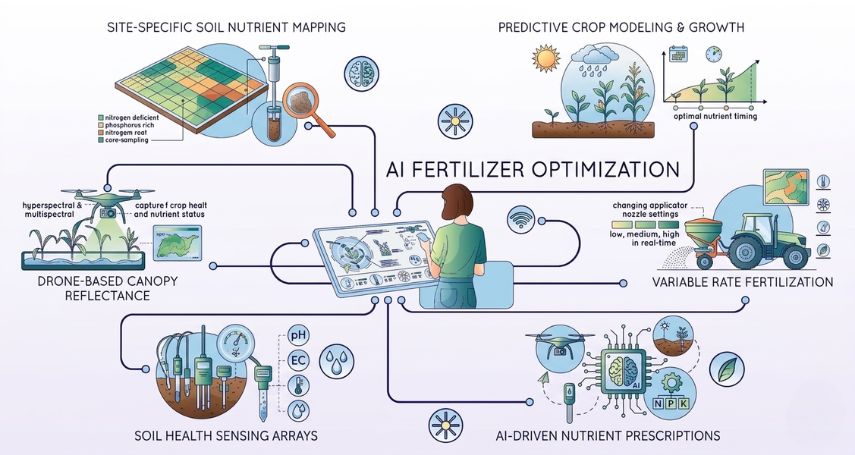
1. Data Collection & Integration
AI systems gather data from multiple sources:
-
Soil sensors: Measure pH, moisture, and nutrient levels.
-
Weather stations: Track temperature, rainfall, and humidity.
-
Satellite and drone imagery: Monitor crop health, chlorophyll levels, and growth patterns.
-
Historical crop and yield data: Provides context for modeling future fertilization needs.
This integrated dataset allows AI to analyze every factor affecting fertilizer performance, creating actionable recommendations.
2. Predictive Analytics
AI uses historical and real-time data to predict nutrient requirements for each crop and field segment. Predictive models can:
-
Forecast nutrient deficiencies before visible symptoms appear.
-
Suggest optimal fertilizer types and quantities.
-
Reduce risks of over-application and environmental contamination.
By leveraging predictive analytics, farmers can act proactively rather than reactively.
3. Automated Recommendations
Once data is analyzed, AI systems generate recommendations tailored to:
-
Crop type and growth stage
-
Soil composition in different zones
-
Upcoming weather conditions
These recommendations are delivered through user-friendly dashboards, mobile apps, or integrated farm management systems, helping you make timely, informed decisions.
4. Continuous Learning
AI systems constantly learn from outcomes and feedback:
-
Adjust fertilizer recommendations based on yield results.
-
Update models using weather variations and soil changes.
-
Improve accuracy and reduce resource wastage over time.
This self-learning loop ensures that fertilizer strategies improve year after year, becoming more precise and effective.
Key AI Technologies in Fertilizer Optimization
Several AI technologies power these advancements:
-
Machine Learning (ML): Analyzes historical data to predict fertilizer needs accurately. It continuously improves predictions as more crop and soil data are collected over time.
-
Computer Vision: Uses drone or satellite imagery to detect crop stress and nutrient deficiencies. This enables targeted interventions, reducing waste and improving yield quality.
-
Natural Language Processing (NLP): Converts textual agronomy reports or sensor readings into actionable insights. It helps agronomists quickly interpret large volumes of unstructured data for better decision-making.
-
Predictive Analytics: Forecasts crop responses to fertilizer applications, helping plan precise schedules. By anticipating future nutrient needs, it minimizes over- or under-fertilization and optimizes resource use.
Organizations working with an end-to-end AI solution provider can implement these technologies to achieve maximum efficiency and sustainable growth, ensuring that both operational and environmental goals are met.
Challenges in Implementing AI in Fertilizer Optimization
While AI offers significant benefits, adoption comes with hurdles:
-
Data Quality: Poor or incomplete data can lead to inaccurate recommendations.
-
Cost of Technology: Sensors, drones, and AI platforms require investment.
-
Technical Expertise: Farmers or operators need training to interpret AI outputs effectively.
-
Integration Complexity: Incorporating AI into existing farm management systems can be challenging.
-
Scalability: Solutions must adapt to large or small farms, ensuring consistent recommendations.
Addressing these challenges is critical to fully leverage AI in fertilizer optimization and achieve measurable ROI.
Benefits of AI in Fertilizer Optimization
AI adoption brings transformative benefits to your farming operations:
-
Real-Time Monitoring: Tracks soil and crop conditions continuously
-
Predictive Analytics: Forecasts nutrient needs before deficiencies occur
-
Zone-Level Precision: Targets specific field areas instead of blanket application
-
Automated Recommendations: Provides actionable insights instantly
-
Continuous Learning: Improves accuracy based on past data and outcomes
Partnering with AI Consulting experts ensures that your fertilizer optimization strategies are precise, measurable, and sustainable.
Future Outlook: AI & Big Data in Environmental Sustainability
The combination of AI and big data is reshaping agriculture with sustainability at its core:
-
Precision Farming: Micro-level recommendations for each section of a field improve productivity and reduce inputs.
-
Climate-Adaptive Agriculture: AI in weather forecasting helps anticipate rainfall, droughts, and temperature fluctuations for smarter fertilization.
-
Integration with IoT: Connected sensors, drones, and tractors create a unified, data-rich ecosystem for intelligent farming.
-
Predictive Resource Planning: Big data and AI models enable long-term planning for crop cycles, irrigation, and fertilizer needs.
-
Sustainable Agriculture Metrics: Continuous monitoring ensures that nutrient application stays within environmental safety thresholds.
The future of AI farming will depend on the integration of these technologies to optimize resources, increase yields, and reduce environmental impact, paving the way for truly intelligent and sustainable agriculture.
If you are looking to maximize yields while reducing environmental impact, now is the time to adopt AI for fertilizer optimization. By leveraging predictive models, real-time monitoring, and data-driven insights, you can transform traditional fertilization into a precise, intelligent process.
Partnering with an AI solution provider in the agriculture industry ensures that implementation aligns with your crops, soil, and operational goals.
Don’t wait, turn your fields into smart, high-yield ecosystems with AI today.