



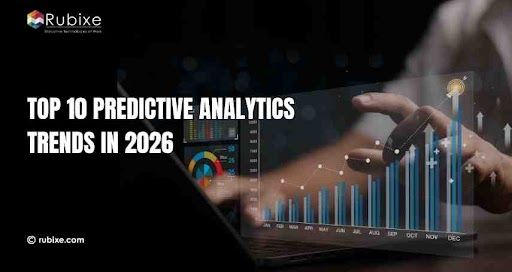
Top 10 Predictive Analytics Trends in 2026
Understand the latest predictive analytics trends in 2026, including AI integration, data modeling, forecasting, business intelligence, and analytics strategies.
Look at any company today; there’s no shortage of data. Dashboards are full, reports keep coming in, and numbers are tracked everywhere.
But when real decisions need to be made, things still get uncertain. Forecasts miss the mark, churn is noticed too late, and opportunities are often recognized only after they’re gone.
The problem isn’t data, it’s knowing what to do with it at the right time.
According to IBM, organizations that use data effectively are far more likely to make faster and better decisions than their competitors.
That’s where predictive analytics is starting to change the game. Instead of reacting to what already happened, businesses are beginning to anticipate what’s coming next.
In 2026, this shift is becoming more visible, changing how companies plan, respond, and grow.
If you are looking to understand what’s changing and how it applies to your business, the trends ahead will give you that direction.
Why Predictive Analytics Is Becoming Critical in 2026
Businesses are moving away from reactive reporting toward forward-looking decision systems. Instead of asking what happened, leaders are focused on what will happen next.
This shift is driven by three clear factors:
1. Faster decision cycles
Markets change quickly. Waiting for monthly reports delays action. Predictive models provide early signals - whether it’s demand spikes, churn risk, or operational issues.
2. Competitive pressure
Organizations already using predictive analytics solutions are improving forecasting accuracy, optimizing pricing, and identifying customer intent earlier than competitors.
3. Cost of inaction
Poor forecasting leads to excess inventory, lost sales, and inefficient resource allocation.
Research from McKinsey & Company shows that organizations using advanced analytics effectively can improve operating margins by up to 60% and see strong gains in revenue growth.
This is where the benefits of predictive analytics begin to show clearly, better planning, reduced uncertainty, and faster execution.
What’s Actually Changing in Predictive Analytics
Predictive analytics has moved from supporting analysis to directly influencing decisions.
Earlier, analytics was largely retrospective - teams reviewed reports, identified patterns, and then decided what to do next. This created delays between insight and action.
Today, predictive analytics is being used to anticipate outcomes and guide decisions as situations evolve.
|
Earlier Approach |
Current Approach |
|
Past data focus |
Future predictions |
|
Static reports |
Real-time Insights |
|
Delayed decisions |
Immediate actions |
|
Manual actions |
Automated decisions |
Models are updated continuously, and insights are applied closer to the point of action rather than after the fact.
Another key shift is how these insights are used. Instead of being confined to dashboards, predictions are now embedded into workflows, impacting areas such as demand planning, customer engagement, and risk management.
Gartner highlights that predictive and AI-driven systems are increasingly being integrated directly into business workflows, enabling faster and more consistent decision-making across organizations.
This change is making the role of predictive analytics in decision making more direct and practical. Decisions are no longer based only on past data but are supported by forward-looking signals. For businesses, this translates into faster responses, better alignment with real conditions, and more consistent execution.
Predictive Analytics Market Growth: What the Numbers Show
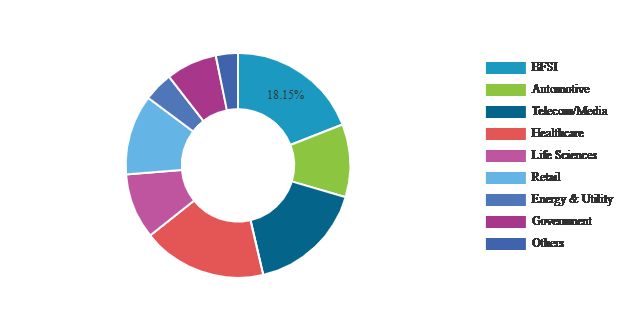
Adoption of predictive analytics is accelerating as organizations move toward faster, data-driven decision-making.
Market Growth: Based on Technavio’s analysis, the global predictive analytics market is expected to grow by USD 28.1 billion between 2024 and 2029, at a CAGR of around 21 - 22%, reflecting strong and sustained demand across industries. This growth is clearly reflected in how adoption is distributed.
Market Distribution: Data from Fortune Business Insights shows that BFSI alone accounts for 18.15 %, making it one of the leading sectors driving predictive analytics investments. Other industries, such as healthcare, retail, telecom, and energy also contribute significantly, each applying predictive models to solve specific operational challenges.
In practice, this means financial institutions are strengthening fraud detection and risk assessment, retailers are improving demand forecasting and inventory planning, and telecom companies are reducing churn through better customer insights.
The combination of steady market expansion and strong sector-wise adoption highlights a larger shift. Predictive analytics solutions are moving beyond experimentation and becoming embedded in everyday business decisions, where timing and accuracy directly influence outcomes.
Key Predictive Analytics Trends to Watch in 2026
1. AI-Powered Real-Time Forecasting
Traditional forecasting works on fixed cycles - weekly or monthly. That approach struggles in fast-moving environments where conditions change quickly. Real-time forecasting addresses this by continuously updating predictions as new data flows in, combining historical patterns with live inputs such as transactions, user behaviour, and external signals.
In practice, this changes how teams operate. Inventory decisions, pricing adjustments, and demand planning can be updated as situations evolve, rather than after the fact. Businesses are able to respond earlier, avoid overcorrections, and stay aligned with actual market conditions instead of outdated projections.
2. Explainable AI Driving Trust and Adoption
As predictive models become more advanced, understanding how they work becomes critical. Explainable AI focuses on making model outputs transparent—highlighting which factors influenced a decision and why.
This clarity makes a practical difference. Teams are more willing to rely on predictions when they can interpret them, and leadership can validate decisions with confidence. It also becomes essential in regulated industries, where decisions must be justified.
Banks like HSBC use explainable AI in credit risk assessment, reducing compliance review time by 30 - 40% while improving internal trust in model-driven decisions.
3. Hyper-Personalization at Scale
Customer behavior has become more dynamic, and broad segmentation is no longer enough to drive engagement. Predictive models now analyze individual-level data, how users browse, interact, and respond, to anticipate what they are likely to do next.
This allows businesses to move from generic messaging to highly relevant interactions. Offers, recommendations, and communication are tailored in real time, improving both conversion and retention. Instead of increasing marketing spend, organizations get more value from the same efforts by focusing on the right audience at the right moment.
4. Predictive Maintenance Becoming Standard
Maintenance strategies are shifting from fixed schedules to prediction-based planning. By analyzing equipment data, usage patterns, and historical failures, businesses can estimate when a machine is likely to fail and act before it happens.
This approach reduces unexpected downtime and avoids unnecessary servicing. Equipment is maintained based on actual condition rather than assumptions, which improves reliability while controlling costs.
Airlines like Lufthansa apply predictive maintenance to monitor aircraft components in real time. Industry estimates suggest this can lower maintenance costs by 10 - 20% and improve uptime by up to 25%, making operations more stable and predictable.
5. No-Code & Low-Code Predictive Tools
Predictive analytics is becoming more accessible across organizations. No-code and low-code platforms allow business users to build and use models through visual interfaces, without needing deep technical expertise.
This changes how quickly ideas move into action. Teams can experiment, test use cases, and generate insights without waiting for dedicated data science support.
As a result, adoption spreads beyond specialized teams and becomes part of everyday decision-making across functions.
6. Integration with Business Operations
One of the most important shifts is how predictive analytics is used within systems. Earlier, insights were generated in dashboards and required manual interpretation. Now, predictions are being embedded directly into operational platforms like CRM, ERP, and supply chain systems.
This brings decisions closer to execution.
For example, a predicted churn risk can automatically trigger a retention action, or a demand spike can adjust inventory allocation in real time. The reliance on manual intervention reduces, and decisions become more consistent across the organization.
7. Predictive Analytics for Risk & Fraud Detection
Risk detection is moving earlier in the process. Instead of identifying issues after they occur, predictive models analyze transaction patterns and behavioral signals to detect anomalies using AI in advance.
This allows organizations to act before damage is done. Fraud attempts can be flagged in real time, and unusual activity can be investigated immediately. Over time, as models learn from new patterns, detection becomes more accurate and responsive to evolving threats.
8. Edge Analytics Enabling Faster Decisions
In many environments, sending data to centralized systems introduces delays. Edge analytics processes data closer to where it is generated on devices, sensors, or local systems, allowing predictions to be made instantly.
This is particularly valuable in operations where timing matters. Whether it’s manufacturing equipment, logistics tracking, or connected devices, decisions can be made at the source without waiting for data transfer and processing.
The result is faster response and greater operational control.
9. Data Privacy-Driven Predictive Models
As data regulations become stricter, predictive analytics is evolving to balance insight with privacy. Techniques such as anonymization and federated learning allow models to learn from data without directly exposing sensitive information.
This makes it possible to continue building accurate predictions while reducing compliance risk. It also strengthens customer trust, which is becoming an important factor in long-term business relationships.
Organizations using approaches like those developed by Google have shown that federated learning can retain 90 - 95% of model accuracy while keeping data decentralized, maintaining both performance and privacy.
10. Industry-Specific Predictive Models
Generic models often miss the nuances that matter in real-world scenarios. Industry-specific predictive models are designed with domain knowledge, incorporating sector-specific variables, constraints, and patterns.
This makes the insights more relevant and actionable. A forecasting model built for retail behaves very differently from one designed for healthcare or finance. When models reflect industry realities, decisions become more precise and aligned with actual business conditions.
The Biggest Challenge: Why Most Businesses Still Struggle to Use Predictive Analytics

-
No clear business problem defined: Many teams start with tools instead of identifying the decision they want to improve. Without a clear use case, predictions remain disconnected from actual business actions.
-
Too many tools, no unified approach: Different departments adopt separate analytics platforms, leading to fragmented insights. This creates confusion instead of improving decision-making.
-
Data silos reduce accuracy: When data sits across multiple systems, models work with incomplete information. This directly affects prediction quality and reduces trust in results.
-
Gap between technical and business teams: Models may be technically strong, but if business teams don’t understand or use them, they fail to create impact. Alignment is often missing.
-
Weak connection to business outcomes: Predictive initiatives are treated as experiments instead of strategic drivers. Without linking to revenue, cost, or efficiency goals, value remains unclear.
Understanding the benefits of predictive analytics is common. Turning that into real execution is where most businesses struggle.
How to Actually Start Using Predictive Analytics in Your Business
-
Start with one high-impact use case: Focus on a single problem like churn, demand forecasting, or lead scoring. This helps deliver faster results and builds internal confidence.
-
Define the decision clearly: Be specific about what you want to predict. Clear questions lead to actionable insights, while vague goals lead to unused outputs.
-
Prioritize outcomes over tools: Choosing tools comes later. First define what success looks like - higher conversions, lower costs, or better forecasting accuracy.
-
Ensure data is ready and connected: Clean and integrated data improves prediction quality. Without this, even the best models will produce unreliable results.
-
Involve business teams early: When business users are part of the process, adoption improves. They help ensure predictions are practical and usable.
-
Use expert guidance to avoid delays: Experienced teams help identify the right approach faster. Well-designed predictive analytics and AI solutions reduce trial-and-error and speed up execution.
Embed Predictive Analytics into Your Business Operations
If your organization is exploring predictive analytics but struggling to see consistent outcomes, the challenge is rarely the technology - it is the lack of a clear approach.
Start by identifying where predictive insights can make an immediate impact. Focus on areas such as demand forecasting, customer retention, or risk detection, where improvements directly influence business performance.
Build a roadmap that connects data, models, and decision-making. Ensure predictions are integrated into daily workflows where actions happen, not left in dashboards.
Prioritize data readiness early. Clean, connected, and relevant data determines how reliable your predictions will be.
For many organizations, working with an experienced partner helps bring structure to this process, right from identifying the right use cases to integrating solutions into real operations.
Rubixe helps businesses move beyond experimentation by designing and implementing predictive analytics solutions tailored to their specific needs. From identifying the right use cases to integrating models into real operations, the focus remains on delivering outcomes that are practical and outcome-focused.
Predictive analytics works best when it is treated as an ongoing part of your operations, not a one-time project. As your data and business needs evolve, your models and strategies should keep pace - so your decisions stay relevant and effective.