










Benefits of Predictive Analytics in Modern Business
The benefits of predictive analytics in modern business include improved decision-making, forecasting, efficiency, risk management, and growth.
Uncertainty is expensive. Forecasting errors, customer churn, operational disruptions, and fraud collectively cost organizations billions each year. Predictive analytics solutions address this challenge by transforming historical and real-time data into forward-looking intelligence. Instead of reacting to events after they occur, businesses can anticipate outcomes and act early. For organizations pursuing sustainable growth, understanding the predictive analytics and its benefits has become essential rather than optional.
Real-World Examples of Predictive Analytics in Business
Leading organizations across industries use predictive analytics solutions to anticipate demand, optimize operations, reduce risk, and improve customer experience. The following example demonstrates how predictive analytics benefits translate into measurable business outcomes at scale.
Amazon - Demand Forecasting & Inventory Optimization
Amazon uses predictive analytics to forecast product demand across regions using historical sales data, seasonality, browsing behaviour, and external factors. This allows the company to position inventory closer to anticipated demand before orders are placed.
Business impact:
-
Lower inventory holding costs
-
Faster delivery times
-
Reduced stockouts and lost sales
-
More efficient warehouse utilization
This capability underpins Amazon’s supply chain advantage and supports same-day and next-day delivery promises.
Benefits of Predictive Analytics in Modern Business
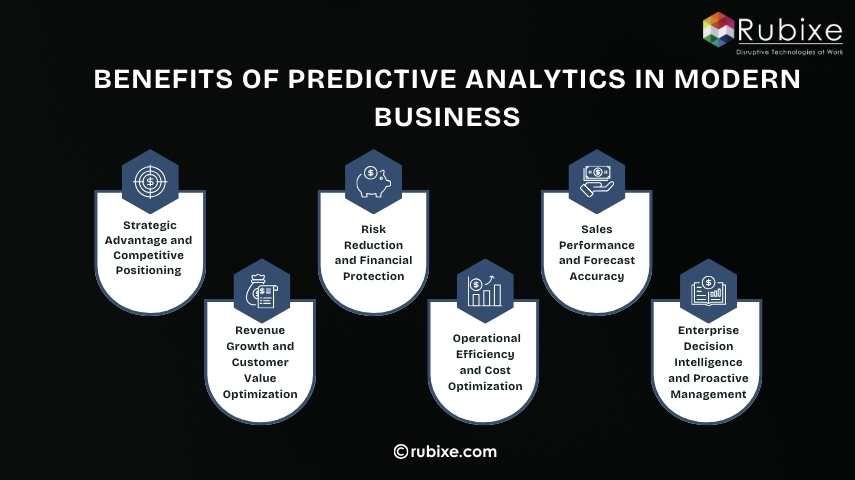
1. Strategic Advantage and Competitive Positioning
Predictive analytics enables leadership teams to anticipate market shifts, demand fluctuations, and emerging opportunities before competitors react. Rather than relying on retrospective reports, executives operate with forward-looking intelligence for expansion planning, pricing strategy, and capital deployment.
Global research shows organizations using advanced analytics outperform peers in revenue growth and profitability because decisions are based on probabilistic outcomes rather than assumptions.
2. Revenue Growth and Customer Value Optimization
Businesses use predictive models to identify high-value prospects, forecast purchasing behaviour, and determine which customers are most likely to convert, churn, or expand.
This allows companies to:
-
Focus marketing spend where conversion probability is highest
-
Personalize offers to maximize lifetime value
-
Reduce acquisition costs
-
Increase retention and cross-sell effectiveness
Organizations that leverage customer analytics extensively report significantly higher ROI from marketing investments due to precise targeting and timing.
3. Risk Reduction and Financial Protection
The key role of predictive analytics is to act as a core tool for managing uncertainty across finance, insurance, banking, and enterprise risk functions. Models detect patterns that signal potential fraud, credit default, operational failure, or compliance issues before they escalate.
Early risk detection enables organizations to:
-
Prevent financial losses
-
Improve underwriting accuracy
-
Maintain regulatory compliance
-
Strengthen business continuity
Financial institutions rely heavily on predictive models for credit scoring and fraud detection, which materially reduces exposure to bad debt and fraudulent transactions.
4. Operational Efficiency and Cost Optimization
Predictive forecasting improves production planning, workforce allocation, inventory management, and logistics coordination. Instead of reacting to shortages or excess capacity, organizations optimize resources proactively.
Key business impacts include:
-
Lower inventory carrying costs
-
Reduced waste and stockouts
-
Improved asset utilization
-
Higher supply chain resilience
Predictive maintenance alone can reduce equipment downtime and maintenance costs substantially by servicing assets only when risk indicators appear.
5. Sales Performance and Forecast Accuracy
Sales organizations use predictive scoring to prioritize opportunities most likely to close, improving pipeline efficiency and quota attainment.
Accurate revenue forecasting supports:
-
Realistic budgeting
-
Resource planning
-
Investor confidence
-
Strategic pricing decisions
Companies adopting data-driven sales forecasting experience stronger pipeline visibility and reduced forecast volatility compared with intuition-based approaches.
6. Enterprise Decision Intelligence and Proactive Management
The overarching benefit is a shift from reactive management to anticipatory leadership. Predictive analytics transforms decision-making from hindsight-driven to evidence-driven, enabling organizations to act before problems or opportunities fully materialize.
Industry projections indicate that a growing majority of enterprises are moving toward proactive strategies powered by advanced analytics rather than traditional reactive models.
How Predictive Analytics Converts Uncertainty into Insights
Predictive analytics has become a decisive capability for organizations that aim to operate with precision rather than approximation. It enables leadership teams to quantify uncertainty, prioritize high-impact opportunities, and prevent costly missteps across revenue, operations, and risk functions. In an environment where small forecasting errors can translate into significant financial consequences, forward-looking intelligence provides a clear operational advantage.
Businesses that embed predictive analytics solutions into core processes gain consistency in performance, stronger resource utilization, and the ability to scale with confidence.
FAQs
1. How do predictive analytics solutions improve business decision-making?
Predictive analytics solutions enable organizations to evaluate likely future outcomes before committing resources. By forecasting demand, revenue trends, customer behaviour, and operational risks, leaders can choose strategies with higher success probability, reduce uncertainty, and avoid costly reactive decisions.
2. What types of businesses benefit most from predictive analytics?
Data intensive industries such as finance, retail, e-commerce, manufacturing, telecommunications, healthcare, and logistics gain the highest impact. However, any organization that collects customer, operational, or transaction data can realize predictive analytics benefits through improved forecasting, efficiency, and risk control.
3. What data is required to implement predictive analytics effectively?
Successful implementation depends on high-quality historical and real-time data, including sales records, customer interactions, operational metrics, financial data, and external variables such as market trends or seasonality. Clean, well-structured data significantly improves model accuracy and business value.
4. How is predictive analytics different from traditional business reporting?
Traditional reporting explains past performance, while predictive analytics estimates what is likely to happen next. This forward-looking capability allows businesses to plan proactively, optimize resources in advance, and prevent issues before they impact revenue or operations.
5. Is predictive analytics suitable for small and mid-sized businesses?
Yes. Cloud-based platforms and scalable predictive analytics solutions have made advanced forecasting accessible without large infrastructure investments. Small and mid-sized organizations can use predictive insights to compete more effectively by improving customer targeting, demand planning, and financial control.
Predictive analytics helps businesses grow revenue by identifying high-value customers, improving conversions, and increasing retention through precise targeting and personalization. It reduces costs by optimizing inventory, staffing, and operations, preventing waste and inefficiencies. Organizations also lower risk by detecting fraud, failures, and market shifts early, avoiding costly disruptions. Overall, it delivers faster, smarter decisions with higher accuracy, enabling consistent performance and a stronger competitive edge.