





What is Generative AI Consulting?
Understand what Generative AI consulting is and how it helps businesses design, implement, and scale AI models for automation and decision support.
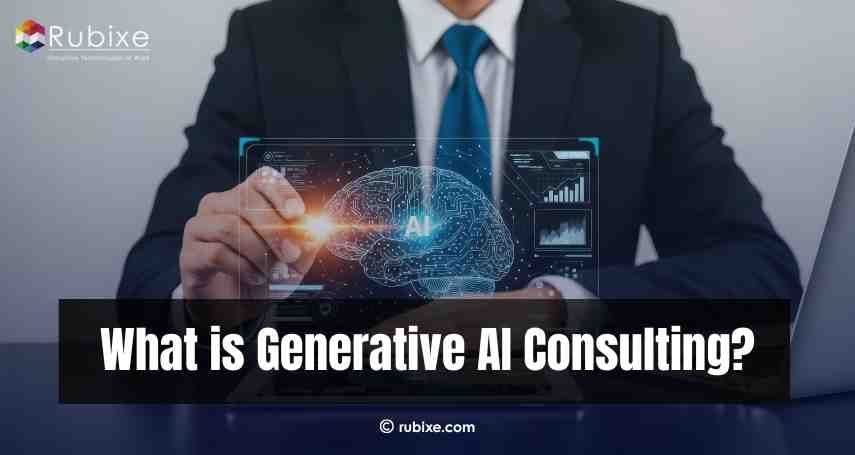
Generative AI is transforming how organisations innovate, optimise operations, and deliver customer value. From automated content creation to intelligent decision support, its applications are expanding rapidly. However, implementing generative AI without a clear roadmap can lead to compliance risks, integration failures, and unclear ROI. This is why generative AI consulting has become essential for enterprises seeking structured adoption, measurable outcomes, and long-term competitive advantage.
What is Generative AI Consulting?
Generative AI Consulting is a specialised advisory service that enables organisations to strategically adopt, implement, and scale generative AI solutions aligned with defined business objectives and measurable outcomes. It combines business strategy, technical architecture, governance planning, and execution oversight to ensure AI investments deliver sustained value.
Unlike traditional AI development services that focus primarily on building models or applications, generative AI consulting addresses the broader transformation journey, including:
-
Business case validation
-
Opportunity prioritisation
-
AI roadmap development
-
Model and infrastructure selection
-
Enterprise integration strategy
-
Governance and compliance frameworks
-
Performance measurement and optimisation
Generative AI refers to advanced AI systems capable of generating text, code, images, simulations, and analytical insights. These capabilities are powered by large-scale foundation models developed by organisations such as OpenAI and Google DeepMind.
A structured consulting engagement ensures these technologies are implemented with strategic intent, operational alignment, and risk controls, turning AI capability into measurable business impact.
Generative AI Consulting Is Gaining Momentum
-
McKinsey & Company estimates that generative AI could add $2.6 trillion to $4.4 trillion annually to the global economy across use cases such as marketing, software engineering, and customer operations.
-
PwC projects AI could contribute up to $15.7 trillion to the global economy by 2030.
-
Gartner predicts that a majority of enterprises will use generative AI in some form within the next few years.
This acceleration creates urgency. Enterprises that implement structured AI strategies are positioned to capture operational efficiencies and innovation advantages.
Challenges Businesses Face Without Expert Guidance
While enthusiasm is high, implementation complexity is often underestimated.
1. Undefined Business Objectives
Many organisations adopt AI tools without linking them to measurable KPIs. This results in fragmented pilots and unclear ROI.
2. Data Readiness Gaps
Generative models depend on structured, high-quality, and secure data. Inconsistent data architecture can severely impact performance.
3. Integration Complexity
AI solutions must integrate with ERP systems, CRMs, analytics platforms, and internal databases. Poor integration planning can disrupt operations.
4. Compliance and Governance Risks
Regulatory requirements around data protection, transparency, and bias are evolving. AI systems influencing decisions must meet compliance standards.
5. Scaling Challenges
Moving from proof-of-concept to enterprise-wide deployment requires infrastructure planning, monitoring frameworks, and change management strategies.
Generative AI consulting provides structured mitigation for each of these risks.
Generative AI Consulting Process
Understanding the consulting process reduces uncertainty for executive stakeholders.
1. Business Assessment and Opportunity Identification
Consultants evaluate workflows, bottlenecks, cost drivers, and growth objectives to identify high-impact AI use cases.
2. AI Strategy and Roadmap Development
A structured roadmap includes:
-
Priority initiatives
-
Cost-benefit analysis
-
Technology stack recommendations
-
Implementation phases
-
Governance planning
3. Model Selection and Solution Design
Choosing the right generative model depends on use case complexity, data availability, privacy requirements, and computational constraints.
4. Infrastructure and Integration
Deployment may involve cloud infrastructure, API integration, internal data pipelines, and cybersecurity controls.
5. Governance, Monitoring, and Optimisation
Consultants establish:
-
Performance tracking metrics
-
Bias detection mechanisms
-
Compliance audits
-
Continuous optimisation strategies
This phased approach ensures generative AI becomes a business asset rather than an experimental initiative.
Use Cases of Generative AI Consulting in Business
Generative AI consulting services apply across industries and functions.
Customer Experience and Support: AI-powered virtual assistants generate contextual responses, automate queries, and enhance engagement.
Marketing and Content Operations: Automated campaign ideation, content drafting, and audience segmentation accelerate go-to-market execution.
Software Development: Code generation, debugging assistance, and documentation drafting reduce development cycles.
Knowledge Management: Enterprises use AI systems to summarise documents, extract insights, and enable conversational access to internal data.
Financial Analysis and Forecasting: Generative AI models simulate scenarios and support strategic planning with predictive insights.
HR and Talent Management: Automated job descriptions, skill mapping, and candidate screening improve hiring efficiency.
Each use case becomes more impactful when aligned with measurable KPIs through consulting frameworks.
Benefits of Generative AI Consulting
1. Strategic Clarity: Consultants align AI initiatives with revenue growth, cost optimisation, or customer retention goals.
2. Faster Time to Value: Structured roadmaps accelerate implementation and reduce experimental delays.
3. Operational Efficiency: Automation of repetitive tasks improves productivity and reduces turnaround time.
4. Risk Mitigation: Governance frameworks address compliance, bias monitoring, and data protection.
5. Scalable Architecture: Solutions are designed to scale as business needs evolve.
6. Competitive Advantage: Organisations that adopt generative AI strategically gain faster innovation cycles and stronger decision intelligence.
How to Choose the Right Generative AI Consulting Partner
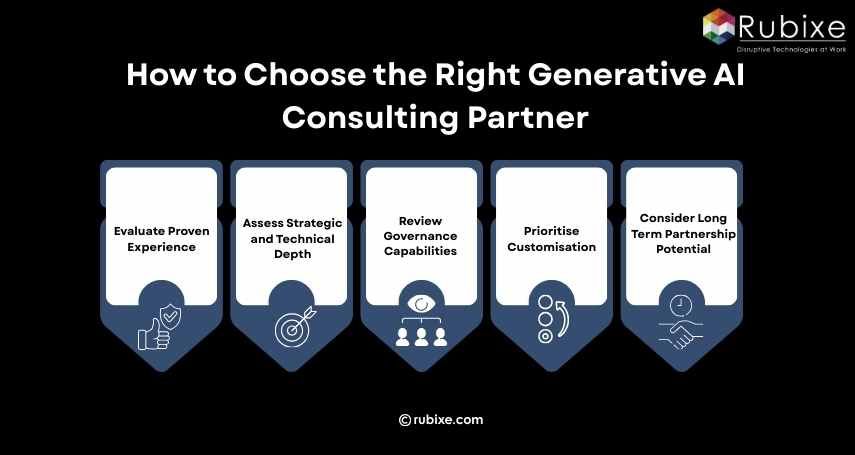
Selecting the right consulting partner directly influences ROI and long-term impact.
-
Evaluate Proven Experience: Look for case studies demonstrating measurable AI outcomes across industries.
-
Assess Strategic and Technical Depth: A reliable partner combines business consulting expertise with engineering capability.
-
Review Governance Capabilities: Strong AI governance, security protocols, and compliance understanding are critical.
-
Prioritise Customisation: Consultants should tailor strategies based on business maturity and industry requirements.
-
Consider Long-Term Partnership Potential: AI transformation is ongoing. Continuous optimization support is valuable.
Emerging Trends in Generative AI Consulting
To stay competitive, enterprises should monitor these developments:
-
Enterprise adoption of foundation models with fine-tuning capabilities
-
Hybrid AI architectures combining predictive and generative systems
-
AI governance frameworks are becoming board-level priorities
-
Increased investment in AI automation for cost efficiency
Consulting services evolve alongside these trends to ensure sustainable adoption.
Why Generative AI Consulting Matters
Generative AI consulting bridges the gap between technological innovation and measurable business transformation. It provides the structure, governance, and execution clarity that enterprises require to implement AI responsibly and profitably. With the right strategy and expertise, generative AI becomes a scalable engine for growth and operational excellence.
FAQs
1. What is Generative AI Consulting in simple terms?
It is a professional advisory service that helps businesses plan, implement, and manage generative AI solutions aligned with their goals.
2. How is generative AI consulting different from AI development?
Consulting focuses on strategy, governance, and roadmap design, while development focuses on building technical solutions.
3. How long does it take to implement generative AI solutions?
Timelines vary depending on complexity, but structured consulting reduces delays and accelerates measurable outcomes.
4. Which industries benefit most from generative AI consulting?
Finance, healthcare, retail, manufacturing, technology, and enterprise services benefit significantly due to data-driven operations.
5. Is generative AI secure for enterprise use?
With proper governance, data protection controls, and compliance frameworks, generative AI can be securely deployed in enterprise environments.
Ready to Transform Your AI Vision into Business Impact?
At Rubixe, we help enterprises design, implement, and scale AI-driven transformation strategies aligned with measurable outcomes. If you are exploring AI consulting to improve efficiency, drive innovation, and strengthen competitive positioning, connect with our experts to build a roadmap tailored to your business goals.
Generative AI Consulting helps organisations strategically adopt and scale AI technologies with measurable ROI. It addresses integration, governance, and scalability challenges through structured frameworks. With expert guidance, enterprises gain efficiency, innovation acceleration, and competitive advantage.