

What Is Enterprise AI and How It Drives Business Growth
Enterprise AI Solutions help businesses automate workflows, improve decision-making, reduce costs, and drive measurable growth with data-driven strategies.
Businesses today operate in data-rich, highly competitive environments where speed, precision, and personalization determine success. Enterprise AI Solutions empower organizations to transform vast volumes of data into strategic action. From optimizing internal operations to enhancing customer engagement, enterprise artificial intelligence creates a measurable impact across every function.
Leaders across industries are investing in scalable AI infrastructure to increase efficiency, reduce costs, strengthen decision-making, and unlock sustainable growth. Understanding how enterprise AI works and how it is applied in business is critical for companies planning long-term digital transformation.
Understanding Enterprise AI
Enterprise AI refers to the integration of artificial intelligence technologies within large-scale organizational systems and workflows. Unlike standalone AI tools or small automation scripts, Enterprise AI Solutions are designed to operate securely, reliably, and at scale across enterprise ecosystems.
These solutions typically combine:
-
Machine Learning for predictive analytics
-
Natural Language Processing for intelligent communication
-
Computer Vision for image and video analysis
-
Robotic Process Automation for workflow optimization
-
Generative AI for content and data synthesis
-
Advanced data engineering for structured and unstructured data management
Enterprise AI integrates with existing business platforms such as AI automation in ERP, CRM platforms, finance tools, cloud infrastructure, and analytics dashboards. This deep integration allows intelligence to flow seamlessly across departments rather than remaining isolated within one system.
Why Enterprise AI Is Critical for Modern Businesses
Organizations generate massive volumes of transactional, behavioral, and operational data. Without intelligent systems, much of this information remains underutilized. Enterprise AI Solutions convert raw data into actionable insights that guide leadership decisions and operational strategies.
Businesses adopt enterprise AI to:
-
Improve forecasting accuracy
-
Automate repetitive tasks
-
Enhance customer personalization
-
Strengthen compliance and security
-
Increase productivity across teams
-
Accelerate innovation cycles
The result is a more agile organization capable of responding quickly to market changes while maintaining operational stability.
How Enterprise AI Is Used Across Business Functions
Enterprise AI delivers value when embedded into core business processes. Its application spans multiple departments, each benefiting from tailored AI capabilities.
-
Marketing and Customer Experience
AI transforms how businesses understand and engage customers. Predictive segmentation models identify high-value customer groups based on behaviour and purchase history. Recommendation engines personalize content and product offerings. Conversational AI systems manage support interactions and gather valuable customer data.
These capabilities improve customer satisfaction, increase retention, and enhance campaign ROI through targeted engagement.
-
Sales and Revenue Optimization
Sales teams leverage Enterprise AI Solutions for lead scoring, opportunity forecasting, and pricing optimization. AI models analyze past deals, buyer behavior, and market conditions to prioritize prospects with the highest conversion probability.
Predictive revenue analytics provide leadership with accurate sales forecasts, enabling better planning and resource allocation.
-
Finance and Risk Management
Financial departments use AI for fraud detection, credit risk assessment, expense monitoring, and budgeting accuracy. Machine learning algorithms detect anomalies in transaction patterns, reducing financial exposure and strengthening compliance.
AI-driven forecasting enhances cash flow planning and supports strategic financial decision-making.
-
Supply Chain and Operations
Operational efficiency is one of the strongest drivers of enterprise AI adoption. Demand forecasting models improve inventory management and reduce stockouts. Predictive maintenance systems monitor equipment health and prevent costly downtime.
Route optimization algorithms streamline logistics, reduce fuel consumption, and enhance delivery performance. These improvements create significant cost savings and operational resilience.
-
Human Resources and Workforce Planning
AI assists HR teams in screening resumes, analyzing employee engagement data, and predicting attrition risk. Workforce analytics support strategic hiring decisions and succession planning.
Enterprise AI Solutions also enhance employee experience through intelligent chatbots, automated onboarding systems, and skills-gap analysis tools.
-
IT and Cybersecurity
IT departments deploy AI for infrastructure monitoring, threat detection, and incident response automation. Advanced algorithms analyze network behavior in real time, identifying unusual activity that may indicate security threats.
This proactive approach strengthens enterprise security frameworks while reducing manual monitoring workloads.
Key Benefits of Enterprise AI Solutions
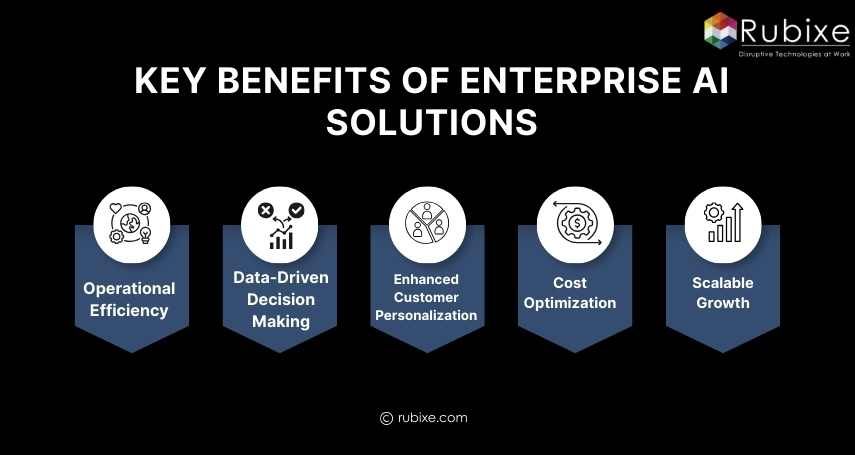
Organizations investing in Enterprise AI Solutions experience measurable advantages across performance metrics.
1. Operational Efficiency
Intelligent automation reduces manual effort and accelerates process execution.
2. Data-Driven Decision Making
Predictive analytics empowers executives with real-time dashboards and forward-looking insights.
3. Enhanced Customer Personalization
AI models analyse behavioural patterns to deliver tailored experiences at scale.
4. Cost Optimization
Process improvements and predictive maintenance reduce operational expenses.
5. Scalable Growth
Enterprise-grade AI infrastructure supports expansion across markets and regions without compromising performance.
These benefits position organizations for long-term competitiveness and strategic leadership.
Industries Transforming Through Enterprise AI
Enterprise AI adoption spans diverse industries, each leveraging AI according to unique operational challenges.
-
Healthcare improves diagnostics and patient management systems.
-
Banking enhances fraud detection and credit assessment models.
-
Retail and e-commerce refine personalization and demand forecasting.
-
Manufacturing deploys predictive maintenance and quality inspection systems.
-
Telecommunications strengthen network optimization and service automation.
-
Logistics enhances route planning and delivery accuracy.
Across sectors, Enterprise AI Solutions function as strategic enablers of digital maturity and operational excellence.
How to Choose the Right Enterprise AI Solutions For Your Business
Selecting the right Enterprise AI Solutions requires careful evaluation aligned with business objectives. Organizations should approach the decision strategically rather than focusing solely on technology trends.
1. Define Clear Business Goals
Begin with measurable outcomes. Whether the objective is revenue growth, cost reduction, risk mitigation, or customer satisfaction improvement, AI initiatives must align with defined KPIs.
2. Assess Data Readiness
AI performance depends on high-quality data. Evaluate data availability, integration capability, and governance frameworks. A strong data foundation ensures accurate modeling and reliable insights.
3. Evaluate Scalability and Integration
Enterprise AI Solutions should integrate seamlessly with existing systems such as ERP, CRM, and cloud platforms. Scalability is critical to support organizational growth without performance bottlenecks.
4. Prioritize Security and Compliance
Security, privacy, and regulatory compliance are essential for enterprise deployments. Choose solutions that offer governance controls, AI audits, and robust cybersecurity frameworks.
5. Consider Customization and Flexibility
Every organization operates differently. The ideal solution offers customization options, adaptable models, and the flexibility to evolve as business needs change.
6. Partner with Experienced Experts
Successful enterprise AI implementation requires technical expertise, strategic planning, and ongoing optimization. Working with experienced AI consulting specialists accelerates deployment and ensures long-term ROI.
The Future of Enterprise AI in Business
Enterprise AI continues to evolve with advancements in generative models, real-time analytics, edge computing, and hyper automation. Businesses are moving toward intelligent ecosystems where AI systems collaborate across departments to drive autonomous decision-making.
Future enterprise environments will rely heavily on AI-powered forecasting, adaptive supply chains, personalized customer journeys, and predictive risk management systems. Organizations that build strong AI foundations today will lead tomorrow’s digital economy.
Why Enterprise AI Solutions Are a Strategic Investment
Enterprise AI Solutions deliver far more than automation. They enable clarity in decision-making, precision in execution, and agility in responding to change. By embedding intelligence across operations, businesses enhance productivity, reduce inefficiencies, and create superior customer experiences.
Organizations seeking sustained growth and competitive differentiation recognize enterprise AI as a core strategic initiative rather than a short-term technology upgrade. The integration of intelligent systems across enterprise functions transforms data into measurable performance gains and long-term business value.
Enterprise AI is shaping the future of business leadership, operational excellence, and scalable innovation. Companies that embrace enterprise-grade intelligence position themselves to thrive in increasingly complex markets while delivering consistent, data-driven results.