








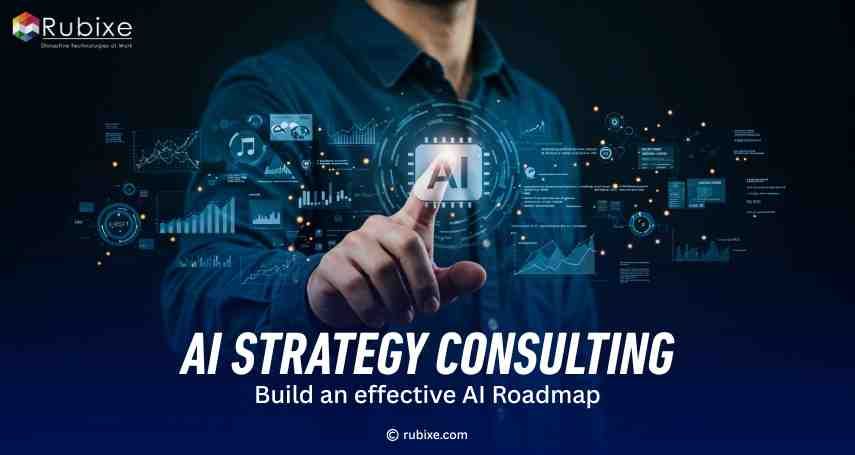
AI Strategy Consulting: Build an Effective AI Roadmap
AI strategy consulting helps build an effective AI roadmap, align goals, identify use cases, and implement scalable AI solutions for business growth.
Are You Investing in AI But Not Seeing Results?
You’ve adopted AI tools.
You’ve explored automation.
Maybe you’ve even launched a few AI initiatives.
But here’s the real question:
Is AI actually delivering measurable business impact?
For most businesses, the answer is unclear.
AI projects often start with excitement - but quickly turn into confusion:
-
No clear ROI
-
Disconnected use cases
-
Poor execution
-
Wasted budget
The problem is not AI.
The problem is the absence of a clear AI strategy.
Without direction, AI becomes experimentation.
With the right strategy, it becomes a scalable growth engine.
What is AI Strategy Consulting?
AI Strategy Consulting helps businesses design a structured plan to adopt AI in a way that delivers real, measurable outcomes.
It focuses on:
-
Aligning AI with business goals
-
Identifying high-impact use cases
-
Preparing data and infrastructure
-
Creating a step-by-step implementation roadmap
In simple terms, it answers:
Where should AI be used?
How should it be implemented?
What results should it deliver?
Unlike generic approaches, a strong AI strategy is customized to your business model, industry, and goals.
Why Businesses Need an AI Roadmap
AI adoption is increasing quickly, but success rates remain low.
Why?
Because businesses:
-
Start with tools instead of problems
-
Ignore data readiness
-
Lack prioritization
-
Fail to define ROI
An AI roadmap eliminates this confusion.
It provides:
-
Clear direction
-
Defined priorities
-
Measurable outcomes
-
Structured execution
Without a roadmap, AI remains a cost.
With a roadmap, AI becomes an investment.
Key Benefits of AI Strategy Consulting
1. Faster ROI: Focus on high-impact use cases that deliver quick results.
2. Reduced Risk: Avoid failed implementations and unnecessary spending.
3. Better Decision-Making: Use data-driven insights instead of assumptions.
4. Scalable Growth: Start small and expand AI initiatives strategically.
5. Competitive Advantage: Stay ahead with intelligent automation and insights.
What an Effective AI Strategy Includes
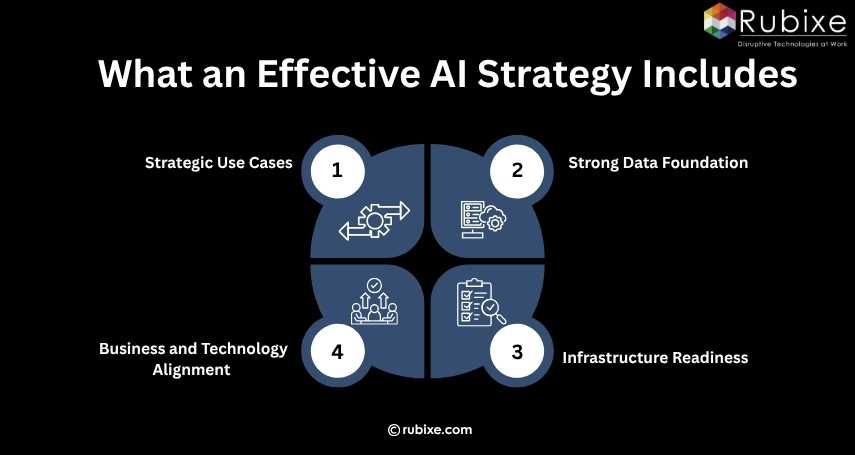
1. Strategic Use Cases
AI should solve real business problems, not random ideas.
Each use case must be evaluated based on:
-
Business impact
-
Feasibility
-
ROI
Example:
Instead of “implement AI,” define:
-
“Use AI to reduce customer churn by 15%.”
2. Strong Data Foundation
AI depends entirely on data.
If your data is:
-
Scattered
-
Incomplete
-
Poor quality
Then AI will fail.
Businesses must:
-
Clean and structure data
-
Ensure accessibility
-
Maintain data security
Insight: Data readiness is often more important than AI itself.
3. Infrastructure Readiness
AI requires:
-
Scalable cloud or on-premise systems
-
Processing power (CPU/GPU)
-
Secure storage
Without this, AI cannot scale effectively.
4. Business and Technology Alignment
AI is not just technical.
It requires alignment between:
-
Business teams
-
Technical teams
This ensures solutions are practical and usable, not just theoretical.
Step-by-Step: Building an Effective AI Roadmap
Step 1: Define Business Goals
Start with clarity.
Ask:
-
What problem are we solving?
-
What outcome do we expect?
Examples:
-
Increase conversions
-
Reduce operational costs
-
Improve customer experience
Step 2: Identify High-Impact Use Cases
Focus on:
-
High ROI opportunities
-
Quick wins
-
Measurable outcomes
Examples:
-
AI chatbots
-
Predictive analytics
-
Recommendation engines
Step 3: Conduct a Data Readiness Assessment
Evaluate:
-
Data quality
-
Data availability
-
Data structure
Fix gaps before implementation.
Step 4: Choose the Build vs Buy Approach
Decide whether to:
-
Use existing AI tools
-
Build custom solutions
Factors:
-
Cost
-
Time
-
Complexity
Step 5: Develop and Train AI Models
-
Select algorithms
-
Prepare datasets
-
Train models
-
Test accuracy
Step 6: Implement and Deploy
-
Integrate into systems
-
Test performance
-
Run pilot projects
Start small before scaling.
Step 7: Monitor and Optimize
Track:
-
ROI
-
Efficiency
-
Accuracy
Continuously improve models.
AI Strategy Framework: 5 Stages to Build a Successful AI Roadmap
1. Assessment: Identify Goals and Data Readiness
Start by defining:
-
What problem do you want to solve
-
What outcomes do you expect
At the same time, evaluate your data:
-
Is it accurate, complete, and accessible?
Why it matters:
AI depends on data. If your data is not ready, the results will be poor.
2. Planning: Define Use Cases and Roadmap
Identify high-impact AI use cases based on:
-
Business value
-
Feasibility
-
ROI
Create a roadmap with:
-
Clear phases
-
Timelines
-
Success metrics
Why it matters:
Proper planning ensures focused execution and avoids wasted effort.
3. Development: Build AI Solutions
This is where execution begins:
-
Prepare and clean data
-
Train AI models
-
Test performance
You can either build custom solutions or use existing tools.
Why it matters:
Well-built models ensure accurate and reliable outcomes.
4. Deployment: Implement and Test
Integrate AI into your systems and start with a small-scale implementation:
-
Run pilot projects (PoC)
-
Test real-world performance
Why it matters:
Helps validate effectiveness before full-scale rollout.
5. Optimization: Monitor and Improve
AI needs continuous improvement:
-
Track performance
-
Update models
-
Optimize results
Why it matters:
Ensures long-term success and scalability.
AI Use Cases by Industry
1. Retail
-
Product recommendations
-
Demand forecasting
-
Customer personalization
2. Healthcare
-
Predictive diagnostics
-
Patient data analysis
-
Automated workflows
3. Finance
-
Fraud detection
-
Risk analysis
-
Automated trading
4. SaaS
-
Customer churn prediction
-
Lead scoring
-
Automated support
Real World Case Studies
Case Study 1: eCommerce Business
Problem: Low conversion rates
Solution:
-
AI-based product recommendations
-
Personalized email campaigns
Results:
-
30% increase in conversions
-
20% increase in repeat purchases
Common Challenges in AI Adoption
-
Poor data quality
-
Lack of internal expertise
-
Resistance to change
-
Overinvestment in tools
-
Unrealistic expectations
AI Strategy Consulting helps overcome these challenges.
How to Choose the Right AI Consulting Partner
Look for:
-
Proven experience
-
Industry expertise
-
Real case studies
-
Custom solutions
-
Transparent communication
Avoid generic, one-size-fits-all approaches.
Governance: A Critical Factor
AI must be managed responsibly.
Focus on:
-
Data privacy
-
Compliance
-
Risk management
-
Ethical AI usage
Without governance, AI can create serious risks.
FAQs
1. What is AI strategy consulting?
It helps businesses plan and implement AI effectively to achieve measurable results.
2. How long does AI implementation take?
Quick wins can take weeks; advanced projects may take months.
3. Is AI expensive?
It depends on implementation. A clear strategy reduces unnecessary costs.
4. Do small businesses need an AI strategy?
Yes. Even small AI use cases can deliver a strong ROI.
What to Do Next
AI is no longer optional. But here’s the truth:
AI without a strategy leads to failure.
A strong AI roadmap ensures:
-
Clear direction
-
Better ROI
-
Faster execution
-
Scalable growth
The companies winning with AI are not the ones using the most tools.
They are the ones with the clearest strategy.
Steps to Get Started with AI
Don’t start with AI tools.
Don’t follow trends blindly.
Start with:
-
A clear business problem
-
A structured roadmap
-
A focused implementation plan
Build small.
Measure results.
Scale smart.
That’s how you turn AI into a real business advantage.