




What Are NLP Chatbots? How Do They Work?
Understand what NLP chatbots are, how they identify user intent, and how AI chatbot solutions help businesses automate support and improve interactions.
Are your customers waiting too long for answers while your competitors reply in seconds?
When a business responds late, it loses more than time, it loses trust and sales. Customers want quick support, clear information, and a smooth online experience. If they don’t get it, they leave the website, cancel purchases, or choose another brand. Slow responses often lead to higher bounce rates, fewer conversions, and more pressure on support teams.
AI chatbot solutions help solve this problem. They do more than send automated messages. They understand what customers are asking, identify their needs, and provide accurate, helpful replies. By handling conversations in a smart way, these systems improve customer experience while reducing workload and support costs.
What Are NLP Chatbots?
NLP chatbots are intelligent systems powered by Natural Language Processing (NLP). They are designed to understand, interpret, and respond to human language in a natural and meaningful way.
Traditional rule-based bots follow strict decision trees. In contrast, NLP chatbots can recognize different ways people phrase questions, understand context, and identify user intent more accurately.
For example:
A rule-based bot might only respond to:
“Track my order.”
An NLP chatbot understands:
-
“Where is my package?”
-
“Has my shipment been dispatched?”
-
“Can you check my delivery status?”
Even though the sentences differ, the intent is the same.
Modern AI chatbot solutions, powered by advanced NLP solutions for businesses, use machine learning models trained on large volumes of conversational data to continuously improve understanding and response accuracy over time.
How Do NLP Chatbots Work?
Understanding how they function helps businesses evaluate their value properly.
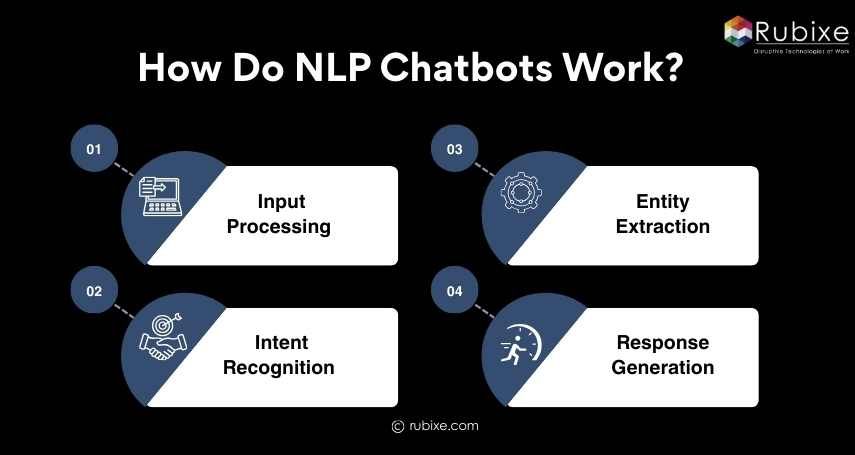
NLP chatbots typically operate in four stages.
1. Input Processing
When a user sends a message, the chatbot breaks it down into smaller components, words, and phrases. This process is called tokenization.
It analyzes grammar, sentence structure, and context clues to prepare the data for interpretation.
2. Intent Recognition
Next, the chatbot identifies the user’s intent.
Examples:
“I need to cancel my subscription.”
Intent: Account cancellation
“Can I get a demo?”
Intent: Sales inquiry
Intent recognition is critical to effective AI chatbot solutions because it determines the direction of the conversation.
3. Entity Extraction
Entities are specific details within a message.
For example:
“Schedule a meeting on Friday at 4 PM.”
Entities:
-
Date: Friday
-
Time: 4 PM
-
Action: Schedule meeting
This enables the chatbot to execute real tasks rather than simply provide information.
4. Response Generation
Finally, the chatbot generates an appropriate response.
This can include:
-
Pulling customer data from CRM systems
-
Providing knowledge base answers
-
Triggering workflows
-
Generating dynamic replies
Advanced conversational AI services may use generative models to create more natural and contextual responses.
Why Businesses Are Investing in AI Chatbot Solutions
The shift toward automation is not about trends, it’s about measurable outcomes.
Companies adopting AI chatbot solutions typically aim to improve speed, reduce costs, and increase customer satisfaction.
Let’s examine the key benefits.
1. 24/7 Availability
Customers expect support at any time.
Chatbots provide instant responses, reducing waiting times and improving engagement. Businesses that reduce response times often see noticeable improvements in customer retention.
2. Cost Efficiency Through Automation
Support teams handling repetitive queries can be expensive to scale.
Customer support automation can handle up to 60% of routine inquiries, such as:
-
Order tracking
-
Password resets
-
Appointment scheduling
-
Basic FAQs
This allows human agents to focus on complex, high-value interactions.
Properly deployed AI chatbot solutions significantly reduce operational costs without reducing service quality.
3. Lead Qualification and Sales Support
Chatbots can act as the first point of contact for potential customers.
They can collect:
-
Contact details
-
Budget information
-
Service requirements
-
Timeline expectations
By filtering and qualifying leads automatically, sales teams spend time on prospects who are more likely to convert.
Many enterprise chatbot solutions report measurable improvements in lead conversion rates after implementation.
Common Concerns About AI Chatbot Solutions
Businesses often hesitate due to misconceptions. Let’s address them directly.
“Will Chatbots Replace Human Agents?”
No.
They handle repetitive tasks, freeing human teams to focus on high-complexity cases. The most successful businesses combine automation with human oversight.
“Are Chatbots Accurate?”
Accuracy depends on training data, implementation quality, and continuous optimization.
Well-designed AI chatbot solutions include monitoring systems and regular updates to maintain high performance.
“Are They Expensive?”
Initial setup costs vary based on complexity.
However, when compared to:
-
Hiring additional support staff
-
Losing sales due to slow response
-
Manual process inefficiencies
The long-term ROI is often substantial.
Key Elements of Successful AI Chatbot Solutions
Not all implementations succeed. Effective deployment requires:
-
Clear objectives
-
Strong data infrastructure
-
CRM and backend integration
-
Continuous performance monitoring
-
Security compliance
Businesses that treat chatbot deployment as a strategic initiative, not a quick tool installation, see the best results.
Measuring ROI
To evaluate performance, track:
-
Response time reduction
-
Customer satisfaction scores
-
Conversion rate improvements
-
Cost per ticket decrease
-
Lead qualification efficiency
For example, a mid-sized service firm deploying AI chatbot solutions experienced:
-
50% reduction in ticket volume
-
20% faster query resolution
-
15% increase in qualified leads
These numbers highlight measurable impact.
The Strategic Role of Conversational AI Services
As organizations grow, scalability becomes essential.
Modern conversational AI services allow businesses to:
-
Handle high interaction volumes
-
Support multiple languages
-
Maintain consistent messaging
-
Integrate across departments
When integrated properly, chatbots become part of the digital infrastructure, not just website add-ons.
The Future of NLP Chatbots
NLP technology continues evolving.
Future systems will become more:
-
Context-aware
-
Emotion-sensitive
-
Multilingual
-
Multimodal (text and voice combined)
Businesses investing early in advanced AI chatbot solutions gain a competitive advantage through better responsiveness and operational agility.
Ready to Upgrade Your Customer Conversations?
NLP chatbots are more than automated responders. They are intelligent systems capable of understanding human language, identifying intent, extracting key information, and delivering meaningful interactions.
When implemented strategically, AI chatbot solutions reduce costs, improve customer satisfaction, accelerate sales processes, and enhance operational efficiency.
The key takeaway is simple:
Technology alone does not create impact. Strategy, integration, and continuous optimization do.
If your organization is facing slow response times, rising support costs, or missed engagement opportunities, the next logical step is evaluating how intelligent automation can improve performance.
AI-powered conversations are becoming the new standard. The question is not whether to adopt AI chatbot solutions, but how effectively you implement them to drive measurable business growth.