









Intelligent Process Automation with Gen AI Trends
Many businesses automate tasks but still struggle with inefficiency. Learn how intelligent process automation improves workflows, decisions, and results.
Are You Automating Work or Just Speeding Up Problems?
Most businesses today are investing in automation. They are using tools, building workflows, and exploring AI. The expectation is clear: faster work, better output, and less manual effort.
But after some time, many businesses face the same problem.
Work is still slow.
Teams are still overloaded.
Errors are still happening.
So what is going wrong?
The answer is simple.
Automation alone is not enough.
If your process is unclear or inefficient, automation will only make it faster not better. This is where Intelligent Process Automation (IPA) with Gen AI trends is making a real difference. It is not just about doing tasks faster. It is about improving how work is done and how decisions are made.
What is Intelligent Process Automation?
Intelligent Process Automation is the use of automation combined with artificial intelligence to manage and improve business processes.
It brings together:
-
Robotic Process Automation (RPA)
-
Artificial Intelligence (AI)
-
Machine Learning (ML)
-
Natural Language Processing (NLP)
Simple Meaning:- It is smart automation that can understand data, learn from it, and make better decisions.
Unlike traditional automation, which follows fixed rules, IPA can handle complex tasks and improve over time.
What Businesses Are Actually Experiencing
From real-world use, one pattern is clear.
Businesses that use only basic automation struggle to see results.
Businesses that combine automation with AI see real improvements.
Example
A hiring team using basic automation can filter resumes using keywords.
But with AI workflow automation, the system can:
-
Understand candidate experience
-
Match skills with job roles
-
Shortlist better candidates
-
Reduce hiring time
This shows one important point:
Automation works better when it understands the process, not just the task.
How Intelligent Process Automation Works
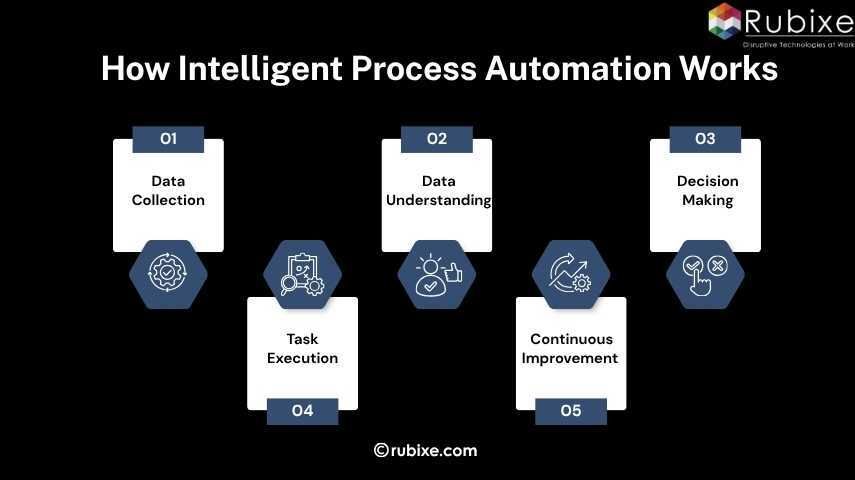
To understand IPA clearly, look at its process:
1. Data Collection: The system collects data from different sources like forms, emails, and databases.
2. Data Understanding: AI analyzes the data to identify patterns and insights.
3. Decision Making: The system decides what action to take based on the data.
4. Task Execution: AI Automation tools perform the required task.
5. Continuous Improvement: The system learns from past actions and improves over time.
This makes IPA more powerful than traditional systems.
Why Traditional Automation Is Not Enough
Traditional automation is limited. It works only on fixed rules and predefined instructions.
It can:
-
Send emails
-
Move data
-
Perform repetitive tasks
But it cannot:
-
Understand context
-
Make decisions
-
Adapt to changes
Simple Example: A rule-based system can send the same email to every user.
But an AI-powered system can:
-
Understand user behavior
-
Personalize the message
-
Improve engagement
This is the difference between basic automation and intelligent automation.
IPA vs RPA vs Traditional Automation
|
Feature |
Traditional Automation |
Intelligent Process Automation |
|
Rule-based |
Yes |
No |
|
Handles complex tasks |
No |
Yes |
|
Learns over time |
No |
Yes |
|
Data understanding |
Basic |
Advanced |
|
Decision making |
No |
Yes |
|
Use case |
Simple tasks |
End-to-end processes |
Key Insight
IPA is the next level of automation. It combines speed with intelligence.
Role of Gen AI in Intelligent Process Automation
Gen AI is transforming automation in a big way.
Earlier systems:
-
Followed instructions
-
Could not adapt
Now with Gen AI:
-
Systems understand language
-
They generate responses
-
They learn from data
Key Improvements
1. Smarter Decision Making: Gen AI can analyze large data sets and suggest the best action.
2. Content Creation: Automation can now create emails, reports, and responses automatically.
3. Improved Accuracy: AI reduces human errors by identifying patterns and checking data.
4. Real-Time Response: Businesses can respond instantly to customers and market changes.
Key Trends in Intelligent Process Automation
1. End-to-End Automation
Businesses are automating complete workflows instead of small tasks.
Example:
Customer onboarding now includes:
-
Form submission
-
Verification
-
Approval
-
Communication
All done automatically.
2. Hyperautomation
Hyperautomation means using multiple technologies together to automate everything possible.
It combines:
-
AI
-
RPA
-
Analytics
3. Data-Driven Workflows
Decisions are based on data instead of guesswork.
This improves:
-
Accuracy
-
Efficiency
-
Results
4. Personalization at Scale
Customers expect personalized experiences.
IPA helps businesses:
-
Understand user behavior
-
Send relevant communication
-
Improve engagement
5. Low-Code and No-Code Platforms
Businesses can now build automation workflows easily without heavy technical knowledge.
Benefits of Intelligent Process Automation
1. Faster Operations: Tasks are completed quickly without delays.
2. Improved Accuracy: Errors are reduced through AI-based checks.
3. Cost Savings: Less manual work reduces operational costs.
4. Better Decision Making: Data-driven insights improve business decisions.
5. Scalability: Businesses can grow without increasing workload.
Common Challenges in Implementation
1. Lack of Clear Goals: Without a clear plan, automation fails.
2. Poor Data Quality: Bad data leads to poor results.
3. Over-Automation: Not every task should be automated.
4. Team Resistance: Employees may resist new systems.
How to Implement Intelligent Process Automation
Step 1: Identify Problem Areas
Focus on tasks that are repetitive and slow.
Step 2: Prepare Your Data
Ensure your data is clean and organized.
Step 3: Start Small
Begin with one process and expand later.
Step 4: Choose the Right Tools
Select tools that match your business needs.
Step 5: Monitor and Improve
Continuously track performance and improve workflows.
Future of Intelligent Process Automation
The future of automation is clear.
Systems will not just perform tasks.
They will:
-
Think
-
Learn
-
Improve continuously
With Gen AI, businesses will achieve:
-
Faster decision-making
-
Better efficiency
-
Improved customer experience
The Future of Intelligent Process Automation
Many businesses are using automation today. But only a few are using it correctly.
Intelligent Process Automation is not about tools.
It is about improving how your business works.
If your processes are unclear, automation will not fix them.
Start with:
-
Clear goals
-
Clean data
-
Simple workflows
Then apply intelligent automation.
Because real growth does not come from doing more work. It comes from doing work in a smarter way.