





Why AI Image Recognition Is Useful for Business
AI image recognition helps businesses save time, reduce errors, improve security, analyze images, track products, monitor inventory, and make decisions.
The Real Problem Businesses Face Today
Businesses deal with thousands of images every day, product photos, security footage, documents, and customer uploads. Checking all these images manually takes a lot of time, costs more money, and still leads to mistakes. Many teams feel stuck because they cannot scale this work faster.
Instead of people spending hours reviewing images, technology can understand images instantly and accurately. It helps businesses reduce effort, avoid errors, and respond faster.
By turning images into useful data, companies can work smarter, improve quality, and deliver better experiences to customers across industries.
What Is AI Image Recognition?
AI image recognition is a technology that allows computers to see and understand images just like humans. It helps machines identify objects, people, text, shapes, and actions in photos and videos.
The system learns by studying thousands or even millions of images. Over time, it understands patterns, colors, and details. Once trained, it can recognize new images quickly and accurately.
For businesses, this means images can be analyzed without manual work, saving both time and effort.
Why Businesses Are Actively Searching for This Solution
Businesses today face common pain points:
-
Too many images to review manually
-
High labor cost for visual checking
-
Human errors during quality checks
-
Slow response time for customers
-
Difficulty scaling operations
Image-based automation solves these problems by making image understanding fast, consistent, and reliable.
That is why more companies are now investing in visual AI solutions to stay competitive.
How AI Image Recognition Works
AI image recognition works by teaching computers to see and understand images like humans.
-
Image Collection: Gathers large sets of images from different sources such as cameras, websites, and databases. These images help the system understand real-world visuals in many conditions.
-
Data Training: Uses labeled images to teach the system what each image contains. This step helps AI learn the difference between objects, people, and backgrounds.
-
Feature Detection: Identifies key details like shapes, colors, edges, and textures in images. These features help AI notice even small visual differences.
-
Image Analysis: Compares new images with previously learned data. The system quickly analyzes patterns to understand what the image shows.
-
Object Recognition: Detects and classifies items, people, or text within the image. Results are delivered fast and with high accuracy.
-
Continuous Learning: Improves accuracy over time by learning from new images and feedback. This helps the system become smarter with regular use.
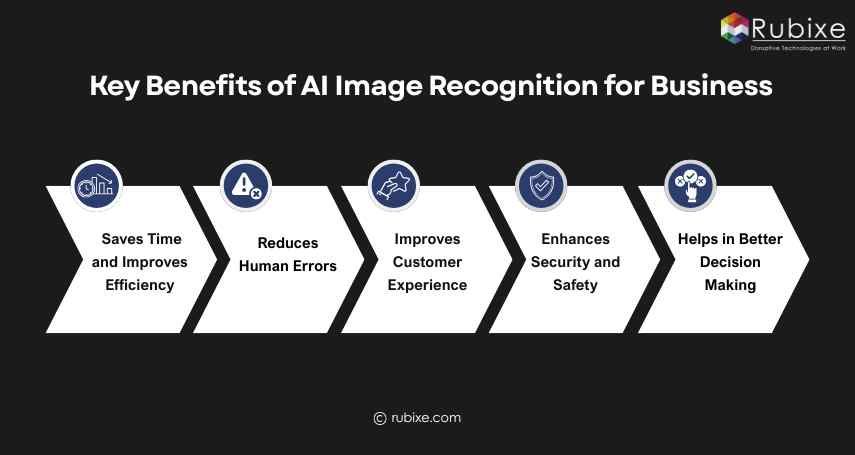
Key Benefits of AI Image Recognition for Business
1. Saves Time and Improves Efficiency
One of the biggest benefits is speed. AI systems can scan thousands of images in seconds. What once took hours or days can now be done almost instantly. By using ai image recognition, businesses reduce manual work and improve overall productivity. Employees can focus on creative and strategic tasks instead of repetitive image checking.
2. Reduces Human Errors
People can get tired or distracted, especially when reviewing many images. AI systems remain consistent and focused. Businesses using ai image recognition experience fewer mistakes in areas such as quality checks, document review, and security monitoring. This leads to better results and higher trust.
3. Improves Customer Experience
Customers expect fast and accurate service. Image recognition helps businesses meet these expectations. With ai image recognition, companies can offer visual search, faster support, and better product suggestions. For example, customers can upload a product image and find similar items instantly.
This creates a smoother and more satisfying customer journey.
4. Enhances Security and Safety
Security is a major concern for many businesses. Cameras are used everywhere, but watching them all the time is not possible for humans. AI image recognition helps monitor video feeds, detect unusual activity, and recognize authorized or unauthorized access. This improves safety while reducing the need for constant human supervision.
5. Helps in Better Decision-Making
Images contain valuable business information. When images are analyzed properly, they can provide useful insights. Using ai image recognition, businesses can track trends, monitor performance, and make data-driven decisions. This leads to smarter planning and better results.
AI Image Recognition vs Manual Image Checking
Before adopting automation, many businesses relied on people to review images.
Here is the difference:
|
Manual Image Checking |
AI-Based Image Recognition |
|
Time-consuming: Employees spend hours reviewing photos, videos, or scanned documents, slowing down operations. |
Instant processing: AI systems can scan thousands of images in seconds, saving huge amounts of time. |
|
High labor cost: Manual checks require large teams, which increases expenses and resources. |
Cost-efficient: Once implemented, AI reduces the need for large teams, lowering operational costs. |
|
Prone to errors: Humans can miss details, especially when tired or under pressure, causing mistakes in quality or data. |
Consistent accuracy: AI provides uniform results every time, reducing errors and improving reliability. |
|
Difficult to scale: Increasing workload means hiring more staff, which is not always practical or fast. |
Easy to scale: AI can handle more images as the business grows without extra staff. |
|
Slower decisions: Processing images manually delays insights, making it harder to act quickly. |
Real-time insights: AI provides instant analysis, enabling faster decisions and immediate action. |
Industry Use Cases of Image Recognition
1. Retail Industry
Retailers use image recognition to manage shelves, track products, and prevent theft. Systems can identify empty shelves and alert staff automatically. This helps improve stock availability and customer satisfaction.
2. Manufacturing Industry
Manufacturing companies use image recognition for quality checks. Products are scanned to find defects before shipping.
This reduces waste, improves product quality, and builds customer trust.
3. Healthcare Industry
In healthcare, image recognition supports diagnosis by analyzing medical images such as X-rays and scans. Doctors can make faster and more accurate decisions with AI support.
4. Logistics and Warehousing
Warehouses use image recognition to track packages, scan labels, and manage inventory. This improves accuracy and speeds up operations.
Challenges and Limitations Businesses Should Know
-
Image Quality Matters: Low-resolution or blurry images can reduce accuracy. AI works best with clear, high-quality visuals.
-
Training Data is Needed: AI needs a lot of labeled images to learn properly. Without good data, results may be wrong.
-
Privacy and Security Concerns: Customer images and sensitive visuals must be protected to comply with privacy laws.
-
Cannot Fully Replace Humans: AI is helpful, but may still need human review for complex or unusual cases.
-
Cost of Implementation: The initial setup of AI systems can be expensive for small businesses.
-
Bias in AI Models: If training data is biased, AI may give unfair or incorrect results.
Future of AI Image Recognition in Business
The future of AI image recognition is very bright for businesses. Technology is improving fast, making AI smarter, faster, and more accurate.
Here are the key points:
-
Real-Time Insights: Businesses will be able to analyze images instantly, helping them make faster and better decisions.
-
Integration with Other Technologies: AI will work with machine learning, IoT, and predictive analytics to automate processes like inventory management and customer behavior tracking.
-
Reduced Manual Work: Tasks that took hours or days will be handled automatically, allowing teams to focus on strategy and growth.
-
Improved Data Privacy: New AI systems will protect sensitive and personal data, ensuring compliance with privacy regulations.
-
Competitive Advantage: Early adoption helps companies stay ahead, improve efficiency, and offer better services to customers.
-
Essential Business Strategy: AI image recognition will become a key part of modern business operations, driving smarter decision-making and higher productivity.
FAQs
1. Is image recognition expensive for businesses?
Costs vary, but automation often saves more money than it costs.
2. Can small businesses use it?
Yes. Many cloud-based tools are affordable and scalable.
3. Is customer data safe?
When used with proper security and compliance rules, data is protected.
4. Does it replace human jobs?
It supports teams by removing repetitive work, not replacing people.
5. How accurate is the technology?
Accuracy improves with better data and regular training.
Images are not just pictures. They are important information for a business.
Using AI image recognition helps companies save time, make fewer mistakes, keep things safe, and give better service to customers. It also helps businesses do more work and make better decisions.
For today’s companies, using visual AI is not just a trend - it helps them stay ahead of others.