

















AI Infrastructure Services: Steps to Build Strong AI
AI infrastructure services help businesses plan, deploy, secure, and manage AI systems using cloud, data platforms, and ongoing operational support
If you’re searching for AI infrastructure services, it’s probably not because you’re curious. It’s because something isn’t working.
Models take too long to train, or deployments feel breakable. Teams may keep rebuilding the same pipelines again and again.
Sometimes, leadership is asking one uncomfortable question: “Are we actually ready to scale AI?”
Most AI problems don’t start with bad models. They start with weak foundations. And that’s exactly where AI infrastructure services decide whether AI becomes a real capability or a constant struggle.
What Is AI Infrastructure?
AI infrastructure is the foundation that allows artificial intelligence systems to function reliably at scale. In simple terms, it includes all the systems, tools, and resources required to store data, train models, deploy them, and keep them running smoothly in real-world environments.
Unlike regular software setups that handle predictable workloads, AI infrastructure must support large volumes of data, heavy computation, and continuous learning cycles.
Models need to be trained repeatedly, updated frequently, and monitored constantly. That means the environment supporting AI must be flexible, resilient, and designed for change.
When businesses invest in AI infrastructure services, they are not just buying hardware or cloud space. They are building an ecosystem where data flows smoothly, models evolve safely, and AI outputs remain dependable over time.
AI Infrastructure vs Traditional IT Infrastructure
Traditional IT infrastructure was built for stability.
AI infrastructure is built for change.
Here’s the difference at a conceptual level:
-
Traditional systems handle fixed workloads
-
AI systems deal with constantly evolving workloads
In classic IT environments:
-
Applications run on CPUs
-
Performance needs are predictable
-
Operations rely heavily on manual intervention
In AI-driven environments:
-
Workloads fluctuate based on data and training cycles
-
GPUs and accelerated computing become essential
-
Pipelines must run automatically and repeatedly
This shift is why many organizations feel friction when AI adoption grows. Their IT setup was never designed for learning systems.
AI infrastructure services bridge that gap by reshaping systems around experimentation, iteration, and scale.
Why Is AI Infrastructure Important Today?
AI adoption is no longer limited to experimentation.
AI now influences:
-
Customer decisions
-
Hiring and workforce planning
-
Financial forecasting
-
Operational optimization
But infrastructure readiness often lags behind ambition. When infrastructure is weak, businesses face risks like:
-
Model failures during peak usage
-
Slow experimentation cycles
-
Inconsistent results across teams
-
Difficulty scaling successful pilots
The problem is subtle.
AI doesn’t always fail loudly. It degrades quietly.
Strong AI infrastructure services reduce these risks by creating stability beneath constant innovation. They allow businesses to move faster without losing control.
Core Components of AI Infrastructure
AI infrastructure works best when viewed as layers rather than isolated tools. Each layer supports a specific role in the AI lifecycle while staying connected to the rest of the system.
Application Layer
This is where AI becomes visible to users. It includes applications, dashboards, APIs, and interfaces that consume AI outputs. Whether it’s a recommendation engine, a forecasting tool, or an internal analytics platform, this layer translates AI results into usable insights.
If this layer fails, the AI value never reaches the business.
Model Layer
The model layer is where intelligence lives. It includes machine learning models, training pipelines, testing workflows, and inference systems. Models move through a lifecycle that starts with training, passes through validation, and ends with deployment into real environments.
This layer must support experimentation while ensuring reliability. Without structure here, teams lose track of versions, results, and performance.
Infrastructure Layer
This is the backbone. Compute, storage, and networking resources live here. Everything else depends on its stability and scalability. When infrastructure is poorly designed, even well-built models struggle to perform.
Hardware and Software Building Blocks
Rather than focusing on specific products, it’s more useful to understand the role hardware and software play in supporting AI workloads.
Hardware Elements
AI systems often require specialized hardware to perform efficiently. GPUs and accelerators handle large-scale computations that CPUs struggle with. Storage systems must move data quickly without bottlenecks. Performance matters because slow infrastructure slows learning.
Well-planned AI infrastructure services align hardware choices with actual workload needs instead of overbuilding blindly.
Software Elements
On the software side, machine learning frameworks enable model development and testing. Data processing tools prepare raw information for training. Orchestration and automation platforms keep everything running together without constant manual effort.
The goal isn’t complexity. It’s coordination.
How AI Infrastructure Works
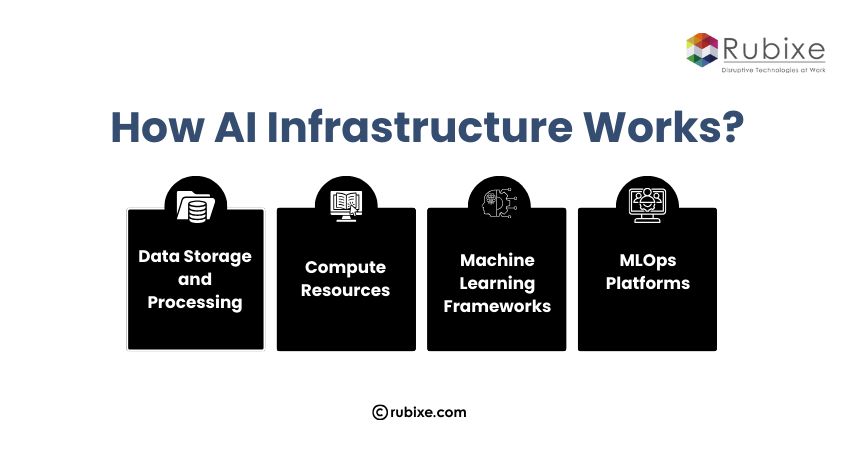
AI infrastructure works best when viewed as a flow rather than a checklist.
Data Storage and Processing
Everything starts with data. Raw information is collected, cleaned, transformed, and prepared through pipelines. These pipelines ensure data remains consistent, traceable, and ready for model use. Poor data handling here creates problems everywhere else.
Compute Resources
Training models requires significant computing power, often in bursts. Inference requires steady, responsive performance. AI infrastructure must support both without conflict, scaling up and down as needs change.
Machine Learning Frameworks
Frameworks provide the environment where models are built and tested. They allow teams to experiment safely, compare results, and refine performance without disrupting production systems.
MLOps Platforms
As AI grows, manual management breaks down. MLOps platforms handle monitoring, version control, deployment tracking, and lifecycle management. They ensure models remain accurate, compliant, and observable after launch.
This is where AI services truly show their value at scale.
Steps to Build Strong AI Infrastructure
Building AI infrastructure is not a one-time setup. It’s a structured process that grows and adapts as business needs change.
Clarify Goals, Use Cases, and Budget
-
Define what problems AI is expected to solve
-
Identify priority use cases before investing in tools
-
Set realistic budgets aligned with business impact
-
Avoid guessing infrastructure needs without clear objectives
Select Hardware and Software Based on Real Workloads
-
Choose compute and storage based on actual data and model demands
-
Avoid overengineering in early stages
-
Balance performance needs with cost efficiency
-
Plan for incremental scaling instead of large upfront investments
Design Networking and Data Pipelines Carefully
-
Ensure reliable and secure data movement across systems
-
Implement proper access controls for sensitive data
-
Build pipelines that support consistent data quality
-
Reduce latency and bottlenecks that slow AI workflows
Choose the Right Deployment Model (Cloud, On-Prem, or Hybrid)
-
Evaluate flexibility requirements for experimentation and scaling
-
Consider regulatory and compliance constraints
-
Assess long-term cost and control implications
-
Avoid following trends without understanding the business impact
Plan Security, Governance, and Compliance Early
-
Define ownership and accountability for AI systems
-
Implement data protection and access policies from the start
-
Align infrastructure with industry and regulatory standards
-
Prevent costly retrofitting of controls later
Deploy, Monitor, and Continuously Improve
-
Track system performance and model behavior over time
-
Monitor resource usage and cost efficiency
-
Adapt infrastructure as AI use cases evolve
-
Many organizations engage AI consulting partners here to reduce blind spots and design for sustainable growth
Key Considerations Before Building AI Infrastructure
Before investing, organizations should pause and evaluate readiness.
Data quality and availability determine how effective AI can be. Long-term scalability matters more than short-term wins. Security and regulatory needs must be understood early. Skill gaps within teams may require support through AI consulting. Future use cases should guide design decisions, not limit them.
When these factors are addressed upfront, AI infrastructure becomes an enabler instead of an obstacle.
Benefits of a Well-Designed AI Infrastructure
Predictable Scalability: AI workloads grow without sudden performance or capacity issues
Faster Training and Deployment: Shorter cycles enable quicker testing, iteration, and rollout
Improved Team Collaboration: Consistent and accessible environments reduce friction across teams
Built-In Governance: Controls are embedded into systems rather than added later
Optimized Operational Costs: Resources are allocated efficiently instead of reacting to failures
These outcomes are the real return on AI infrastructure services.
Organizations that treat infrastructure as an afterthought often struggle to scale, govern, or trust their AI outcomes. Those who invest thoughtfully in AI infrastructure services build a foundation that supports growth, experimentation, and resilience.
If your goal is long-term AI impact rather than short-lived pilots, the next step is clear. Choose the best AI consulting company that understands not just AI, but the infrastructure that makes it work.
Build strong foundations today, and everything you layer on top becomes easier tomorrow.