















Can AI for Finance Eliminate All Human Errors?
Explore whether AI for finance can eliminate human errors by automating analysis, improving accuracy, and supporting smarter, data-driven financial decisions.
What if human error weren’t inevitable in finance?
From spreadsheets to late-night approvals, finance teams live with constant risk. Today, AI for finance promises accuracy, speed, and control, but does it actually remove mistakes or simply change how we manage them? The answer might surprise you.
Why Human Error Is So Hard to Eliminate in Finance
Finance operates under constant stress. Tight deadlines, regulatory pressure, complex data, and high stakes create an environment where errors are not intentional but inevitable. Even the most experienced professionals face limits.
The Most Common Sources of Financial Errors
-
Manual data entry and reconciliation across multiple systems
-
Spreadsheet dependency, often built by individuals and reused for years
-
Cognitive overload during month-end or quarter-end closings
-
Inconsistent judgment across teams and regions
-
Delayed anomaly detection, when issues surface only after damage is done
What AI for Finance Actually Does Differently
Unlike traditional finance software, Artificial Intelligence for Finance doesn’t just follow rules. It learns patterns, flags inconsistencies, and adapts to changing data conditions in real time.
Instead of reacting after an error occurs, AI systems are designed to anticipate and prevent mistakes before they happen. That shift from correction to prevention is the real breakthrough.
Where AI for Finance Dramatically Reduces Human Error
-
Continuous Data Validation: AI monitors transactions as they happen, not days later. Errors are flagged instantly, not during audits.
-
Pattern Recognition at Scale: AI identifies anomalies across millions of records, something no human team can do consistently.
-
Automated Reconciliation: Discrepancies between systems are resolved automatically, eliminating manual matching errors.
-
Predictive Risk Detection: AI spots unusual trends that often precede financial mistakes or fraud.
Why “Zero Error” Is the Wrong Question
The more important question isn’t whether artificial intelligence for finance can eliminate all errors but whether it can eliminate avoidable errors.
And the answer to that is increasingly clear: yes, at scale. AI removes fatigue, bias, distraction, and inconsistency, the very conditions that cause most financial errors.
The Emotional Cost of Financial Errors That No One Talks About
-
Finance teams lose confidence
-
Leaders second-guess decisions
-
Audits become stressful
-
Trust erodes internally
When artificial intelligence for finance takes over repetitive and error-prone tasks, teams feel something rare in finance: relief. That emotional shift leads to better judgment, stronger collaboration, and calmer leadership.
How AI for Finance Handles Complexity Better Than Humans
Finance today is no longer linear. Transactions span currencies, geographies, regulations, and interconnected systems, creating layers of complexity that are difficult to manage manually. AI thrives in this environment by processing vast volumes of data simultaneously, identifying patterns humans may miss, and applying consistent logic across every scenario. Instead of reacting after issues arise, Artificial Intelligence for Finance anticipates risks, adapts to changing conditions, and brings clarity to complexity at a speed and scale no human team can match.
Key Capabilities That Make AI for Finance Superior
-
Multi-dimensional analysis across time, systems, and scenarios
-
Real-time monitoring instead of periodic reviews
-
Consistency, regardless of workload or pressure
-
Learning loops that improve accuracy over time
Where humans rely on experience, AI relies on evidence every time.
Real-World Finance Areas Where AI Reduces Errors Fast
-
Accounting and Close Processes: AI accelerates closing cycles while reducing reconciliation mistakes.
-
Compliance and Reporting: Regulatory checks run continuously, lowering compliance risks.
-
Forecasting and Planning: AI models remove guesswork, reducing forecast bias and planning errors.
-
Fraud Detection: Subtle anomalies are detected early, before losses escalate.
-
Expense and Payables Management: Duplicate payments and classification errors are automatically flagged.
Why Speed Is Critical in Error Prevention
Most financial errors become costly because they’re caught too late. Artificial Intelligence for Finance operates at machine speed, detecting anomalies instantly, triggering real-time alerts, and enabling rapid corrective action before small issues escalate. This ability to respond in the moment doesn’t just reduce risk; it quietly becomes a powerful competitive advantage.
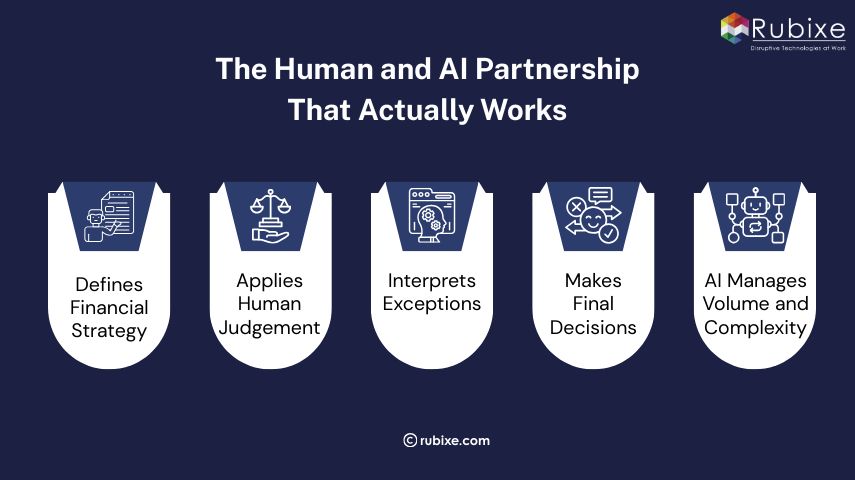
The Human and AI Partnership That Actually Works
-
Defines Financial Strategy: Finance professionals set goals, policies, and direction, ensuring AI operates within clear business and regulatory boundaries.
-
Applies Human Judgement: Critical thinking and contextual understanding guide decisions that AI alone cannot make.
-
Interprets Exceptions: Humans assess unusual cases, edge scenarios, and nuances that require experience and insight.
-
Makes Final Decisions: Accountability and responsibility remain firmly with finance leaders and teams.
-
AI Manages Volume and Complexity: AI processes large datasets, complex transactions, and repetitive tasks with speed and accuracy, reducing the risk of manual errors.
Why Some AI Finance Implementations Fail
Not all AI deployments succeed, and failures usually trace back to weak foundations. When data quality is ignored, processes lack clarity, teams aren’t ready, or governance is missing, even advanced artificial intelligence for finance falls short. Its effectiveness depends entirely on the strength of the systems, structures, and discipline supporting it.
The Role of AI Readiness in Error-Free Finance
-
Data Accuracy and Structure: Ensure financial data is clean, consistent, and well-organized so AI models can deliver reliable insights and predictions.
-
System Integration: Assess how AI will connect with existing finance systems, workflows, and tools to avoid disruptions or data silos.
-
Risk Tolerance: Define acceptable levels of financial, operational, and regulatory risk before introducing AI-driven decisions.
-
Compliance Requirements: Evaluate regulatory obligations and reporting standards to ensure AI usage aligns with legal and audit expectations.
How AI Consulting Strengthens AI for Finance
Strategic AI consulting ensures finance teams focus on the right use cases, align AI initiatives with regulatory and audit requirements, and embed security and governance from the start. It also enables responsible scaling as adoption grows. Without expert guidance, even the most powerful AI tools struggle to deliver meaningful results.
How We Approach AI for Finance at Our Company
-
AI Consulting and Readiness Audits: We evaluate data quality, processes, and risk factors to ensure finance AI is implemented with clarity and confidence.
-
Secure, Scalable AI Services: Our AI solutions are built to grow with your finance operations while maintaining reliability and performance.
-
Domain-Aligned AI Staffing: Experienced finance and AI professionals work together to ensure models align with real-world financial workflows and decision-making.
-
Strong AI Cybersecurity Frameworks: Security, governance, and compliance are embedded at every layer to protect sensitive financial data.
Trust, Transparency, and Explainability Matter
Finance teams need to understand why AI flags an issue, not just that it does. Effective Artificial Intelligence for Finance is explainable, auditable, secure, and compliant, ensuring every insight can be trusted and validated. In the end, trust, not technology, is the true currency of financial transformation.
Will AI for Finance Ever Eliminate All Errors?
-
Repetitive Errors: AI consistently handles routine calculations and checks, removing mistakes that arise from repeated manual work.
-
Fatigue-Driven Mistakes: Unlike humans, AI doesn’t tire, lose focus, or rush decisions, maintaining accuracy across long operating hours.
-
Inconsistency: AI applies the same rules and logic every time, ensuring uniform treatment across transactions and reports.
-
Delayed Detection: Continuous monitoring allows AI to spot anomalies early, before small issues escalate into major problems.
Artificial intelligence for finance doesn’t promise perfection; it delivers control, clarity, and confidence. As financial mistakes grow more costly, preventing most errors is no longer optional but a responsibility. The future belongs to organizations that combine human judgment with machine precision and act before mistakes turn into lessons.