












AI Implementation Challenges in Industry: A Practical Guide for Businesses
Understand the main challenges of using AI in industry, including data problems, high costs, system setup issues, and training employees to use AI tools.
Why do so many AI projects fail even after significant investment?
While Artificial Intelligence is transforming industries, most organizations struggle to move from experimentation to real business impact. The issue is not AI itself , but data readiness, system complexity, and organizational alignment.
Implementing AI in industry requires more than technology. It requires transformation across data, infrastructure, people, and strategy.
Why AI Implementation Is Difficult in Real Industries
Businesses adopt AI to automate processes, predict outcomes, reduce operational costs, and improve efficiency. That’s why AI in industry is not just a technology project; it’s a transformation initiative. Many organisations discover this only after they begin.
Data Readiness Is Often Overestimated
-
Data Quality Over Data Quantity: Industrial organisations often generate vast amounts of data, but AI requires data that is clean, accurate, and reliable, not just abundant.
-
Consistency and Standardisation: For AI models to perform effectively, data must be consistently formatted and structured across systems, machines, and processes.
-
Sufficient Historical Depth: AI systems require an adequate amount of historical data to identify patterns, trends, and anomalies with confidence.
-
Problem-Relevant Data: Data must directly relate to the specific business or operational problem being addressed, rather than being collected without a clear purpose.
-
Fragmented Legacy Systems: Much industrial data remains siloed across older systems, making integration and data access complex and time-consuming.
Legacy Systems Don’t Play Well with AI
Most industries were not built with AI in mind but evolved through layers of legacy systems, custom software, and manual processes. Integrating AI into such environments is rarely seamless, with challenges like poor data sharing, outdated infrastructure, limited APIs, and heavy reliance on workarounds. Without careful planning, AI remains an isolated tool rather than a connected capability, limiting its impact and slowing adoption across the organisation.
Talent Gaps and Skill Mismatch
-
Need for Multidisciplinary Expertise: AI in industry requires a rare combination of domain knowledge, data science, engineering, and business strategy skills that are rarely found in a single team.
-
Domain AI Knowledge Gap: Domain experts deeply understand operations and processes, but often lack familiarity with AI capabilities and limitations.
-
Technical Operational Disconnect: Data scientists and engineers may excel at building models but struggle to apply them effectively within complex industrial environments.
-
Leadership Feasibility Blind Spots: Business leaders understand strategic goals but may lack clarity on what is technically and operationally feasible with AI.
-
Misaligned Expectations and Outcomes: These gaps result in unrealistic timelines, poorly defined project scopes, and frustration across teams.
-
Why Hiring Alone Isn’t Enough: Simply recruiting AI talent does not solve the problem; success requires cross-functional alignment, clear governance, and ongoing guidance.
-
Importance of Structured Collaboration: When teams are supported with the right frameworks and leadership, AI initiatives move from experimentation to sustainable industrial impact.
Cultural Resistance and Fear of Change
Employees are more likely to adopt AI systems when leadership communicates how automation supports productivity rather than replacing roles completely.
Unclear Use Cases and Misaligned Expectations
-
Solving the Wrong Problems: Many AI initiatives fail not because the technology is ineffective, but because it is applied to problems where AI adds little or no real value.
-
Over-Automation Attempts: Trying to automate too many processes at once increases complexity, stretches resources, and reduces the chances of meaningful success.
-
Trend-Driven Adoption: Adopting AI because it is fashionable rather than necessary often leads to solutions searching for problems.
-
Unrealistic ROI Expectations: Expecting immediate returns from complex AI initiatives ignores the time required for data preparation, learning, and optimization.
-
Lack of Clear Success Metrics: Launching AI pilots without defined goals or measurable outcomes makes it difficult to evaluate impact or justify scaling.
-
Importance of Strategic Focus: AI delivers the greatest value in the industry when initiatives are focused, measurable, and tightly aligned with core business priorities.
Scaling AI Beyond Pilot Projects
Launching a proof of concept is only the first step; scaling AI across departments, plants, or regions presents far greater challenges. Many organisations struggle with infrastructure limitations, inconsistent data pipelines, a lack of standardised deployment processes, and weak monitoring or governance. As a result, AI initiatives often plateau: solutions that worked in controlled pilots expose hidden gaps when scaled into real-world operations.
Ethical, Security, and Compliance Concerns
-
Data Privacy and Ownership: Ensuring that sensitive operational and customer data is handled responsibly is critical, with clear policies on access, storage, and usage.
-
Model Transparency and Explainability: AI decisions must be understandable to stakeholders, enabling trust, validation, and accountability in industrial processes.
-
Bias in Decision Outcomes: Unchecked biases in AI models can lead to unfair or inaccurate outcomes, impacting efficiency, compliance, and employee trust.
-
Cybersecurity Vulnerabilities: AI systems introduce new attack surfaces that must be secured against hacking, manipulation, or data breaches.
-
Regulatory Compliance: Organisations in regulated industries must ensure AI systems meet legal standards, are auditable, and align with industry-specific regulations.
-
Mitigating Long-Term Risk: Ignoring these considerations can not only halt AI adoption but also create operational, legal, and reputational risks over time.
Measuring Real Business Impact
AI success is often measured by technical metrics like model accuracy or processing speed, but leadership focuses on tangible business outcomes. The real challenge is linking AI outputs to measurable impact, such as cost reduction, productivity gains, quality improvement, risk mitigation, and customer satisfaction. Without a clear demonstration of value, AI initiatives risk losing executive support and struggling to secure long-term investment.
Why These Challenges Create a Quiet Competitive Gap
Here’s the subtle reality many leaders don’t immediately see: While some organisations hesitate due to these challenges, others work through them systematically.
Over time, this creates a widening gap. Companies that solve the hard parts of AI in industry build operational intelligence that compounds. Those who delay remain stuck in reactive decision-making. The fear isn’t that competitors are “better”; it’s that they are learning faster.
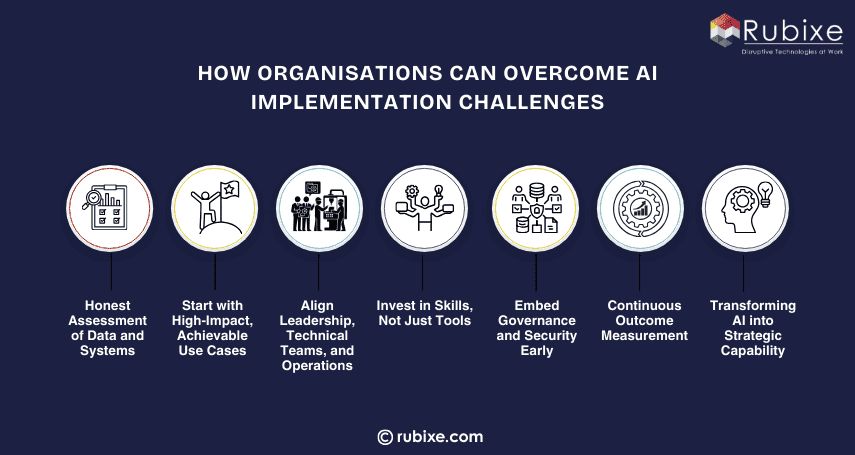
How Organisations Can Overcome AI Implementation Challenges
-
Honest Assessment of Data and Systems
Evaluate the quality of your data, existing systems, and overall AI readiness to identify gaps and opportunities before starting any initiative. -
Start with High-Impact, Achievable Use Cases
Focus on projects that deliver measurable value quickly, building confidence and demonstrating the potential of AI within the organisation. -
Align Leadership, Technical Teams, and Operations
Ensure cross-functional collaboration so that strategic goals, technical feasibility, and operational realities are all addressed from the outset. -
Invest in Skills, Not Just Tools
Equip teams with the knowledge and expertise to use AI effectively, rather than relying solely on software or platforms. -
Embed Governance and Security Early
Integrate data governance, compliance, and cybersecurity measures from the beginning to reduce risk and ensure ethical AI use. -
Continuous Outcome Measurement
Regularly track and evaluate results to learn, refine, and scale AI initiatives, turning experimentation into sustained business impact. -
Transforming AI into Strategic Capability
This structured approach moves AI from a risky experiment to a reliable, value-driving capability across the organisation.
The Role of the Right AI Partner
Many organisations underestimate the value of guidance during AI adoption. The right AI partner goes beyond delivering models or tools; they help identify realistic opportunities, prepare data and infrastructure, align AI with business strategy, address workforce readiness, and build secure, scalable solutions. We support organisations navigating AI in industry by combining expertise in AI consulting, AI staffing, AI services, AI readiness audits, AI cybersecurity, and automation. The focus is not just on speed, but on confidence, sustainability, and long-term value.
The Hidden Cost of Delaying AI Adoption
-
Lost Insights from Unused Data: Delaying AI adoption means valuable data remains untapped, preventing organisations from uncovering trends, anomalies, or actionable insights.
-
Missed Opportunities for Process Optimisation: Without AI, processes continue to operate at current efficiency levels, leaving potential productivity gains and cost savings unrealized.
-
Slowed Workforce Upskilling: Postponing AI adoption delays the development of employee skills needed to work effectively with intelligent systems, impacting long-term competitiveness.
-
Reduced Strategic Flexibility: Organisations that lag in AI adoption struggle to respond quickly to market shifts, operational challenges, or emerging business opportunities.
-
Relevance in an Increasingly Complex Environment: AI is not just a trend it enables companies to stay agile, competitive, and relevant as industrial operations and markets become more complex.
Implementing AI in industry is complex, but not impossible. The challenges around data, systems, skills, and scaling are real - but solvable with the right strategy.
Organizations that approach AI with preparation and structure will build long-term competitive advantage, while others risk falling behind in operational intelligence.