




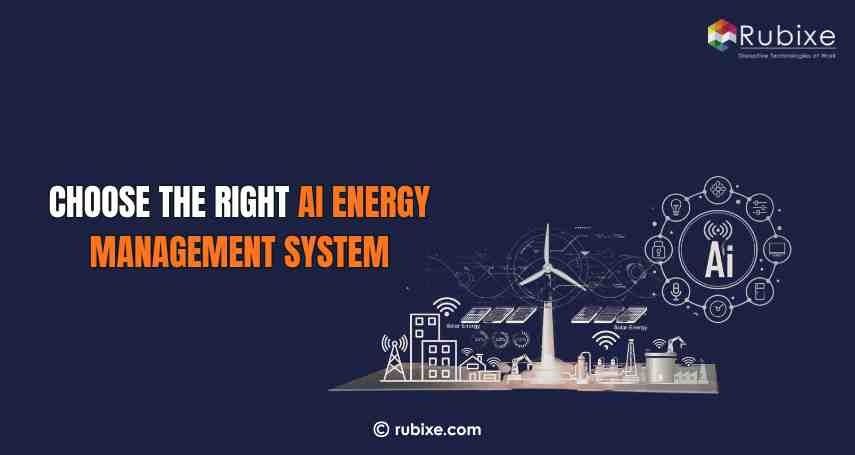
Choosing the Right AI Energy Management System
Choosing the right AI energy management system helps businesses reduce energy costs, improve efficiency, enable automation, and integrate with existing systems.
Are you paying more for energy every quarter, even though production hasn’t increased?
This is not uncommon. Many businesses see rising utility bills without a clear reason. Machines run longer than necessary. HVAC systems operate at fixed settings regardless of occupancy. Peak demand penalties quietly inflate costs. Most organizations collect energy data, but they don’t convert it into action.
This is where an AI energy management system becomes essential.
But here’s the real challenge: not all systems are equal. Some provide dashboards. Some provide reports. Only the right system provides intelligence and control.
If you are considering investing in one, this guide will help you choose correctly.
Understanding What an AI Energy Management System Really Does
An AI energy management system goes beyond traditional monitoring. It doesn’t just record energy consumption, it analyzes behavior, predicts patterns, and recommends optimization actions automatically.
Traditional energy monitoring systems:
-
Show usage reports
-
Highlight historical data
-
Require manual review
-
React after costs rise
AI-driven systems:
-
Detect anomalies instantly
-
Learn usage behavior over time
-
Predict future demand
-
Suggest cost-saving adjustments
-
Automate energy optimization decisions
Think of it as the difference between a thermometer and a smart climate control system. One measures. The other acts.
Why Businesses Are Moving Toward AI Energy Optimization
Energy is often one of the largest controllable expenses in operations. For manufacturing plants, commercial facilities, and data centers, energy can represent 15–30% of operating costs.
Now multiply that across multiple facilities.
This is why smart energy management solutions are no longer optional—they are strategic.
AI energy optimization helps businesses:
-
Reduce peak demand charges
-
Identify idle equipment energy waste
-
Prevent inefficient runtime patterns
-
Improve equipment lifespan
-
Support sustainability goals
It transforms energy from a fixed cost into a manageable variable.
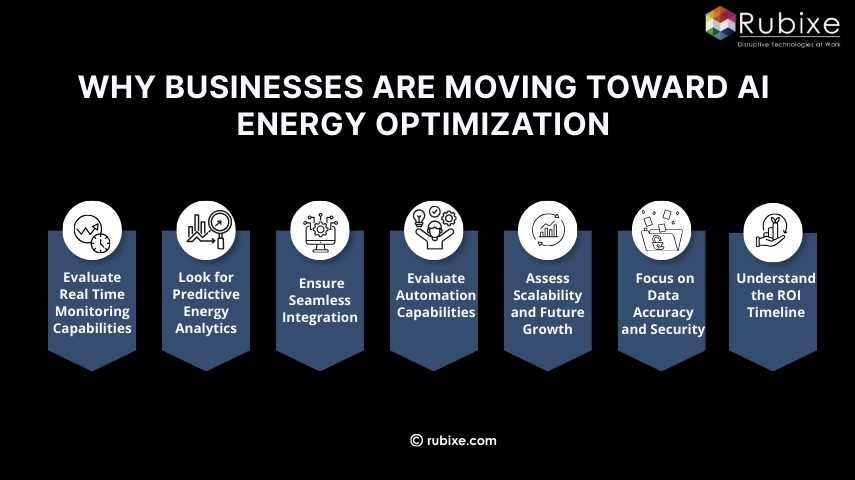
Step 1: Evaluate Real-Time Monitoring Capabilities
The first requirement of any serious AI energy management system is real-time visibility.
If the system provides data only after hours or days, optimization becomes delayed. Real-time energy monitoring allows immediate detection of:
-
Unexpected power spikes
-
Equipment malfunction
-
After-hours consumption
-
Sudden load imbalances
For example, if a compressor continues running during non-production hours, real-time alerts can notify facility managers immediately instead of discovering it at month-end billing.
Ask vendors:
-
Does the system provide live energy dashboards?
-
Are alerts automated?
-
Can it track energy at equipment-level granularity?
Without real-time insight, intelligence is limited.
Step 2: Look for Predictive Energy Analytics
Data alone doesn’t create value. Prediction does.
A strong AI energy management system uses predictive energy analytics to forecast:
-
Peak load periods
-
Seasonal demand shifts
-
Equipment stress cycles
-
Maintenance-related inefficiencies
Predictive analytics turns energy management from reactive correction into proactive prevention.
If the system cannot forecast trends, it’s simply reporting, not optimizing.
Step 3: Ensure Seamless Integration
An AI energy system should integrate smoothly with existing infrastructure, and this is where strong AI integration services make a critical difference.
Your business may already have:
-
IoT sensors
-
Smart meters
-
Building management systems
-
ERP platforms
-
Industrial control systems
If integration requires major restructuring, downtime increases, and implementation becomes expensive. Professional AI integration services ensure the new system connects seamlessly without disrupting operations.
Look for systems that:
-
Offer API compatibility
-
Support multiple hardware standards
-
Scale across facilities
-
Integrate with cloud environments
The stronger the integration framework, the faster the ROI and long-term operational efficiency.
Step 4: Evaluate Automation Capabilities
AI becomes powerful when it acts independently.
Some energy systems identify issues but require manual corrections. That limits impact.
A well-designed AI energy management system should automate:
-
HVAC adjustments based on occupancy
-
Equipment scheduling
-
Load balancing
-
Lighting control
-
Demand response participation
For example, during peak tariff hours, the system can automatically reduce non-essential loads without affecting productivity.
Automation removes human delay and increases efficiency and consistency.
Step 5: Assess Scalability and Future Growth
Your business will grow. Your energy system must grow with it.
Ask:
-
Can the system support multiple locations?
-
Can it handle increased equipment load?
-
Is it cloud-scalable?
-
Does it allow modular upgrades?
Choosing a rigid platform may lead to replacement within a few years.
A scalable AI energy management system protects your investment.
Step 6: Focus on Data Accuracy and Security
Energy optimization decisions rely on accurate data.
If sensors are unreliable or data streams are inconsistent, AI predictions will be flawed.
Also, energy usage data reflects operational behavior. Security is critical.
Ensure the system provides:
-
Encrypted cloud storage
-
Secure API connections
-
Role-based access control
-
Compliance with data standards
Security and accuracy should not be optional features.
Step 7: Understand the ROI Timeline
Many businesses hesitate because they see AI systems as expensive investments.
But the real question is: how quickly can it pay for itself?
Most AI energy management systems deliver measurable ROI within 12 to 24 months when properly implemented.
Savings come from:
-
Reduced demand penalties
-
Lower energy waste
-
Optimized runtime schedules
-
Extended equipment lifespan
-
Improved maintenance planning
Calculate current annual energy expenses and estimate a 10 -15% reduction. That gives a realistic savings projection.
Common Mistakes to Avoid
1. Choosing the Cheapest Option
Low-cost systems often lack predictive intelligence and automation. Short-term savings lead to long-term inefficiencies.
2. Ignoring User Experience
If dashboards are complicated, teams won’t use them. The system should present clear, actionable insights, not overwhelming data charts.
3. Underestimating Change Management
Implementing AI energy optimization requires internal alignment. Teams must trust the system and adopt recommendations.
4. Not Defining Clear Goals
Before implementation, define objectives:
-
Reduce energy costs by 15%
-
Lower peak demand charges
-
Improve sustainability ratings
-
Achieve carbon reduction targets
Clear goals ensure measurable outcomes.
Sustainability and Compliance Benefits
Beyond cost reduction, AI energy management systems support sustainability initiatives.
They help businesses:
-
Track carbon footprint
-
Meet ESG reporting standards
-
Reduce environmental impact
-
Improve energy transparency
In many regions, regulatory pressure around energy efficiency is increasing. AI provides compliance support alongside savings.
The Strategic Advantage
Energy management is no longer just a facilities function, it’s a business strategy.
Companies that implement AI-driven energy optimization gain:
-
Predictable operational costs
-
Better budgeting accuracy
-
Improved equipment performance
-
Competitive advantage through efficiency
While competitors react to rising energy prices, AI-enabled organizations adapt automatically.
Why Choose Rubixe as Your AI Energy Management Partner
Choosing the right AI energy management system is as much about technology as it is about partnership. Rubixe combines deep technical expertise, real-world experience, and a proven implementation framework that ensures measurable results.
Here’s why Rubixe stands out:
1. End-to-End AI Expertise
It has a strong track record of designing, deploying, and optimizing AI solutions across industries. From strategy and assessment to implementation and ongoing support, we manage the entire lifecycle of your energy optimization project.
2. Customized Solutions, Not One-Size-Fits-All
We understand that every facility, factory, or building has unique energy patterns. It builds tailored AI energy management systems that align with your operations, infrastructure, and business goals for maximum results.
3. Real-Time Insights and Predictive Analytics
Our AI platform goes beyond basic reporting. With real-time visibility, predictive forecasting, and automated optimization, you get intelligence that drives action, not just information.
4. Proven Cost and Efficiency Outcomes
It focuses on measurable performance. Clients see reductions in energy waste, peak demand charges, and operational inefficiencies. Our approach delivers ROI within months, not years.
5. Seamless Integration and Scalable Architecture
Whether you operate a single facility or a global enterprise, our systems integrate smoothly with your existing infrastructure, including IoT devices, smart meters, and building management systems, without costly overhauls.
Make the Right Choice
Choosing the right AI energy management system is about long-term operational intelligence, not just monitoring software.
The right solution will:
-
Provide real-time visibility
-
Deliver predictive insights
-
Automate energy optimization
-
Integrate seamlessly
-
Scale with your growth
-
Generate measurable ROI
Energy is one of the few controllable expenses in business. When managed intelligently, it becomes a strategic advantage rather than a cost burden.
If your organization is serious about reducing operational expenses, improving sustainability, and gaining smarter control over energy usage, now is the time to evaluate a robust AI energy management system.
The question is not whether you need AI for energy optimization.
The question is whether you are ready to stop paying for inefficiency.
Choosing the right AI energy management system helps businesses reduce energy costs, improve efficiency, enable automation, and integrate with existing systems.