
















What is API Automation?
What API Automation is, how it works, its tools, benefits, integration, testing, development, deployment, workflow, and process in modern software systems.

Modern businesses run on interconnected systems, websites, mobile apps, cloud platforms, payment gateways, CRMs, analytics tools, and more. Each of these systems communicates through APIs, quietly powering everyday digital operations. As organizations scale, manually testing and managing these connections becomes inefficient, error-prone, and costly. This is where API automation emerges as a critical capability, especially when combined with AI automation solutions that enhance speed, intelligence, and reliability.
For technology leaders, product teams, and operations managers, API automation delivers faster releases, stable integrations, and seamless user experiences. Whether launching a SaaS platform, managing fintech transactions, or running e-commerce infrastructure, automated API workflows ensure that systems communicate correctly under real-world conditions. Businesses that invest early in automation gain agility, reduce downtime risk, and improve customer trust - all essential for competitive growth.
What is an API
An API (Application Programming Interface) is a set of rules that allows different software systems to communicate with each other. It acts as a messenger that sends requests, retrieves data, and delivers responses between applications.
Every time a user logs into an app using social media credentials, checks real-time weather inside a travel app, or completes an online payment, APIs are working behind the scenes.
Key characteristics of APIs:
-
They enable system-to-system communication
-
They expose specific functions or data securely
-
They standardize how applications interact
-
They support integration across platforms and services
Types of APIs commonly used in business environments include:
-
REST APIs: Widely used for web services due to simplicity and scalability
-
SOAP APIs: Structured protocols often used in enterprise systems
-
GraphQL APIs: Allow clients to request precise data sets
-
Internal APIs: Used within an organization’s systems
-
Third-party APIs: Provided by external services such as payment gateways or mapping tools
APIs form the backbone of digital ecosystems. When they fail, entire services can break. This makes reliable testing and monitoring essential.
What is API Automation
API automation refers to the process of automatically testing, validating, and monitoring APIs without manual intervention. Instead of engineers repeatedly sending requests and verifying responses by hand, automated scripts simulate real interactions at scale.
Automation covers multiple aspects:
-
Functional testing (Does the API work as expected?)
-
Performance testing (Can it handle heavy traffic?)
-
Security validation (Is data protected?)
-
Integration testing (Do systems communicate correctly?)
-
Regression testing (Do updates break existing functionality?)
When powered by AI automation solutions, API automation becomes more intelligent. AI can analyze patterns, detect anomalies, generate test cases, prioritize risks, and adapt to changes in real time.
For example, if an e-commerce platform updates its checkout service, automated tests can instantly verify pricing accuracy, payment processing, inventory updates, and order confirmation workflows. This prevents faulty releases that could disrupt revenue.
Key Benefits of API Automation
Organizations across industries adopt API automation because it delivers measurable operational and financial advantages.
-
Faster Development Cycles
Automated testing runs continuously during development, enabling teams to release updates quickly without compromising stability. Continuous integration pipelines rely heavily on API automation.
-
Improved Reliability
Manual testing can miss edge cases. Automated scripts execute thousands of scenarios consistently, reducing the likelihood of failures in production environments.
-
Cost Efficiency
Although initial setup requires investment, automation reduces long-term testing costs by minimizing manual effort and preventing expensive downtime incidents.
-
Early Defect Detection
Issues identified early in the development process are easier and cheaper to fix. Automated tests catch problems before they reach customers.
-
Scalability
As applications grow, the number of integrations increases exponentially. Automation handles this complexity without proportional growth in manpower.
-
Enhanced Security Monitoring
Automated checks can identify vulnerabilities, unauthorized access patterns, and data exposure risks.
-
Better Customer Experience
Stable integrations lead to smoother transactions, faster response times, and fewer service interruptions.
When combined with AI automation solutions, businesses gain predictive insights that help prevent issues rather than reacting after failures occur.
Use Cases of API Automation in Business
API automation supports a wide range of operational scenarios across industries.
-
E-commerce Platforms
Online stores rely on APIs to connect inventory systems, payment gateways, shipping providers, and marketing tools.
Automation enables:
-
Real-time stock updates
-
Order processing workflows
-
Fraud detection checks
-
Customer notifications
Without automation, managing thousands of daily transactions would be impractical.
-
Financial Services
Banks and fintech companies use APIs for payments, identity verification, risk analysis, and regulatory reporting.
Automated API workflows support:
-
Instant payment processing
-
Compliance checks
-
Transaction monitoring
-
Account synchronization
Reliability and security are especially critical in this sector.
-
SaaS and Cloud Platforms
Software-as-a-service products integrate with numerous third-party tools. API automation ensures seamless data exchange between systems.
Typical uses include:
-
User provisioning across platforms
-
Subscription management
-
Analytics data aggregation
-
System health monitoring
4. Healthcare Systems
Hospitals and digital health platforms exchange patient records, lab results, insurance information, and appointment data through APIs.
Automation helps maintain accuracy, timeliness, and regulatory compliance while reducing administrative workload.
5. Internal Enterprise Operations
Organizations automate internal processes such as HR onboarding, payroll integration, reporting dashboards, and supply chain coordination through API workflows.
This reduces delays and eliminates manual handoffs between departments.
Role of AI Automation Solutions in API Automation
 Traditional automation follows predefined rules. AI-driven automation adds intelligence, enabling systems to adapt, learn, and optimize.
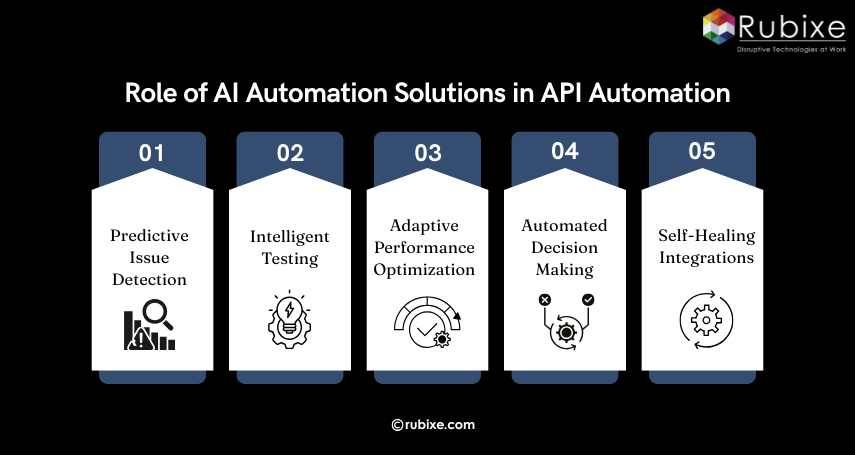
AI automation solutions enhance API automation in several ways.
1. Predictive Issue Detection
Machine learning models analyse historical performance data to anticipate failures before they occur. Systems can reroute traffic or trigger alerts proactively.
2. Intelligent Testing
AI can generate test cases automatically based on usage patterns, identifying edge cases that manual testers might miss.
3. Adaptive Performance Optimization
AI systems adjust resource allocation dynamically to maintain speed during peak loads.
4. Automated Decision Making
In complex workflows, AI can determine the best action based on context - for example, approving transactions, flagging anomalies, or prioritizing requests.
5. Self-Healing Integrations
If an API endpoint changes or fails, AI systems can attempt alternative routes or corrective actions without waiting for human intervention.
This level of autonomy is increasingly important for large enterprises managing hundreds of integrations.
Best Practices for Implementing API Automation
Successful implementation requires strategic planning, not just tools.
-
Design APIs for Automation
Well-structured APIs with consistent naming, documentation, and error handling are easier to automate and maintain.
Poorly designed interfaces lead to fragile automation scripts.
-
Use Continuous Testing
Automation should run throughout the development lifecycle, not only before release. Continuous testing identifies issues early when they are cheaper to fix.
-
Prioritize Security
APIs expose critical functionality. Automated security checks should include authentication validation, access control testing, and vulnerability scanning.
-
Monitor Performance in Real Time
Automation should include ongoing monitoring to detect latency spikes, failed requests, or abnormal behaviour.
-
Maintain Documentation
As systems evolve, documentation must stay current. Clear specifications reduce integration errors and onboarding time for new teams.
-
Combine Human Oversight with Automation
Automation improves efficiency but should not eliminate governance. Critical decisions still require human review, especially in regulated industries.
Organizations seeking enterprise-grade deployment often partner with automation specialists, who provide advanced digital and AI-driven transformation services.
Future Trends in API Automation
Several technological shifts are shaping the next generation of API automation.
-
AI-Driven Autonomous Systems
Future platforms will manage integrations with minimal human intervention. Systems will monitor themselves, optimize performance, and resolve issues automatically.
-
Event-Driven Architecture
Organizations are moving from request-response models to real-time event streams. Automation tools must handle continuous data flows efficiently.
-
Low-Code and No-Code Integration Platforms
Business users increasingly build workflows without deep programming knowledge. Visual automation tools are expanding access beyond technical teams.
-
Enhanced Security Automation
With rising cyber threats, automated threat detection using AI and response will become standard in API ecosystems.
-
Observability and Analytics
Advanced monitoring tools provide deep insights into API behaviour, helping organizations optimize performance and user experience.
Why API Automation Matters for Digital Transformation
Digital transformation initiatives depend on seamless system integration. APIs connect customer interfaces, internal operations, partners, and data platforms.
Without automation, maintaining these connections becomes unsustainable as complexity grows.
API automation enables organizations to:
-
Deliver services faster
-
Improve reliability and uptime
-
Reduce operational risk
-
Support innovation at scale
-
Integrate emerging technologies efficiently
When powered by AI automation solutions, these capabilities expand further, enabling intelligent operations that adapt in real time.
API automation has become a cornerstone of modern digital operations. By automatically validating integrations, performance, and security, it ensures that complex systems function reliably at scale. Businesses leveraging AI automation solutions gain additional advantages through intelligent testing, predictive insights, and adaptive monitoring.
For technology-driven organizations, API automation reduces operational risk, accelerates product delivery, and enhances customer experience. As digital ecosystems grow more interconnected, automation will play an increasingly central role in sustaining business continuity and competitive advantage.
Companies looking to streamline integrations, improve software quality, and enable scalable growth should consider expert guidance to implement advanced automation frameworks tailored to their needs.