



When Businesses Need AI Adoption Services
Businesses turn to AI adoption services to manage operational gaps, improve data use, support scaling, and align technology investments with growth goals.
Artificial intelligence has transformed from an emerging technology into a core driver of business performance. Companies now rely on AI to enhance decision-making, automate processes, and create new value. Integrating AI capabilities demands more than selecting tools, it requires careful planning, technical alignment, and change management. AI adoption services provide the structured expertise needed to evaluate organizational readiness, craft tailored strategies, and implement solutions that deliver measurable results.
For growing enterprises facing resource constraints or complex integrations, partnering with specialists often proves essential. Let’s outline the clear indicators that signal when your business should engage AI adoption services, supported by current industry data and practical guidance.
What is AI Adoption?
AI adoption refers to the strategic process by which businesses integrate artificial intelligence technologies into their core operations, workflows, and decision-making to drive efficiency, innovation, and competitive advantage. It goes beyond simply purchasing AI tools or running isolated pilots; true adoption embeds AI across functions such as automating routine tasks, enhancing data analysis, personalizing customer experiences, or enabling predictive insights, while aligning with overall business goals.
This involves assessing readiness, selecting appropriate solutions (from machine learning to generative and agentic AI), upskilling teams, establishing governance for ethics and compliance, and scaling implementations for measurable impact. According to recent industry insights, successful AI adoption focuses on people as much as technology, turning experimentation into enterprise-wide transformation that boosts productivity and unlocks new value.
Understanding AI Adoption Services
AI adoption services encompass a range of professional support designed to help organizations integrate artificial intelligence into their core processes. This goes beyond simply buying AI tools; it involves a structured approach to evaluating needs, building infrastructure, training teams, and measuring outcomes.
Providers typically offer assessments to gauge your current tech maturity, custom roadmaps for implementation, and ongoing support to address risks like data privacy or ethical concerns.
Think of it as a bridge between ambition and execution. For instance, services might include AI readiness audits, where experts review your data quality and systems compatibility, or staffing solutions to bring in skilled data scientists temporarily. The goal is to ensure AI delivers tangible value, such as improved efficiency or new revenue streams, without overwhelming your internal resources. Businesses often turn to these services when they're excited about AI's potential but unsure how to start or scale it safely.
Key Signs Your Business Needs AI Adoption Services
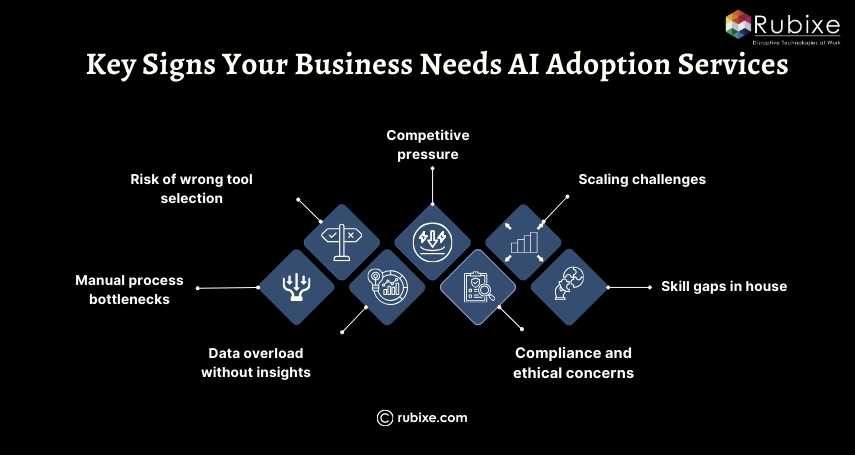
Not every company requires outside help to dip its toes into AI, but certain red flags suggest it's time to bring in professionals.
One clear indicator is when manual processes are bottlenecking growth. If your team spends hours on repetitive tasks like data entry, inventory tracking, or customer queries, AI could automate these, freeing up time for strategic work. But without expertise, you might end up with mismatched tools that create more problems than they solve.
Another sign is data overload without insights. Many businesses collect vast amounts of information but struggle to analyze it effectively. If you're sitting on untapped data that could inform better decisions - like predicting market trends or personalizing customer experiences, AI adoption services can help build the analytics frameworks you need.
Similarly, if competitors are pulling ahead with AI-driven innovations, such as chatbots for 24/7 support or predictive maintenance in manufacturing, delaying could erode your market share.
Scaling challenges also point to the need for expert guidance. Small and medium-sized enterprises (SMEs) often face this when trying to expand without proportionally increasing headcount. AI can enable that growth, but integrating it requires skills in areas like machine learning or cybersecurity that in-house teams might lack.
Finally, if regulatory compliance or ethical issues around AI (like bias in algorithms) keep you up at night, services focused on governance can provide the safeguards to move forward confidently.
Benefits of Engaging AI Adoption Services
Partnering with AI adoption services isn't just about fixing problems, it's about unlocking opportunities. One major advantage is accelerated implementation. Experts can cut through the trial-and-error phase, helping you deploy AI solutions in months rather than years. This leads to quicker returns, such as a 30% reduction in operational costs for companies with high AI adoption.
These services also promote data-driven decision-making. By integrating AI into business functions like sales forecasting or supply chain optimization, businesses gain real-time insights that boost accuracy and agility.
In healthcare, for example, AI adoption has improved patient outcomes through predictive diagnostics, while in retail, it enhances personalization to drive sales.
Moreover, professional support minimizes risks. Services often include ethical AI frameworks to address biases and ensure compliance with regulations like GDPR. This builds trust with customers and stakeholders.
For SMEs, the cost savings are particularly appealing - AI can handle more work without expanding teams, allowing for scalable growth. Overall, businesses that use these services report higher innovation rates and a stronger competitive edge in their industries.
Overcoming Common Challenges with Professional Support
AI adoption isn't without hurdles, and that's precisely why services exist. A common pitfall is poor data quality; surveys show that 45% of executives cite data accuracy and bias as barriers. Adoption experts tackle this by conducting audits and cleaning datasets, ensuring your AI models are reliable from the start.
Talent gaps are another issue. 42% of leaders note a lack of expertise as a roadblock. Services bridge this through staffing or training programs, upskilling your workforce without long-term hires. AI adoption challenges like meshing AI with legacy systems, are addressed via customized workflows that avoid disruptions.
Financial justification can be tricky too, with 42% struggling to prove ROI. Providers help by setting clear metrics and piloting small-scale projects to demonstrate value quickly. Privacy concerns (40%) are mitigated with robust security protocols. By handling these obstacles, AI adoption services turn potential setbacks into smooth transitions, helping businesses realize AI's full potential.
Current Trends and Statistics in AI Adoption
The AI landscape is evolving rapidly, with adoption rates soaring. In 2025, 78% of global companies integrated AI into daily operations, up from previous years. By the end of 2026, organization-wide AI use in professional services nearly doubled to 40%. Globally, generative AI usage hit 16.3% of the population, with countries like the UAE leading at 64%.
A key trend is the shift toward agentic AI, where systems not only generate content but act autonomously. Over 62% of companies are experimenting with agents, and 23% are scaling them. Physical AI, combining AI with robotics, is also gaining traction, with 58% of firms using it at least limitedly. However, governance lags; only one in five has mature models for agentic AI oversight.
Industries like manufacturing (12% adoption rate) and retail (4%) show varied progress, but overall, AI's annual growth rate is projected at 36.6% through 2030. These stats underscore the urgency: businesses adopting AI now are seeing productivity boosts and cost savings, while laggards risk falling behind.
How to Select the Right AI Adoption Service Provider
Choosing a right AI adoption provider starts with assessing their expertise. Look for firms with proven track records in your industry. Check for comprehensive offerings, including readiness assessments, implementation, and post-launch support.
Evaluate their approach to ethics and security, reputable providers prioritize transparent AI and compliance. Client testimonials and case studies can reveal real results, such as reduced costs or improved efficiency. Cost transparency is key; opt for flexible models like project-based fees over long-term contracts.
Finally, ensure they emphasize people-first strategies, including employee training to foster adoption. A good fit will align with your business goals, offering scalable solutions that grow with you.
In a world where AI is reshaping industries, knowing when to seek AI adoption services can position your business for long-term success.
If you're spotting those signs in your operations, it might be time to explore how expert guidance in AI adoption services can transform your approach. Reach out to a trusted AI provider today to start your journey toward smarter, more efficient operations.