










How to Create an AI Adoption Strategy for Your Business
Learn how to implement a step-by-step AI adoption strategy for your business to enhance efficiency, lower costs, and improve team collaboration effectively

Without a clear AI adoption plan, companies risk wasting resources and missing opportunities. Many businesses invest in AI tools but struggle to translate them into measurable outcomes because their approach lacks structure and alignment with business objectives.
A robust AI Adoption strategy ensures that your initiatives deliver tangible value, reduce risks, and position your organization for scalable growth. This guide walks you through practical steps, key considerations, and best practices to implement AI effectively across your business.
What Is an AI Adoption Strategy?
An AI Adoption strategy is a roadmap that defines how an organization identifies, implements, and scales AI initiatives to achieve business objectives. It provides a clear framework for decision-making, resource allocation, and prioritization of projects.
By aligning technology adoption with business goals, organizations can avoid fragmented efforts, reduce inefficiencies, and ensure that AI delivers measurable impact across teams.
Why AI Adoption Matters for Business Growth
AI has the potential to transform business operations, but without a structured plan, companies risk misalignment between AI initiatives and strategic goals. Effective adoption reduces operational waste, improves decision-making, and creates competitive advantages.
Investing in a structured strategy explains why AI Adoption matters, helping leadership prioritize initiatives, allocate resources effectively, and ensure compliance with regulatory standards.
Conducting an AI Readiness Assessment
Before implementing AI, it’s critical to understand your current capabilities and identify gaps. A comprehensive AI readiness audit evaluates technology infrastructure, data quality, and organizational preparedness.
Evaluating Current Data and Infrastructure:
High-quality, accessible data is the backbone of successful AI adoption. Assess your systems, storage, and integration capabilities to ensure that AI models will have reliable inputs.
Identifying Skill Gaps in Your Team:
AI initiatives require expertise in data science, engineering, and analytics. Understanding your team’s capabilities helps identify areas where training or external support is necessary.
How to Decide Where to Use AI
AI implementation should focus on areas where it creates maximum value. Begin by identifying processes, workflows, or functions that benefit most from automation, predictive analytics, or optimization.
Industries are already leveraging AI in meaningful ways:
-
AI Adoption in industries such as manufacturing enables predictive maintenance and quality control.
-
Retail companies use AI to personalize customer experiences.
-
Finance teams adopt AI for fraud detection and risk management.
Prioritizing high-impact areas ensures that your AI investments deliver measurable results quickly.
How to Build an AI Adoption Strategy Step by Step
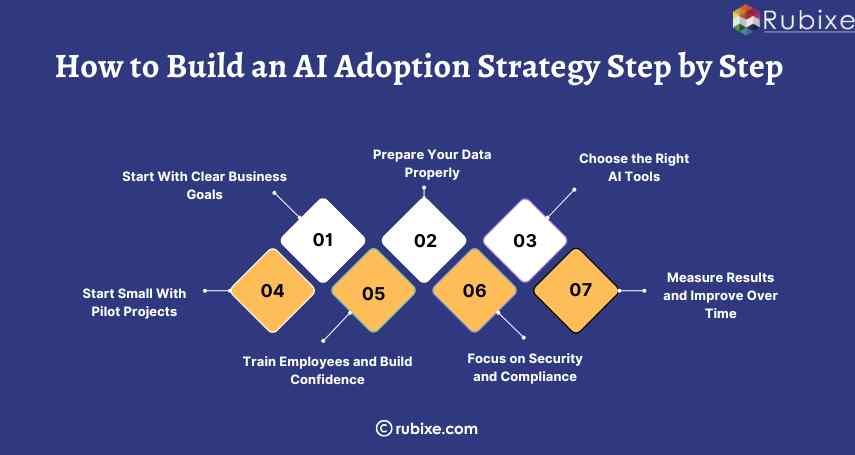
Here’s a structured approach to implement AI successfully, integrating AI adoption implementation steps naturally throughout.
Step 1: Start With Clear Business Goals
Define the outcomes you want to achieve: revenue growth, operational efficiency, or enhanced customer experience. Goals provide focus and help evaluate AI project success.
Step 2: Prepare Your Data Properly
Clean, structured, and accessible data is critical for effective AI models. Include governance, security, and compliance measures to protect sensitive information.
Step 3: Choose the Right AI Tools
Select tools that align with your objectives, team skill set, and existing systems. Partnering with AI services for business growth ensures you select scalable, reliable solutions.
Step 4: Start Small With Pilot Projects
Launch pilot projects to validate feasibility, measure impact, and gather feedback. Implement lessons learned before scaling. Implement AI in your business gradually to minimize risk.
Step 5: Train Employees and Build Confidence
Provide upskilling and clear communication to help employees adopt AI confidently. Encourage collaboration between teams to support successful adoption.
Step 6: Focus on Security and Compliance
Establish processes to ensure regulatory compliance and ethical AI use. Incorporate monitoring, auditing, and security protocols throughout the AI lifecycle.
Step 7: Measure Results and Improve Over Time
Track performance with KPIs such as cost savings, efficiency gains, and ROI. Use feedback loops to refine strategy and enhance results continually.
Common Mistakes to Avoid During AI Adoption
-
Implementing AI without a clear strategy: Many organizations dive into AI projects without defining objectives or aligning them with business goals. This leads to wasted resources and initiatives that fail to deliver measurable results.
-
Ignoring data quality or integration challenges: Poor data quality or unintegrated systems can cause inaccurate AI predictions and AI adoption impacts employees across teams. Failing to provide proper training or communicate changes can result in resistance, underutilization, and failed projects.
-
Scaling too quickly without validation: Rushing to implement AI across multiple departments without testing pilot projects increases risk. Gradual implementation with validated results helps reduce errors and optimize performance.
Avoiding these mistakes ensures that your AI adoption initiatives are efficient, ethical, and aligned with business objectives, maximizing ROI and long-term impact.
How AI Supports Different Business Teams
AI adoption drives improvements across multiple functions:
-
Sales and Marketing: Predictive analytics help create targeted campaigns and personalized recommendations. AI also enables better lead scoring and customer segmentation, helping your teams focus on high-value opportunities.
-
Operations: Automated workflows, inventory optimization, and process efficiency reduce manual errors and speed up operations. AI also provides real-time insights into supply chain performance, enabling proactive decision-making.
-
Finance: Risk management, forecasting, and anomaly detection improve accuracy and reliability in financial processes. AI also assists in automating reporting and compliance tasks, freeing teams to focus on strategic analysis.
-
HR: Talent acquisition and workforce analytics streamline recruitment and employee development. AI can also identify skills gaps and support personalized learning programs, enhancing overall workforce effectiveness.
By integrating AI effectively, teams can improve productivity, reduce operational risks, and make data-driven decisions confidently across the organization.
Partnering With the Right Experts
Implementing AI successfully often requires external expertise. An experienced AI Development company can guide your business in selecting the right tools, implementing scalable solutions, and ensuring alignment with strategic goals.
When to Hire External Experts
-
When internal capabilities are limited
-
For complex or large-scale AI initiatives
-
To accelerate adoption and reduce risk
Choosing Between Consulting and In-House Teams
Consulting partners provide expertise and proven methodologies, while internal teams can maintain long-term operational control. Many businesses benefit from a hybrid approach for maximum effectiveness.
The Future of AI in Business
AI adoption is evolving rapidly, with trends including:
Emerging AI Trends: AI adoption is evolving rapidly, and businesses are exploring new ways to integrate it effectively. Generative AI is revolutionizing content creation, design, and automation, enabling faster innovation and reducing manual effort.
Integration Into Core Business Processes: AI is moving beyond isolated projects to become embedded in daily operations, from supply chain optimization to customer service automation. This deeper integration allows companies to leverage real-time insights and drive operational efficiency across departments.
Focus on Ethical and Governed AI Adoption: As AI becomes more pervasive, organizations are prioritizing ethical AI practices, transparency, and accountability. Governance frameworks ensure that AI systems are compliant, secure, and aligned with organizational values, reducing risk while enhancing trust among stakeholders.
Competitive Advantage Through AI Strategy: Businesses that establish a clear AI Adoption strategy today are better positioned to take advantage of emerging technologies, anticipate market changes, and stay ahead of competitors.
Don’t leave your AI initiatives to chance.
Partner with experts to implement AI in your business and leverage AI services for business growth. Start building your structured AI Adoption strategy to deliver measurable impact across your teams and operations.
FAQs
1. What is an AI adoption strategy?
It is a plan that helps businesses use AI in a structured and effective way.
2. Can small businesses use AI?
Yes. Small businesses can start with simple tools and grow step by step.
3. Is AI expensive?
Costs vary. Starting small helps control spending.
4. How long does AI adoption take?
Small projects can show results within weeks.
5. Is AI safe for business data?
Yes, when security and compliance rules are followed.