





How Businesses Use AI Services for Sales and Marketing
Discover how AI services improve sales and marketing through lead generation, forecasting, automation, personalization, and ROI measurement.
Sales teams miss leads. Follow-ups come late. Ad costs keep rising. And it is hard to know what customers really want.
Many businesses face these problems even with plenty of tools. The gap is not data. It is how teams use it.
AI services help close that gap. They use predictive analytics, smart automation, and personalization to guide daily decisions. The right choice depends on your goals, your data, and your current systems. This guide shows what each service does and how to get started.
What Are AI Services for Sales and Marketing?
AI services are expert-built solutions that help teams sell and market better. They cover strategy, model building, and automation. Businesses use them to run sharper sales operations, better campaigns, and closer customer relationships. If you are new to the topic, read what AI services are and how they work.
AI Consulting and Strategy Services: AI consulting services help you pick the right use cases. A consultant checks your data and systems, then builds a roadmap. You learn what to build first and what to skip.
AI and Machine Learning Development Services: Developers build models that fit your needs. Common examples are lead scoring, recommendation systems, and forecasts. Each model learns from your own data and supports a clear business decision.
AI Automation and Integration Services: These services connect your CRM, marketing tools, and workflows. Data moves on its own. Your team stops copying records by hand and saves time on manual work.
AI Tools vs. Custom AI Services: Ready-made tools are quick and cheap to start. They suit common tasks like email drafts. Custom services fit when you have unique data, special workflows, or strict security needs. Many teams start with tools and go custom later.
Key AI Services for Sales
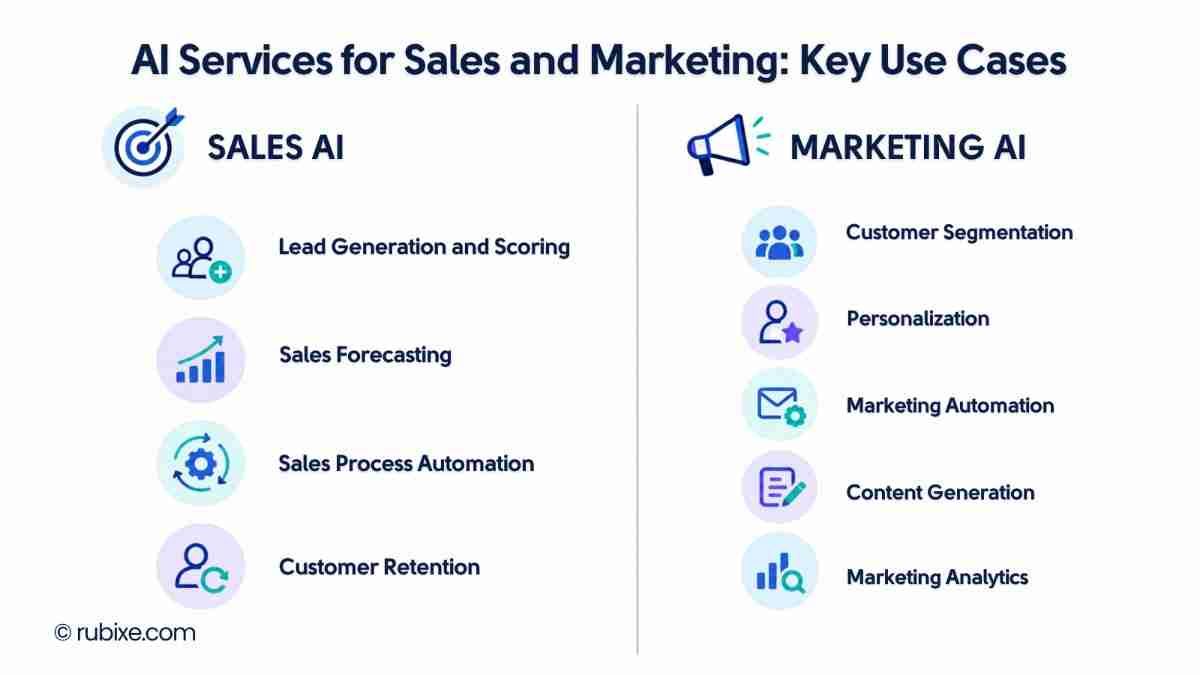
Sales AI helps with lead management, rep productivity, forecasting, and retention.
AI Lead Generation and Lead Scoring Services: AI studies your customer and prospect data. It finds patterns in who buys. Then it scores new leads so reps call the best ones first. This is the core of AI lead generation.
AI-Powered Sales Forecasting Services: Machine learning models read past sales and pipeline activity. They estimate future demand and revenue. Leaders can plan hiring, stock, and targets with more confidence.
Sales Process Automation Services: AI sends follow-ups, writes call summaries, and updates the CRM. This is AI sales automation. A person should still review key messages and deal notes before they go out.
AI-Powered Customer Retention and Recommendation Services: AI spots behaviour patterns, such as a drop in product use. These can be early churn signals. It also suggests what a customer may want next, which opens cross-selling chances.
Key AI Services for Marketing
Marketing AI helps you understand customers, improve campaigns, and personalize messages.
AI-Powered Customer Segmentation Services: AI groups audiences by behaviour, preferences, and other customer data. It finds segments that manual rules miss. Each group then gets a message that fits.
AI Personalization Services: AI suggests products, tailors messages, and improves the customer journey. A shopper sees items that match their interests. A buyer gets content that fits their stage.
AI Marketing Automation Services: AI marketing automation runs campaign workflows. It picks audiences, tests variants, and adjusts campaigns as results come in. Your team spends less time on setup and more on strategy.
Generative AI Services for Marketing Content: Generative AI drafts articles, email copy, ad variations, and creative ideas. It speeds up first drafts. Always fact-check the output, keep your brand voice, and get human approval before you publish.
AI Marketing Analytics and Optimization Services: AI reviews campaign data and finds patterns. It shows which channels work and which do not. This helps you move budget to what performs.
Real-World Applications of AI Services in Business
The three examples below are hypothetical scenarios. Each shows the problem, the service, the workflow, and the metrics to track. They are not customer results. For your own plan, back your case with verified case studies.
Using AI Services to Improve B2B Lead Conversion
-
Problem: A B2B software firm gets many demo requests. Reps treat every lead the same, so strong leads wait too long.
-
Service: AI lead scoring with CRM integration.
-
Workflow: The model scores each new lead based on past won deals. High scores go to reps right away. Low scores move into nurture emails.
-
Metrics: Qualified lead conversion rate, response time, and sales cycle length.
Using AI Services to Personalize E-commerce Marketing
-
Problem: An online store sends the same offers to everyone. Email results stay flat.
-
Service: AI segmentation and personalization.
-
Workflow: AI groups shoppers by browsing and purchase history. It picks products for each group. Emails and site banners update to match.
-
Metrics: Conversion rate, revenue per customer, and cost per acquisition.
Using AI Services to Improve Sales Forecasting
-
Problem: A distributor keeps missing its quarterly forecast. Stock runs short or piles up.
-
Service: An AI forecasting model.
-
Workflow: The model trains on past sales and pipeline data. It refreshes every week. Managers compare its output with rep estimates.
-
Metrics: Forecast error, stock-out rate, and time spent on forecast reviews.
How to Choose and Implement the Right AI Services
Use this five-step framework.
Step 1: Identify Your Business Goals
Pick one clear sales or marketing problem. State the result you want, such as cutting lead response time in half.
Step 2: Assess Data Quality and Technology Readiness
Review your data, CRM, marketing platforms, access rights, and integration needs. Poor data gives poor results. An AI readiness assessment can show the gaps early.
Step 3: Select the Right AI Services Provider
Check technical skill, industry experience, integration ability, security practices, support, and cost. Ask for proof of past work.
Step 4: Start With a Small AI Pilot Project
Test one limited workflow. Record a baseline first. You need it to prove the gain later.
Step 5: Measure Performance and Scale Gradually
Review the results and fix the gaps. Expand only when the solution shows clear value.
How to Measure the ROI of AI Services
Track the right numbers for each service.
|
AI service |
KPI to monitor |
|
AI lead generation and scoring |
Qualified lead conversion rate |
|
AI sales forecasting |
Forecast error |
|
Sales process automation |
Time saved on administrative tasks |
|
AI marketing automation |
Cost per acquisition |
|
AI personalization |
Conversion rate and revenue per customer |
|
AI consulting and implementation |
Business outcomes against baseline |
|
Overall AI investment |
Incremental ROI and total implementation costs |
Measure performance before and after launch. Count integration and ongoing running costs, not just the license fee. Then compare results over a fair period. A few weeks is rarely enough.
Challenges of Implementing AI Services
Know the main risks before you invest.
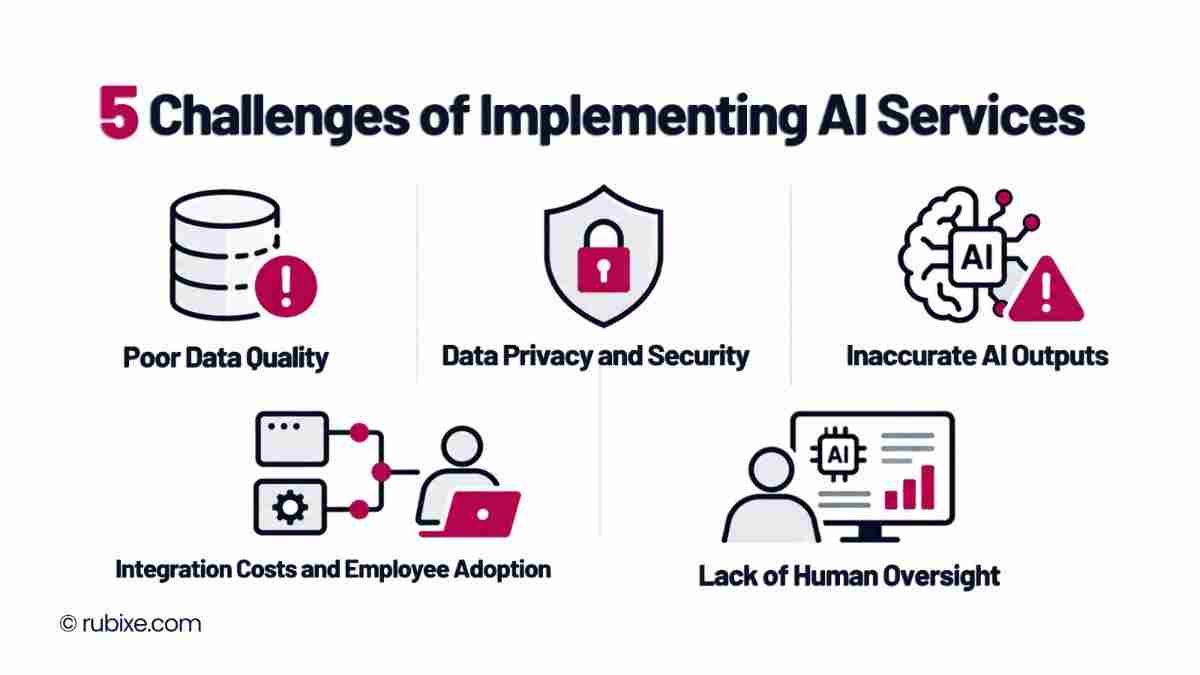
Poor Data Quality and Limited Data Availability: Models learn from your data. Gaps, duplicates, and old records lead to weak predictions.
Data Privacy and Security Concerns: Customer data is sensitive. You must control who can see it and how tools store it.
Inaccurate Predictions and AI-Generated Outputs: AI can be wrong. Generated text can also include false facts. Test outputs before you trust them.
Integration Costs and Employee Adoption: Connecting systems takes time and money. Teams also need training, or they will ignore the new tools.
The Need for Human Oversight: People should review high-stakes decisions and customer-facing content.
Set up simple safeguards. Use data governance rules and access controls. Test models before launch. Train your staff. Then monitor results on an ongoing basis.
Future Trends in AI Services for Sales and Marketing
Some of these tools are proven today. Others are still emerging. We mark the difference.
AI Agents for Sales and Marketing Workflows: This one is emerging. AI agents may handle multi-step tasks, like researching a lead and drafting outreach. They need clear permissions and human oversight.
More Personalized Customer Experiences: This is already in use and growing. AI can use customer context to make each interaction fit better.
Human and AI Collaboration: AI handles repetitive work. People bring judgment, trust, and strategy. Strong teams use both.
Frequently Asked Questions
What Are AI Services?
AI services are expert-led offerings that help businesses use AI. They include consulting, model development, automation, and system integration. Companies use them to solve specific problems, such as lead scoring or demand forecasting.
How Can AI Services Improve Sales and Marketing?
They help teams find better leads, respond faster, and forecast more accurately. In marketing, they support segmentation, personalization, and campaign testing. The gains depend on data quality and a clear goal.
Which AI Services Are Best for Lead Generation?
AI lead scoring and lead generation services work best. They rank prospects by likelihood to buy. Pair them with sales process automation so reps can follow up quickly.
What Is the Difference Between AI Tools and Custom AI Services?
Tools are ready-made and fast to set up. Custom services are built around your data and workflows. Choose tools for common tasks. Choose custom work for unique needs or strict security rules.
How Much Do AI Services Cost?
Cost depends on scope, data readiness, integrations, and whether you use tools or custom builds. A pilot costs less than a full rollout. Ask for an itemized quote that includes integration and running costs.
How Can Businesses Measure the ROI of AI Services?
Set a baseline before launch. Track KPIs such as conversion rate, forecast error, and cost per acquisition. Then compare results to total costs over a fair period.
Choosing the Right AI Services for Business Growth
The right AI services can support lead generation, sales forecasting, marketing automation, personalization, and better decisions. Good results come from a defined goal, reliable data, planned integrations, and tracked outcomes.
Ready to turn your sales and marketing data into results? Talk to Rubixe. Our team will review your goals, check your data readiness, and suggest the right mix of AI consulting, AI and machine learning development, and automation services. Book a consultation and start with one small pilot.