











How to Find the Right Artificial Intelligence Company
Evaluate artificial intelligence companies by expertise, data readiness, use cases, and measurable outcomes aligned with your specific business goals and needs

Everyone claims to do AI. Very few actually deliver it.
I have sat across the table from dozens of vendors who opened their laptops, showed a glossy slide deck, and used the word "AI" seventeen times before I could ask a single technical question. Not once did they mention data quality, model limitations, or what happens when the system fails.
Here is an uncomfortable truth: the majority of companies that call themselves artificial intelligence companies are not AI companies at all. They are software vendors, data analysts, or automation shops who added "AI" to their pitch deck sometime after 2022 and never looked back.
That is not a doubtful conclusion. It is a practical one. If you are searching for genuine artificial intelligence services, the kind that can automate decisions, generate predictions, or build intelligent systems at scale, then sorting signal from noise is your first real challenge. This guide will help you do exactly that.
Why the Search Is Harder Than It Looks
The global AI market is projected to exceed $800 billion by 2030. That kind of money attracts a lot of entrants, and not all of them belong. When every company, from a two-person dev shop to a multinational consultancy, describes itself using the same language, machine learning, generative AI, and neural networks, the terminology stops being useful.
This is happening alongside some important realities:
-
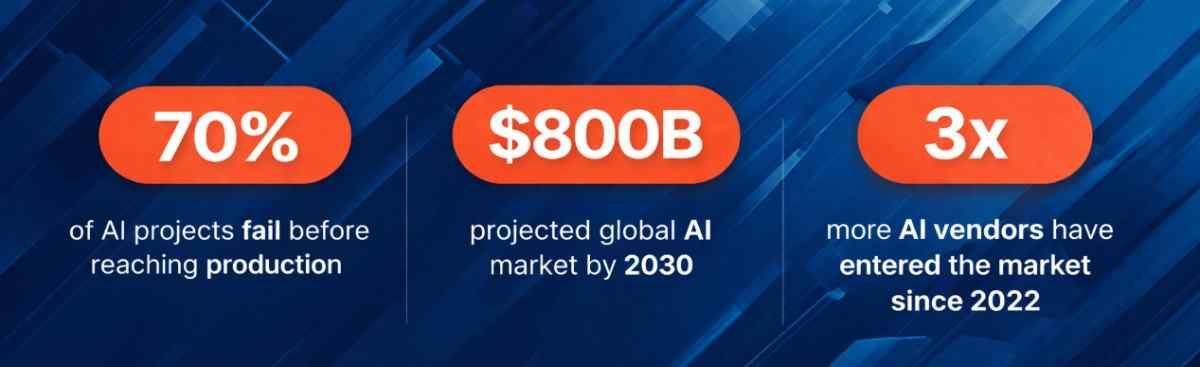
70% of AI projects fail before reaching production
-
$800B projected global AI market by 2030
-
3x more AI vendors have entered the market since 2022
 The result? Businesses either overpay for a custom solution they could have bought off the shelf, or they under-invest in generic tools that never fit their actual problem. Both are expensive mistakes.
Find the Perfect AI Company in 5 Simple Steps
You do not need a procurement team or a technical co-founder to evaluate AI vendors confidently. You need a clear process. Follow these five steps, and you will walk into every vendor conversation with the right questions and leave with the right answers.
1. Define your problem before you define your technology
Write down the specific business outcome you want, not the tool you think you need.
"We want to reduce customer loss by 15%" is a solvable problem.
"We want an AI chatbot" is a solution in search of a problem.
Clarity here eliminates half the vendors on your list before you make a single call.
2. Audit your data before anyone else does
Every honest AI company will ask about your data early. Know your answer.
-
How much do you have?
-
How clean is it?
-
Where does it live?
A vendor who never asks about your data is a vendor who is not building for your situation; they are selling a template.
3. Test technical depth with one honest question
Ask them to describe a project that did not go as planned and what they changed.
A team with real production experience will have a crisp, specific answer.
A team running on sales confidence will avoid giving a clear answer.
That single question separates practitioners from presenters.
4. Verify claims with reference conversations, not reference names
Do not settle for a logo or a name. Ask to speak with a past client directly, and ask that client the questions the vendor would not want you to ask:
-
Did the timeline hold?
-
Did the results match the pitch?
-
Would they hire them again?
5. Run a paid pilot before any long-term commitment
Four to eight weeks is enough time to see how a team thinks, communicates, and handles the unexpected.
A company confident in its work will welcome a pilot.
One that resists it is protecting something, and you should find out what before you sign anything.
Most failed AI engagements begin with a solution looking for a problem. Define your problem first. The right AI company will help you refine it, but they cannot define it for you.
What to Look for in an Artificial Intelligence Company
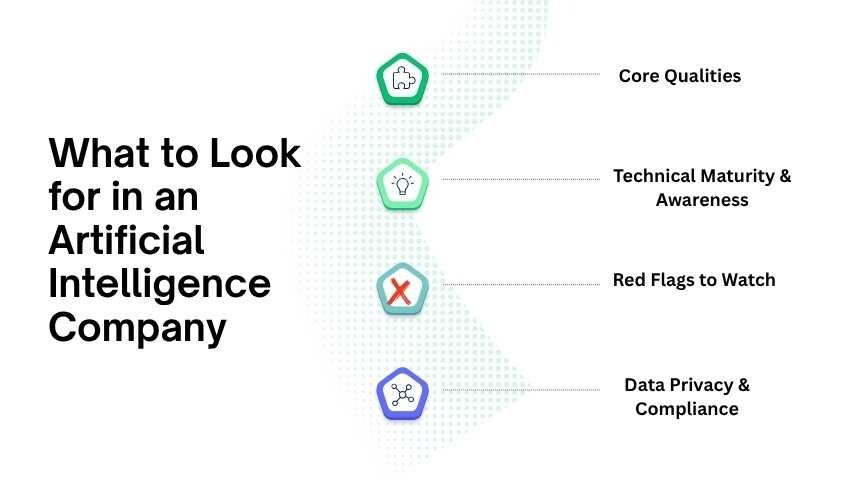
Core Qualities
-
Beyond the five-step process, the best artificial intelligence companies share a set of qualities that are easy to spot once you know what to look for.
-
They ask more questions than they answer in the first meeting.
-
They talk about trade-offs honestly.
-
They show you what they have built, not just what they can theoretically build.
Technical Maturity & Awareness
-
Look for teams that actively discuss failure modes, data bias, model limitations, and edge cases.
-
AI systems fail in specific and often predictable ways:
-
data changes over time
-
poor generalisation
-
overfitting to historical patterns
-
A team that raises these issues unprompted is one that has encountered them in real environments.
Red Flags to Watch
-
Watch for this red flag: If a company promises impressive AI results but shows little interest in your existing data quality, infrastructure, or governance, walk away.
-
Great AI work begins with honest data assessment, not confident promises.
Data Privacy & Compliance
-
Also, ask how they handle data privacy, particularly if your industry is regulated.
-
Compliance with relevant data protection standards, whether GDPR in Europe or DPDP in India, should be treated as non-negotiable, not an afterthought.
The Right AI Consulting Partner Changes the Outcome
Artificial intelligence consulting is not a sales pitch for a pre-built product. It starts with listening and diagnosis. A credible AI consulting firm will spend meaningful time understanding your business before recommending any specific approach.
Be cautious of firms that arrive at the first meeting with a solution already defined. That usually means they are fitting your problem to the product they already sell, not designing something that actually fits your context.
The best AI consulting relationships involve knowledge transfer, not dependency creation. You should come away understanding more about AI than when you started, with internal teams that are more capable of working with AI systems going forward.
Why Choose Rubixe as Your Artificial Intelligence Company
Finding the right AI partner is hard. Rubixe makes it straightforward. Here is what sets them apart from the crowded field of artificial intelligence companies claiming to deliver results.
1. Problem-first approach
It begins every engagement by understanding your business outcome, not by pitching a product. Their consultants ask the uncomfortable questions other vendors skip.
2. End-to-end AI services
From data strategy and model development to deployment and ongoing optimisation, Rubixe covers the full AI lifecycle, so you are never left managing multiple vendors for one outcome.
3. Transparent delivery model
Clear pricing, defined milestones, and client ownership of all models and data. No lock-in, no black boxes. You know what you are getting and what you are paying for at every stage.
4. Proven in production
Rubixe has delivered AI consulting engagements across industries, including finance, healthcare, and retail, with measurable outcomes, not just case study headlines.
5. Knowledge transfer built in
Every engagement is designed to leave your internal team more capable. Rubixe builds AI literacy into the process, not dependency on their own continued involvement.
6. Pilot-ready from day one
Rubixe actively encourages scoped pilots before large commitments. They are confident enough in their work to prove value quickly and structured enough to do it in weeks, not months.
Talk to Rubixe about your AI project →
Finding the right artificial intelligence company is less about finding the most impressive name and more about finding the right fit for your specific problem, your data maturity, and your team's capacity to absorb change.
The companies delivering genuine AI value are the ones that ask hard questions before offering easy answers.
Use the five-step process in this guide as your filter. Define your problem clearly. Push on technical depth, data practices, and real client evidence. Start with a pilot. And choose a partner who prioritises your outcomes over their own revenue model.
The field of AI is moving fast, but the principles for choosing a credible partner remain the same: methodological accuracy, transparency, and a track record that holds up to detailed review. Everything else is noise.