







Top AI Chatbot Trends in 2026
AI chatbot trends with machine learning, NLP, automation, customer support, personalization, voice assistants, deep learning, and virtual agents.
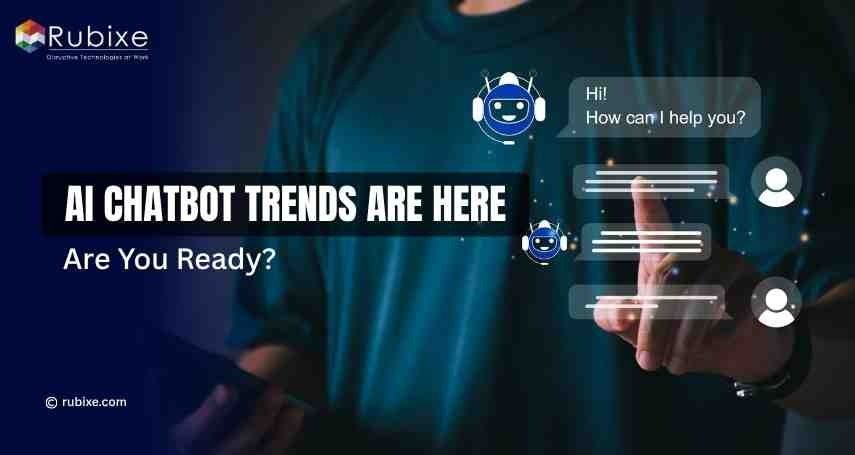
If your business is finding it hard to manage customer queries, respond quickly, or turn website visitors into leads, the issue is usually in the system, not the effort. This is where AI chatbot solutions help by handling conversations efficiently, reducing manual work, and improving conversions. Let’s look at what’s changing in 2026 and how you can use it to get better results.
What is AI Chatbot
An AI chatbot is a software system that uses artificial intelligence to simulate human-like conversations across text and voice. Unlike rule-based bots, modern AI chatbot solutions use machine learning, natural language processing, and large language models (LLMs) to understand context, intent, and user behaviour.
They can handle multi-step conversations, learn from interactions, integrate with business systems like CRM and ERP, and deliver real-time, personalized responses across websites, apps, messaging platforms, and internal systems.
Why AI Chatbots are Becoming Essential for Business Growth
The shift toward digital-first customer behaviour has made response time, personalization, and availability critical. Businesses that fail in these areas lose customers quickly.
Here’s why AI chatbot solutions are now essential:
1. Always-On Customer Engagement
Customers expect responses instantly, regardless of time zones. AI chatbots provide 24/7 support without increasing operational cost.
2. Cost Efficiency at Scale
Handling thousands of conversations manually requires large teams. Chatbots reduce this dependency while maintaining consistency.
3. Data-Driven Decision Making
Every interaction becomes a data point. Businesses gain insights into customer intent, pain points, and behaviour patterns.
4. Faster Conversion Cycles
Chatbots guide users through decision-making, answer objections, and reduce drop-offs in sales funnels.
5. Integration with Business Systems
Modern AI chatbot solutions integrate with sales, marketing, and support tools, creating a unified system instead of isolated automation.
Before implementing, companies often begin with an AI readiness assessment to understand whether their data, workflows, and infrastructure can support AI-driven systems effectively.
AI Chatbot Market Statistics
Recent data highlights the rapid adoption and impact of chatbot technology:
-
According to Chatbot.com, over 80% of businesses are expected to use chatbots in some form by 2026.
-
Around 67% of consumers have interacted with a chatbot for customer support.
-
Businesses report up to 30% cost savings in customer service operations after implementing chatbots.
-
Chatbots can handle up to 80% of routine queries, freeing human agents for complex tasks.
-
Nearly 90% of customers expect immediate responses, which is a key driver behind chatbot adoption.
These numbers show a clear shift: chatbots are no longer optional - they are becoming foundational systems.
Top AI Chatbot Trends - 2026
In 2026, AI chatbot solutions are shifting from basic automation to becoming integral parts of business operations, shaping how companies engage, operate, and scale. Let's explore the key trends redefining how they deliver value.
1. Hyper-Personalization Driven by Live Data
Chatbots are no longer responding with pre-defined logic. They are actively interpreting user behaviour in real time, what users browse, how they interact, what they previously searched, and even where they drop off.
This allows businesses to move from generic conversations to highly contextual interactions. For example, in eCommerce, a chatbot can recommend products based on a user’s browsing pattern, previous purchases, and price sensitivity, all within seconds.
This level of personalization directly impacts engagement and conversion because users feel understood, not processed.
2. Unified Voice and Text Experiences
The interaction layer is changing. Users no longer want separate systems for voice and text, they expect continuity.
Modern AI chatbot solutions allow users to start a conversation through voice, switch to text midway, and continue without losing context. This is particularly valuable in mobile-first markets, where users shift between typing and speaking depending on convenience.
For businesses, this means designing conversations that are not channel-specific but experience-driven.
3. From Chatbots to Action-Oriented AI Agents
One of the most important shifts in 2026 is the transition from conversational bots to execution-driven AI agents.
Instead of stopping at answering queries, chatbots are now completing tasks. They can schedule meetings, process transactions, update records, and trigger workflows across systems without human intervention.
This evolution introduces complexity, which is why businesses are investing more in AI governance frameworks. Clear boundaries, validation layers, and audit mechanisms are becoming essential to ensure these systems act accurately and responsibly.
4. Real-Time Integration with Core Business Systems
Earlier chatbot implementations often worked in isolation, leading to limited functionality. That model is disappearing.
Today, AI chatbot solutions are deeply integrated with CRM platforms, marketing tools, payment systems, and internal databases. This allows chatbots to act on real data instead of static information.
For example, a chatbot can check order status, update customer details, initiate refunds, or even trigger internal workflows - all within a single conversation.
This level of integration transforms chatbots from support tools into operational assets.
5. Context-Aware and Memory-Driven Conversations
A major frustration in early chatbot systems was repetition - users had to explain the same issue multiple times. That gap is now being addressed through persistent memory and context awareness.
Modern chatbots retain conversation history across sessions. They understand where the user left off, what was previously discussed, and what the intent was.
This results in smoother interactions, faster resolutions, and a more natural conversational experience. Over time, this builds trust, which is critical for long-term customer relationships.
6. Regional Intelligence and Multilingual Capability
As businesses expand into diverse markets, language adaptability has become a priority. In regions like India, multilingual AI chatbots are being trained in multiple regional languages, enabling businesses to connect with users in their preferred language. This goes beyond translation, it includes understanding cultural nuances, local expressions, and user intent. The result is higher engagement, better accessibility, and stronger market penetration, especially in non-English-speaking segments.
7. Human and AI Collaboration Models
The idea that chatbots replace humans is being replaced by a more practical approach - collaboration.
Chatbots now handle repetitive and high-volume queries, while human agents focus on complex or sensitive interactions. The transition between AI and human support is smoother, with chatbots passing context, summaries, and user history to agents.
This reduces resolution time and improves efficiency without compromising the quality of interaction.
8. Security and Compliance as Core Design Principles
With chatbots accessing sensitive customer and business data, security is no longer an add-on, it is built into the system from the start.
AI chatbot solutions are designed with encryption, access control, and compliance standards in place. Businesses are prioritizing data protection to avoid risks related to privacy breaches and regulatory issues.
This trend is particularly critical in industries like finance, healthcare, and enterprise SaaS, where data sensitivity is high.
9. Rise of Industry-Specific Chatbot Systems
Generic chatbot solutions are gradually losing effectiveness. Businesses now require systems that understand their domain deeply.
Industry-specific AI chatbot solutions are trained with relevant data, workflows, and use cases. For example:
-
In healthcare, chatbots assist with patient triage and appointment scheduling
-
In finance, they support transactions and account-related queries
-
In education, they guide learners through courses and resources
This specialization improves accuracy and makes the chatbot more valuable to both the business and the end user.
10. Shift Toward Structured AI Adoption
Random chatbot implementation is one of the biggest reasons for failure. Businesses are now taking a structured approach.
Instead of starting with tools, they begin with strategy - defining use cases, aligning with business goals, and building a roadmap. This is where structured AI adoption becomes critical.
A structured approach ensures that chatbot implementation delivers measurable outcomes, integrates well with existing systems, and scales effectively over time.
Benefits of AI Chatbot Solutions
When implemented correctly, AI chatbot solutions deliver real business impact:
1. Improved Customer Experience: Instant, accurate responses improve satisfaction and retention.
2. Operational Efficiency: Automates repetitive tasks, reducing workload on teams.
3. Scalability: Handles thousands of conversations simultaneously without performance drop.
4. Lead Generation and Qualification: Captures and qualifies leads before passing them to sales teams.
5. Consistency: Delivers uniform responses across all customer interactions.
6. Faster Decision-Making: Provides real-time insights for business optimization.
Many organizations partner with an AI consulting partner to align chatbot implementation with broader business strategy.
Move Forward with the Right AI Chatbot Strategy
Adopting AI chatbot solutions without a clear plan often leads to underperformance. The real impact comes when technology is aligned with business goals, data readiness, and execution strategy.
This is where Rubixe supports businesses.
Rubixe works with organizations to:
-
Identify the right chatbot use cases based on actual business needs
-
Evaluate readiness through structured assessments
-
Design scalable chatbot architectures
-
Ensure smooth integration with existing systems
-
Build solutions that deliver measurable outcomes, not just automation
Whether you are starting from scratch or improving existing systems, the focus should be on building AI that works in real scenarios, not just demos.
If you are planning to implement or scale AI chatbot solutions, the next step is to move with clarity, not assumptions. Partnering with a team that understands both AI and business execution can make that difference.
AI Chatbot Solutions in 2026 have evolved into core business systems that directly impact customer experience, operational efficiency, and revenue growth. The real value comes from implementing them with a clear strategy, strong integrations, and a structured approach rather than treating them as simple automation tools. Businesses that move early with the right execution will transform chatbots into scalable, long-term growth drivers.