












How to Plan an AI Digital Consulting Strategy
Plan an AI digital consulting strategy with expert support to align business goals, choose the right AI tools, improve decisions and drive business growth
Many businesses want to use AI, but most struggle with where to begin. Choosing the wrong tools, lacking clear goals, or implementing AI without a roadmap often leads to wasted time and money. A strong AI digital consulting strategy helps businesses adopt AI in a practical, structured, and result-driven way.
Benefits of an AI Digital Consulting Strategy
Implementing a strong AI Digital Consulting Strategy offers multiple benefits:
-
Faster Decision-Making: AI provides insights from large datasets, enabling teams to make informed decisions quickly.
-
Improved Customer Experience: Personalized recommendations, chatbots, and automated services enhance customer satisfaction.
-
Operational Efficiency: AI can automate repetitive tasks, freeing staff for more strategic work.
-
Cost Savings: Reducing errors and optimizing processes can significantly cut expenses.
-
Competitive Advantage: Businesses using AI strategically often outperform competitors in sales, marketing, and operations.
For example, Netflix uses AI to recommend content to users. Their AI-driven strategy increases viewer engagement and boosts subscription retention.
Top Steps to Build an Effective AI Digital Consulting Strategy
Step 1: Understand Your Business Needs
Before implementing AI, identify the areas where it can add real value. Ask questions like:
-
Which processes are time-consuming?
-
Where are we losing revenue or efficiency?
-
Which business decisions can benefit from data-driven insights?
A strong AI Digital Consulting Strategy begins with understanding these pain points. For instance, if your sales team struggles to prioritize leads, predictive analytics can focus their efforts on the most promising opportunities.
Step 2: Set Clear Goals
Every strategy needs well-defined goals. In AI consulting, goals should be:
-
Specific: For example, improve lead conversion by 20%.
-
Measurable: Trackable through KPIs like sales, response time, or customer engagement.
-
Achievable: Goals must match your resources and team capacity.
-
Relevant: Aligned with overall business objectives.
-
Time-bound: Set deadlines for achieving them.
Example goal: “Use AI chatbots to reduce customer support response time by 50% within six months.”
Goals act as the backbone of your AI Digital Consulting Strategy, guiding tool selection and implementation.
Step 3: Analyze Data and Resources
AI depends on quality data. Review:
-
Customer databases
-
Sales and marketing reports
-
Website analytics
Next, assess your resources. Do you have in-house AI experts or will you need external consultants? Your AI Digital Consulting Strategy should plan for data readiness, technical resources, and staff training.
Example: A retail business may have customer purchase data but lack AI expertise. The strategy would involve training staff or hiring consultants alongside choosing AI tools.
Step 4: Select the Right AI Tools
AI has many applications. Choose tools that align with your goals:
-
Predictive Analytics: Forecast sales or demand trends.
-
Chatbots & NLP: Automate customer service and feedback analysis.
-
Recommendation Engines: Suggest products to users based on behavior.
-
Process Automation: Reduce repetitive work for higher efficiency.
The right tools ensure your AI Digital Consulting Strategy delivers measurable outcomes without unnecessary costs.
Step 5: Develop a Step-by-Step Implementation Plan
A clear roadmap makes AI adoption smoother:
-
Pilot Project: Test AI on a small scale to see effectiveness.
-
Integration: Connect AI tools with your existing systems.
-
Training: Equip your staff to manage and use AI tools effectively.
-
Monitoring: Track performance against KPIs regularly.
-
Scaling: Expand AI use based on successful results.
Example: Start with AI chatbots for customer support, monitor performance, then extend AI to sales forecasting and marketing optimization.
Step 6: Measure and Optimize
Monitoring AI results is crucial. KPIs may include:
-
Increased efficiency
-
Higher sales or lead conversions
-
Improved customer satisfaction
-
Reduced operational costs
A strong AI Digital Consulting Strategy incorporates ongoing measurement and optimization to maximize ROI.
Step 7: Learn from Experts
AI consulting experts bring valuable skills:
-
Knowledge of industry-specific AI applications
-
Guidance on tool selection and best practices
-
Support for training and scaling AI adoption
Involving experts ensures your AI Digital Consulting Strategy is reliable and effective.
Future Trends in AI Digital Consulting
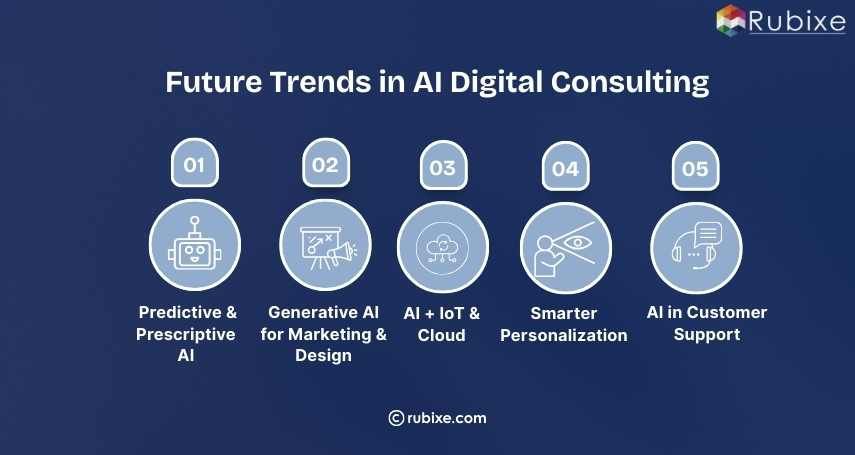
AI is changing fast, and businesses need to keep up. Here are some important trends to know:
1. Predictive & Prescriptive AI
AI can do more than just look at data. Predictive AI can guess what might happen next, like which products customers may buy. Prescriptive AI can even suggest what actions a business should take, helping teams make smarter choices quickly.
2. Generative AI for Marketing & Design
Generative AI can create content automatically, such as ads, social media posts, images, or even product descriptions. This saves time and helps businesses reach more customers without needing extra staff.
3. AI + IoT & Cloud
When AI works with Internet of Things (IoT) devices and cloud systems, it can collect and analyze data from many sources. For example, AI can track inventory, monitor machines, or study customer behavior. This helps businesses work faster and make better decisions.
4. Smarter Personalization
AI can learn about each customer and show them products or services they are most likely to like. This “smart personalization” makes customers happier and can increase sales.
5. AI in Customer Support
AI chatbots and virtual assistants are improving fast. They can answer questions, solve problems, and even give advice to customers 24/7, reducing waiting time and improving service quality.
FAQs
Q1: What is an AI Digital Consulting Strategy?
A: It’s a roadmap for adopting AI effectively to achieve business goals.
Q2: Why do businesses need an AI strategy?
A: Without a strategy, AI projects often fail and waste resources.
Q3: Can small businesses implement AI?
A: Yes. Even small companies can use AI tools with a structured strategy.
Q4: How much does AI consulting cost?
A: Costs vary depending on tools, scale, and consulting expertise. Pilot projects can minimize expenses.
An AI Digital Consulting Strategy is more than just using technology. It is a plan that helps businesses make better decisions, work faster, and grow. By knowing what it is, its benefits, and following a clear plan, businesses can use AI well.
Start with understanding your needs, setting goals, analyzing data, and choosing the right AI tools. Implement step by step, monitor results, involve experts, and continuously optimize.
With a strong strategy, AI becomes a powerful partner for your business growth.