




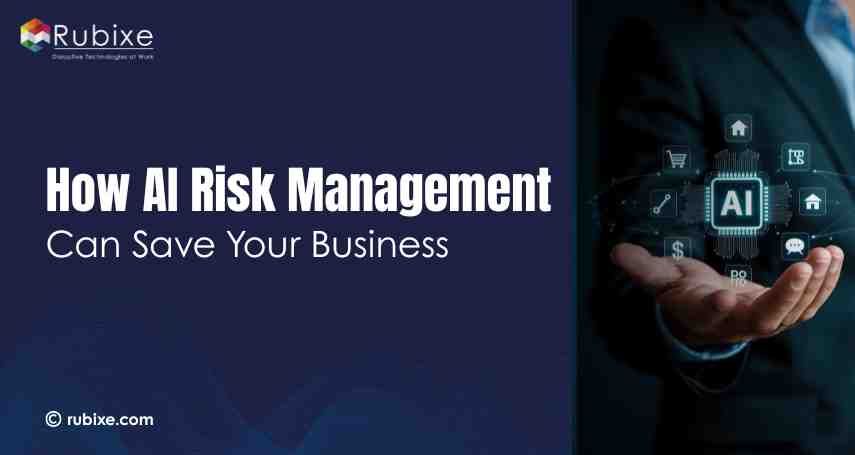
How AI Risk Management Can Save Your Business
AI risk management services help businesses identify risks, reduce losses, manage compliance, protect operations, and support safer business decisions.
You launch your AI system with confidence. Predictions are accurate. Decisions are fast.
Everything looks perfect. Until one day, it approves the wrong application, exposes sensitive data, or rejects qualified candidates.
That’s when excitement turns to panic.
Most organizations talk about what AI can do, but few prepare for what happens when it goes wrong.
That’s exactly where AI Risk Management steps in: ensuring your AI drives growth safely instead of creating costly blind spots.
Understanding AI Risk Management
AI Risk Management is the structured process of identifying, assessing, and reducing the risks that come with AI systems across their lifecycle, from data collection and model training to deployment and real-world use.
Think of it this way: AI governance sets the rules. Artificial Intelligence risk management applies them in real situations.
It blends people, processes, and technology. Policies alone don’t work. Tools alone don’t work. What works is alignment.
That means:
-
Clear ownership of AI decisions
-
Defined accountability when something fails
-
Guardrails around how data and models are used
-
Continuous monitoring, not one-time checks
When done right, they don’t slow teams down. It gives them confidence to move faster because they know someone is watching the blind spots.
Why AI Risk Management Matters
Here’s the uncomfortable truth.
AI adoption is moving faster than AI safety.
Most organizations are already using AI in Cybersecurity, marketing, HR, customer support, analytics, or operations. But many still treat risk as something to handle after deployment.
That’s risky.
AI systems don’t fail loudly. They fail quietly. They make small errors repeatedly until the damage becomes public, legal, or expensive.
Without AI Risk Management, businesses face:
-
Data leaks that break customer trust
-
Biased outputs that invite legal scrutiny
-
Decisions no one can justify or explain
-
Compliance issues with evolving regulations
-
Reputational damage that outlasts the tech itself
What makes this worse is that AI amplifies mistakes. One wrong rule in a manual process affects one case. One wrong rule in AI affects thousands.
The good news? Businesses that take AI risk seriously don’t just avoid problems; they gain clarity. They know which AI projects are safe to scale and which need guardrails first.
That’s how AI becomes an advantage, not a gamble.
Key AI Risks to Consider
Most AI risks fall into four major buckets, and ignoring even one can cost you.
Data Risks
AI is only as good as the data it learns from. If your data is incomplete, biased, outdated, or insecure, your AI will reflect those flaws at scale.
Common data risks include:
-
Exposure of sensitive customer or business data
-
Poor data quality leads to inaccurate predictions
-
Hidden bias baked into training datasets
-
Unauthorized access to training or inference data
When data trust breaks, AI trust breaks with it. This is why data governance sits at the foundation of Artificial Intelligence risk management.
Model Risks
Models themselves introduce risk. Complex AI models can be manipulated, misunderstood, or misused. Some risks aren’t obvious until the system is live.
Typical model risks include:
-
Adversarial inputs designed to confuse AI
-
Prompt injection in generative AI systems
-
Over-reliance on black-box models with no explainability
-
Vulnerabilities from third-party or open-source components
When teams can’t explain why an AI made a decision, trust erodes internally and externally.
Operational Risks
AI doesn’t operate in isolation. It lives inside real business systems.
Over time, environments change. Customer behavior shifts. Markets evolve. If AI isn’t monitored, it slowly becomes outdated.
Operational risks often come from:
-
Model drift due to changing data patterns
-
Poor integration with existing IT systems
-
Lack of ownership over AI performance
-
No clear response plan when AI fails
This is where many businesses struggle, not because AI is broken, but because no one is responsible for keeping it healthy.
Ethical and Legal Risks
This is the risk category that makes headlines.
AI Services decisions impact real people. When systems discriminate, invade privacy, or act unfairly, consequences follow fast.
Ethical and legal risks include:
-
Bias in hiring, lending, or pricing decisions
-
Violations of data protection laws
-
Lack of transparency in automated decisions
-
Regulatory penalties and public backlash
Once trust is lost here, no amount of technical optimization can repair it quickly.
Benefits of AI Risk Management
 Here’s the part most teams miss.
AI risk management isn’t about fear. It’s about leverage. When risk is managed properly, AI delivers stronger results, not weaker ones.
-
Enhanced Security and Compliance: Structured risk controls help identify vulnerabilities at an early stage. Sensitive data remains protected, access is tightly controlled, and AI models are tested before they are deployed. This approach reduces security breaches, prevents compliance gaps, and avoids regulatory disruptions.
-
Better Decision-Making: When AI risks are clearly mapped, leaders are able to make informed decisions. The focus shifts from questioning whether AI should be used to understanding where it can create value safely. This clarity helps prioritize investments, eliminate unnecessary pilots, and align AI initiatives with real business goals.
-
Resilience and Trust: Continuous monitoring ensures AI systems do not fail silently. Issues are detected early, models are corrected on time, and decisions remain transparent and explainable. This builds trust among customers, employees, and regulators, which is essential for long-term adoption.
-
Efficiency and Innovation: Effective AI risk management enables faster innovation. Routine checks are automated, risks are flagged early, and teams spend less time resolving issues. This allows them to focus more on building scalable and impactful solutions.
Building a Strong AI Risk Management Framework
Managing AI risk isn’t about one policy or one tool. It’s about building a system that changes with your business using the AI Risk Management Framework.
Here’s how organizations do it effectively.
-
Establish Governance and Roles: Clear ownership of AI outcomes is essential. Accountability should be defined across leadership, technical teams, legal, and operations so AI initiatives are not isolated. When responsibility is shared and ownership is clear, risks are addressed before they escalate.
-
Perform Risk Assessment (Map and Measure): Every AI use case should be documented by identifying data sources and understanding who is impacted. Teams must continuously evaluate what could go wrong, how severe the impact could be, and how likely each risk is to occur.
-
Implement Controls (Govern and Manage): Once risks are identified, practical controls must be put in place. These include restricting data access, testing for bias, validating models, maintaining human oversight in critical decisions, securing AI systems, and defining clear escalation paths for failures.
-
Continuous Monitoring and Review: AI systems evolve as data, markets, and regulations change. Ongoing monitoring through audits, performance checks, and fairness reviews ensures systems remain reliable, compliant, and aligned with real-world conditions. This approach turns AI initiatives into long-term business assets.
Why AI Consulting Is Important
Here’s where many businesses get stuck.
They understand the risks and agree AI needs guardrails. But they’re unsure how to design and execute it correctly.
An experienced AI consulting partner helps businesses:
-
Identify hidden risks across data, models, and workflows
-
Align AI initiatives with business and regulatory requirements
-
Design scalable AI risk management frameworks from day one
-
Choose the right tools instead of piling on unnecessary tech
-
Implement human-in-the-loop systems where accountability matters
More importantly, consultants bring an outside perspective. Internal teams are often too close to the system to spot blind spots. Consultants challenge assumptions, stress-test models, and ask uncomfortable questions before regulators or customers do.
Another key advantage? Speed.
Instead of learning through costly trial and error, businesses accelerate safely. But without AI Risk Management, that same technology can quietly introduce errors, bias, security gaps, and compliance issues that damage trust and growth over time.
Organizations that take risk seriously don’t slow down. They move smarter. They scale AI with confidence, protect their data, and stay ahead of regulations instead of reacting to them.
The businesses that win with AI aren’t just the ones that adopt it first. They’re the ones that manage it right.
Because when AI is governed well, it doesn’t create uncertainty. It creates control, resilience, and long-term advantage.