
















How Is Machine Learning Used in Cybersecurity?
Learn how machine learning strengthens security systems and how AI cybersecurity services boost threat detection, automation, and real-time business protection

Cyberattacks today are faster, stealthier, and more automated than ever. From ransomware and phishing to zero-day exploits and insider breaches, organisations face threats that evolve daily. Static rule-based security tools struggle to identify sophisticated attack patterns hidden within massive volumes of data.
Machine learning changes how cybersecurity operates. Analyzing behavioural patterns, detecting anomalies, and adapting to new threat signatures in real time brings intelligence and speed to digital defense systems. Integrated within a structured AI cybersecurity service, machine learning enables continuous threat monitoring, predictive risk analysis, and rapid incident response.
What Is Machine Learning in Cybersecurity?
Machine learning is a subset of artificial intelligence that enables systems to learn from data and improve performance over time without manual reprogramming. In cybersecurity, machine learning models analyse network activity, system logs, user behaviour, and historical attack data to identify suspicious patterns.
Unlike traditional signature-based detection methods that rely on predefined rules, machine learning recognises anomalies and behavioural deviations. This allows AI cybersecurity solutions to detect previously unknown threats and adapt continuously.
The core strength lies in pattern recognition at scale, something manual monitoring cannot achieve with the speed or accuracy required today.
Use Cases of Machine Learning in Cybersecurity: Step-by-Step Guide
Machine learning operates across multiple layers of cybersecurity infrastructure. Below are practical implementations used in enterprise environments.
1. Threat Detection and Classification
Step 1: Collect traffic, endpoint, and behavioural data.
Step 2: Train models to distinguish normal activity from malicious behaviour.
Step 3: Classify detected threats by severity and impact.
This structured detection mechanism improves prioritisation and speeds remediation.
2. Anomaly Detection
Machine learning establishes behavioural baselines for users and systems. When unusual login times, excessive data transfers, or irregular access requests occur, the system flags them for review.
This capability forms a core pillar of reliable AI Cybersecurity service solutions.
3. Phishing and Email Security
Machine learning analyzes email patterns, language cues, attachments, and embedded links. It detects advanced phishing attempts that bypass traditional spam filters.
4. Endpoint Protection
Endpoints remain a primary attack surface. Machine learning continuously monitors device behaviour and identifies suspicious processes before malware spreads.
5. Network Intrusion Detection
ML-powered intrusion detection systems examine packet-level data and recognise deviations from standard communication patterns.
6. Fraud Detection and Behavioural Biometrics
In financial and enterprise systems, machine learning identifies irregular transaction behaviour or authentication inconsistencies, strengthening fraud prevention strategies.
Each use case enhances protection layers within an integrated AI cybersecurity service framework.
Benefits of Using Machine Learning in Cybersecurity
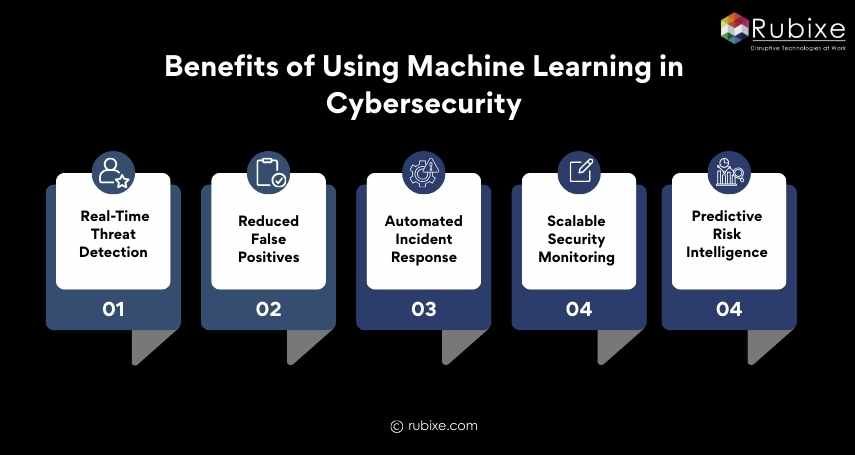
1. Real-Time Threat Detection
Machine learning analyses millions of data points within seconds. It identifies malware activity, suspicious login attempts, abnormal traffic flows, and lateral movement across networks. An advanced framework of AI cybersecurity service uses these capabilities to stop threats before they escalate.
2. Reduced False Positives
Security teams often deal with alert fatigue. Machine learning models refine detection accuracy over time, filtering irrelevant alerts and prioritising high-risk activities.
3. Automated Incident Response
Automation allows immediate containment actions such as isolating compromised endpoints or blocking malicious IP addresses. This significantly reduces response time.
4. Scalable Security Monitoring
As businesses grow, data volume increases. Machine learning scales effortlessly, ensuring protection across cloud, on-premise, and hybrid environments.
5. Predictive Risk Intelligence
Machine learning identifies emerging attack patterns and predicts vulnerabilities, strengthening proactive defense strategies within AI cybersecurity service solutions.
Why Businesses Should Integrate Machine Learning for Security
-
Stronger Threat Visibility
Machine learning processes high-volume data streams across cloud infrastructure, applications, and endpoints. This improves visibility into hidden risks.
-
Faster Containment
Automated responses reduce dwell time, the period attackers remain undetected within systems.
-
Improved Cost Efficiency
Early detection lowers breach impact, regulatory penalties, and recovery expenses. Investing in a right AI cybersecurity service reduces long-term financial exposure.
-
Continuous Adaptation
Threat actors evolve techniques frequently. Machine learning adapts without requiring manual rule updates.
-
Competitive Security Advantage
Organisations demonstrating advanced cybersecurity capabilities build stronger trust with customers, partners, and regulators.
Recent industry research shows that over 60% of organisations are actively integrating machine learning and AI tools into core cybersecurity processes, with the AI cybersecurity market expected to exceed $38 billion by 2026, reflecting rapid adoption of intelligent threat detection and response systems.
What’s Next: The Future of Machine Learning in Cybersecurity
The evolution of AI cybersecurity service models is accelerating. Emerging advancements include:
-
Self-learning security orchestration systems
-
Real-time threat intelligence fusion
-
Adaptive zero-trust frameworks
-
AI-driven vulnerability management
-
Autonomous security operations centres
As attack surfaces expand with IoT, remote work, and cloud computing, machine learning will remain central to scalable protection strategies.
Organisations investing in intelligent cybersecurity infrastructure today position themselves for stronger resilience tomorrow.
Frequently Asked Questions
1. How does machine learning improve cybersecurity accuracy?
Machine learning analyses behavioural patterns and historical attack data to reduce false positives and improve threat precision.
2. Can machine learning detect zero-day attacks?
Yes. By identifying anomalies rather than relying solely on known signatures, it recognises unknown or emerging threats.
3. Is machine learning suitable for small and mid-sized businesses?
Scalable AI cybersecurity service models allow businesses of all sizes to implement machine learning-based protection.
4. Does machine learning replace human cybersecurity teams?
Machine learning supports analysts by automating monitoring and detection. Strategic oversight remains essential.
5. How secure is AI-based cybersecurity infrastructure?
When properly implemented with governance controls and regular model updates, machine learning strengthens overall security posture.
Strengthen Your Cyber Defense with Intelligent Protection
Machine learning has become a defining force in modern cybersecurity. Businesses seeking faster detection, automated response, and scalable protection are increasingly adopting AI cybersecurity service models to secure digital assets.
A structured, enterprise-grade cybersecurity strategy built on AI and machine learning can significantly reduce vulnerabilities, improve compliance readiness, and enhance operational resilience.
To explore AI cybersecurity solutions designed for evolving threat landscapes, connect with a specialised team delivering intelligent, scalable, and future ready protection frameworks.