

Fix Attendance Errors with AI Facial Recognition System
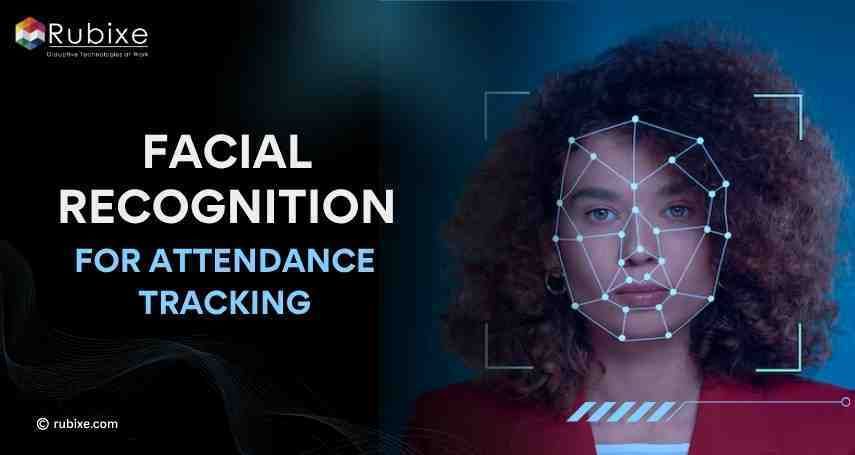
Facial recognition for attendance tracking verifies employee identity, reduces buddy punching, and improves workforce accuracy with real-time systems.
Most operations managers I speak to carry a quiet suspicion about their attendance data. They see 95% on the report. They know the floor tells a different story. Someone clocked in for a colleague who hadn't arrived. Someone left early but is marked present. The system logged a credential, not a person.
That gap between the record and reality is exactly what AI facial recognition solutions are built to close.
This is why many companies are moving from biometric devices to a facial recognition attendance system for employees that ensures real identity verification.
What is an AI Facial Recognition System?
An AI facial recognition system is a technology that uses artificial intelligence to identify or verify a person by analyzing their facial features from images or video.
It works by capturing a face, extracting unique facial patterns (like distance between eyes, nose shape, jawline), and matching them with stored data to confirm identity in real time.
Why Traditional Attendance Systems Keep Failing You
Manual registers, RFID cards, and PIN-based punch clocks share a critical flaw: they track a credential, not a person.
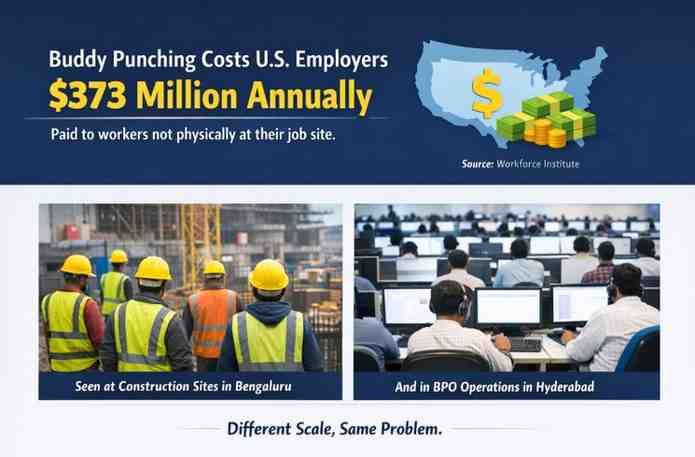
Research has found that buddy punching costs US employers an estimated $373 million annually, paid to workers not physically at their job site. That number may be geography-specific, but the behavior is universal. I've seen it in construction sites in Bengaluru and in BPO operations in Hyderabad. The scale differs. The pattern doesn't.
 Fingerprint scanners were the industry's first real answer. They work reasonably well until the workforce scales past 500 employees, shift changes happen in under 10 minutes, or the scanner sits near a dusty production floor where fingerprints don't read cleanly. I've watched lines of workers queue at a single biometric terminal at 8:58 AM for a 9:00 AM shift. That's not efficient. That's a new problem with old clothes.
How AI Facial Recognition Solutions Work
AI facial recognition for attendance doesn't just capture a face. It verifies a live person against a stored biometric profile in under two seconds, without any physical contact.
A modern AI attendance system eliminates manual errors and simplifies workforce tracking.
Here's what that means operationally:
-
No touching shared hardware
-
No queuing at a single terminal
-
No proxy possible, the system sees the face, not a card or PIN
-
Logs are timestamped and tamper-proof
Modern systems use 2D and 3D facial mapping to extract over 80 nodal points, the distance between eyes, the depth of cheekbones, and the jawline geometry. These are compared against an enrolled profile in real time. If the face doesn't match, the system doesn't record attendance.
Well-implemented AI facial recognition attendance systems can achieve accuracy rates of 94 - 99% under real-world conditions, meaningfully higher than manual verification or RFID. That accuracy gap matters when you're running payroll for 1,000+ employees
AI Facial Recognition Solutions for Attendance in Real Workplaces
A manufacturing client we worked with ran three shifts across two facilities. Their legacy punch card system had no way to distinguish who was on which shift, or whether the person scanning at 6:00 AM was actually scheduled for that slot. Overtime claims were nearly impossible to verify.
After deploying an AI facial recognition attendance system with edge cameras at entry points, the result over 90 days was a 23% reduction in disputed overtime claims and a payroll reconciliation turnaround that dropped from two days to four hours. Not because the system was magic, but because the data was finally trustworthy.
This is also a practical example of how AI facial recognition improves customer experience. When internal operations run on accurate, real-time data, businesses can ensure better staffing, faster response times, and more consistent service delivery.
That's the real value. Not just the capture of attendance, but the downstream confidence in every decision that data powers: scheduling, compliance reporting, contractor billing, and shift analysis.
Comparing Attendance Systems: What You're Actually Choosing Between
|
Feature |
Manual / Register |
RFID / Card |
Fingerprint |
AI Facial Recognition |
|
Proxy-proof |
✗ |
✗ |
Partial |
✓ |
|
Contactless |
✗ |
✓ |
✗ |
✓ |
|
Real-time sync |
✗ |
Partial |
Partial |
✓ |
|
Works at scale (500+) |
✗ |
✓ |
Partial |
✓ |
|
Integration with HRMS |
Manual |
Partial |
Partial |
✓ |
|
Accuracy under poor lighting |
N/A |
High |
Moderate |
Moderate–High |
|
Audit trail |
✗ |
Partial |
✓ |
✓ |
The table makes one thing clear: no system is without trade-offs. AI facial recognition struggles in extremely poor lighting or when occlusion (masks, helmets, glasses) is heavy. It works best when entry points are reasonably controlled, a standard that most commercial premises already meet.
The Market Is Growing Because the Problem Is Real
The global face recognition attendance system market was estimated at USD 1.37 billion in 2022 and is projected to reach USD 4.88 billion by 2030, growing at a CAGR of 17.2%. That kind of growth doesn't happen because of hype. It happens because HR teams across sectors are hitting the same wall with their current systems, and finding that AI facial recognition is the first scalable alternative that actually removes the proxy problem at the root.
The Asia Pacific region, where workforce density and shift-based industries are concentrated, is among the fastest-growing adopters. India's manufacturing, logistics, and IT sectors are active deployment environments right now.
How AI Facial Recognition Fixes Attendance Errors
AI facial recognition systems automate attendance tracking by verifying employee identity in real time, eliminating manual errors and fraud.
1. Eliminates Buddy Punching
Ensures only the actual employee can mark attendance through face verification.
2. Accurate Time Tracking
Captures precise check-in and check-out timestamps without manual input.
3. Prevents Manual Errors
Removes inaccuracies caused by registers, cards, or biometric failures.
4. Contactless & Secure
Enables hygienic, touch-free attendance with high-level security.
5. Real-Time Monitoring
Provides instant visibility into employee attendance and shifts.
6. Fraud & Duplicate Detection
Identifies fake entries or duplicate identities instantly.
What to Get Right Before You Deploy
This is where most implementations stumble. The technology is mature. The integration often isn't.
-
Enrolment quality matters most: If the initial facial data capture is done in poor light or at bad angles, the system will generate false rejections in production. Spend time on enrolment. It determines everything downstream.
-
HRMS integration is non-negotiable: A facial recognition terminal that logs data into a separate silo, disconnected from your payroll or leave management system, has halved its value before day one. Insist on API-level integration with your existing HR stack.
-
Privacy and consent must be addressed upfront: Biometric data is sensitive. Employees have a right to know how their facial data is stored, for how long, and who has access to it. This isn't optional, it's both an ethical requirement and, in many jurisdictions, a legal one. Gartner flagged that deepfake-based attacks on biometric systems increased 200% in 2023, which means the data security architecture around your facial recognition system matters as much as the system itself.
-
Lighting and camera placement are hardware decisions, not software ones: A well-placed IR camera at eye level in consistent lighting outperforms expensive AI on a poorly mounted camera every time.
Benefits of AI Facial Recognition Solutions Across Industries
This shift also enables employee attendance automation, reducing dependency on manual processes.
-
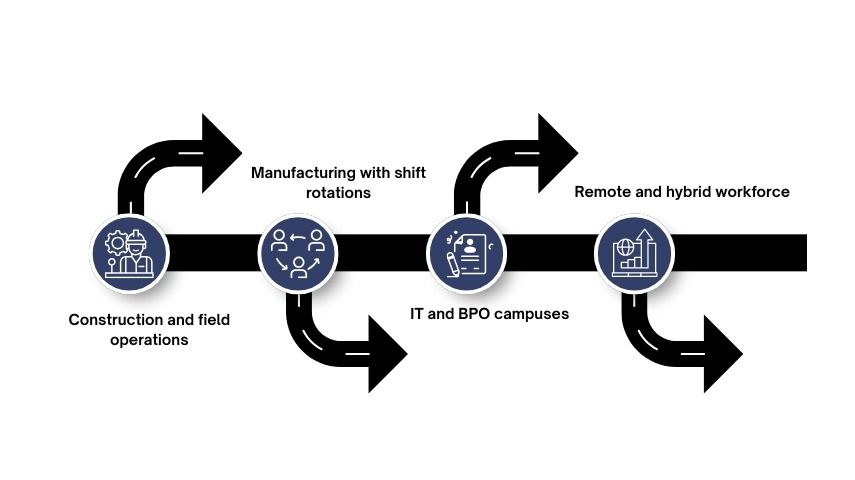
Construction and field operations: Distributed worksites with large contractor workforces where verification of who is actually on-site is a safety and billing requirement, not just HR compliance.
-
Manufacturing with shift rotations: where the cost of incorrect overtime claims accumulates quickly, and the workforce is too large for manual verification to be reliable.
-
IT and BPO campuses: where contactless systems reduce hygiene concerns and high-volume entry points (500 - 1,000 employees in a 15-minute window) need parallelized check-in.
-
Remote and hybrid workforce: Integrated with video-based check-in tools, AI facial recognition can verify identity at virtual punch-in, reducing the gap between "logged in" and "actually working."
The Honest Limitation You Should Know
AI facial recognition is not equally accurate across all demographic groups in older or lower-quality models. This is a documented gap, not in well-calibrated modern systems, but you should ask your vendor directly: what is the false rejection rate across your workforce demographic? If they can't answer that, probe harder.
No technology earns trust by overpromising. The best AI implementations I've seen are the ones where the HR team understood the system's constraints before deployment, not after the first dispute.
FAQs
1. What is a facial recognition attendance system?
A facial recognition attendance system identifies employees using AI and automatically marks attendance based on real-time facial data.
2. Is AI attendance accurate?
Yes, well-implemented AI systems can achieve up to 94 - 99% accuracy in real-world conditions.
3. Can facial recognition replace biometric systems?
In most cases, yes. It offers better accuracy, faster processing, and contactless operation.
4. Is facial recognition safe for employee data?
It is safe when proper data security, access control, and compliance practices are followed.
Fix Attendance Errors with AI Facial Recognition Solutions
Pull your last three months of attendance data and calculate the gap between scheduled hours and verified hours. If that number surprises you, and for most organisations it will, you now have the business case to explore AI facial recognition attendance solutions.
The data you're working from is only as reliable as the system that captured it.
Ready to see how AI facial recognition fits your specific workforce? Talk to the team at Rubixe. We've deployed AI solutions across industrial and enterprise environments and can give you a clear, no-hype assessment of what works at your scale.