










AI Readiness Assessment: Why Companies Get It Wrong Before They Start
Not sure if your business is ready for AI? This honest guide covers the AI readiness assessment checklist and frameworks that actually work.
Every week, I speak to business leaders who have already spent months, sometimes over a year, trying to "get AI off the ground." The story is almost always the same. They bought a tool. They hired a vendor. They ran a pilot. And then nothing moved.
The problem was never the technology. The problem was that nobody paused long enough to ask: Are we actually ready for this?
That is exactly what an AI readiness assessment is designed to answer. Not just "can we do AI?" but "what will it take, specifically, for our organisation to make AI work?"
What Is AI Readiness Assessment?
An AI readiness assessment is a structured audit of your organisation's current state across five critical dimensions: strategy, data, infrastructure, people, and governance.
It does not tell you which AI vendor to pick. It tells you what gaps stand between your ambitions and your ability to execute before you commit budget and time.
I have seen companies skip this step and pay dearly. A manufacturing firm I worked with spent eight months building a predictive maintenance model on data that had never been cleaned or labelled. The model was technically sound. The data was not. The project was scrapped. That is an avoidable loss, and a very common one.
Running an AI audit assessment before you invest is not caution. It is a strategy.
5 Pillars of AI Readiness Framework
Over two decades of working in AI implementation, I have seen these five areas determine whether a project succeeds or dies.
1. Strategic Alignment - Do You Know Why You Are Doing This?
The single most dangerous phrase I hear in boardrooms is: "We need to be doing something with AI."
That is not a strategy. That is pressure.
Before any technical work begins, leadership must define the specific business problems AI is being asked to solve. Not broad themes, specific problems. "Reduce customer churn by 15% in the next two quarters" is a usable objective. "Use AI to improve customer experience" is not.
Ask yourself:
-
Which business unit will use this, and how?
-
What does success look like 12 months from now?
-
Who owns accountability for outcomes - not just delivery?
If these questions do not have clear answers, the AI readiness assessment starts here.
2. Data Readiness - The One Factor That Decides Everything
Bad data kills AI projects faster than anything else.
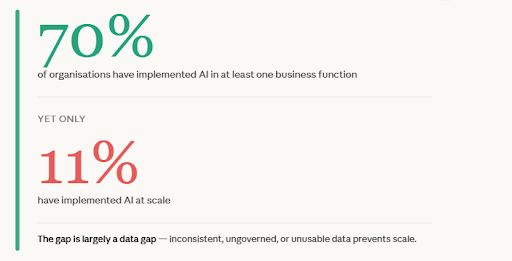
Over 70% of organisations have implemented AI in at least one business function - yet only 11% have implemented it at scale. The gap between 70% and 11% is largely a data gap. Organisations that got AI into pilots could not scale because their data was inconsistent, ungoverned, or simply not in a format AI systems could use.
 Your data readiness checklist should include:
-
Availability - Does the data actually exist, and can your systems access it in real time?
-
Quality - Is it clean, labelled, and consistent across sources?
-
Governance - Do you have policies for who owns, accesses, and updates data?
-
Volume - Do you have enough historical data for the use case you have in mind?
A useful test: ask three people in your organisation where the last 12 months of sales data lives. If they give you three different answers, your data readiness is low.
3. Technology Infrastructure - Can Your Systems Support AI?
AI does not run on intention. It runs on compute, connectivity, and integration.
You do not need to have everything built. But you need to know what you do not have, so you can plan for it.
This includes evaluating whether your current systems can handle data pipelines, integrate with AI models, and scale as usage grows.
4. People and Skills - The Gap Nobody Wants to Talk About
This is where most AI readiness audits are too polite.
According to Gartner's 2024 survey, in 57% of high-maturity AI organisations, business units trust and are ready to use new AI solutions compared to just 14% in low-maturity organisations. That gap is not about tools. It is about people, culture, and trust.
I have watched technically successful AI deployments fail because the team using the outputs did not understand them, did not trust them, and quietly went back to their spreadsheets. Adoption does not happen by default.
5. Governance and Ethics - The Dimension Most Companies Skip
Governance is the least glamorous part of the framework. It is also the one that protects you.
This covers:
-
Responsible AI policies - who decides how models are used and updated?
-
Bias monitoring - how do you detect and correct for bias in model outputs?
-
Regulatory compliance - especially for sectors like finance, healthcare, or HR, where AI decisions carry legal weight
-
Accountability structures - when the AI is wrong, who is responsible?
McKinsey's 2024 survey found that just 18% of organisations have an enterprise-wide council with authority to make decisions involving responsible AI governance. If you are in the other 82%, you are making AI decisions without a safety net.
AI Readiness Levels: Where Does Your Organisation Stand?
The table below maps the five readiness levels most frameworks use, with honest descriptions of what each looks like in practice.
|
Readiness Level |
What It Looks Like |
Typical Next Step |
|
Level 1 - Unaware |
No AI initiatives, no data strategy, no AI literacy in leadership |
Executive education, basic data audit |
|
Level 2 - Exploring |
Pilots underway, but ad hoc, no governance, poor data quality |
Define a focused use case, clean core data |
|
Level 3 - Developing |
One or two AI tools in production, but siloed and unscaled |
Build central governance, integrate data sources |
|
Level 4 - Scaling |
Multiple functions using AI, governance in place, and ROI being tracked |
Expand use cases, upskill business teams |
|
Level 5 - Embedded |
AI integrated into core operations, continuous improvement culture |
Innovate at the model layer, explore frontier AI |
Most organisations I assess sit at Level 2 or 3. That is not a failure. It just means the path forward requires foundations first, not more pilots.
A Practical AI Readiness Checklist

Use this as a starting point. It is not exhaustive, but it will surface your biggest gaps quickly.
Strategy
-
AI use cases tied to specific, measurable business outcomes
-
Executive sponsor identified for each initiative
-
AI roadmap is reviewed at least quarterly by leadership
Data
-
Inventory of all data sources completed
-
Data quality baseline established (completeness, accuracy, consistency)
-
Data governance policy documented and enforced
Infrastructure
-
Cloud or on-premise architecture decision made and documented
-
Core systems have API access for AI integration
-
Security and access controls meet regulatory requirements
People
-
Skills gap analysis completed across AI-facing teams
-
Training plan in place for both technical and non-technical staff
-
A change management plan exists for the affected workflows
Governance
-
Responsible AI policy in place
-
Model monitoring and retraining process defined
-
Compliance review completed for sector-specific regulations
What Separates Organisations That Scale AI From Those That Stay Stuck in Pilots
Gartner's research is direct on this: by 2030, CIOs expect that 75% of all IT work will be done by humans augmented with AI, and 25% by AI alone. That is not a distant future. It is four years away.
The organisations that will be in that 75%+25% are already building readiness today. The ones that will be scrambling are running their fourth pilot with no governance, no data strategy, and no clear owner.
In my experience, the companies that scale AI share three traits:
-
They start with a problem, not a technology. They identify a specific pain point, a bottleneck in operations, a data-heavy task that consumes analyst time, a customer drop-off pattern that nobody has been able to explain. They then ask whether AI can solve it, and how.
-
They treat data as infrastructure, not a by-product. These companies invested in data quality and governance before they needed it for AI. They are not scrambling to clean 10 years of messy CRM records while trying to train a model at the same time.
-
They involve business teams from day one. The best AI deployments I have seen had operations managers, customer service leads, and sales teams in the room from the design phase, not just the IT department. When the output landed, people understood it and used it.
Your AI Readiness Check-In Starts With One Conversation
Pull together four people: your head of IT, your head of data (or the person who owns your databases), one business unit leader, and one HR or L&D lead.
Ask each of them: "If we started an AI project next month, what is the single biggest thing that would stop it from working?"
Write down the four answers. You now have your AI readiness assessment priorities.
If the answers are technical, your infrastructure or data maturity is low. If the answers are about people or culture, your change readiness is the gap. If nobody can answer the question at all, the strategy gap is your first problem to solve.
At Rubixe, we run structured AI readiness assessments as the first step of every end-to-end AI engagement. Not because it is a service. Because every time we have skipped it or a client has insisted on skipping it, the project has cost more, taken longer, and delivered less than it should have.
The assessment does not slow you down. It stops you from running fast in the wrong direction.
Ready to find out where your organisation actually stands?
Book a complimentary AI Readiness Assessment with Rubixe - a structured 90-minute session that gives you a clear view of your gaps, strengths, and the right place to start.