










AI Readiness Audit: Why Most Businesses Fail Before AI Even Starts
Assess your IT infrastructure, data, and teams for AI readiness. Follow our checklist, maturity model, and industry examples to ensure successful AI adoption.
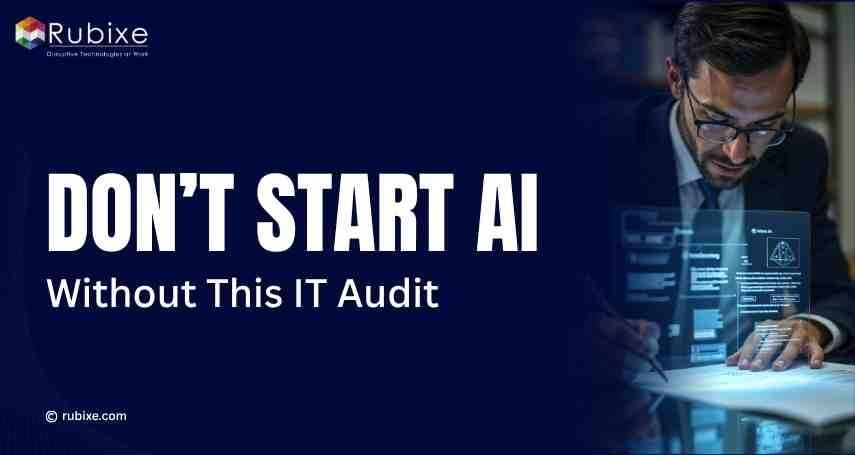
Is your IT infrastructure ready for AI adoption?
Many businesses implement AI tools expecting instant results, only to face delays, underperformance, or failed projects. The main reason for AI project failures is often that businesses’ IT systems, data, and teams are not fully ready to support AI.”
An AI Readiness Audit evaluates infrastructure, data, talent, and processes, identifies gaps, and sets a roadmap for successful AI deployment.
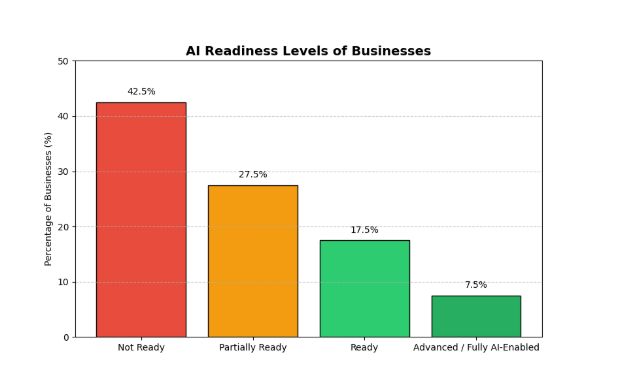
According to our AI Readiness Audit framework, nearly 35 - 50% of businesses are “Not Ready” for AI adoption, 25 - 30% are “Partially Ready,” 15-20% are “Ready,” and only 5-10% are “Advanced / Fully AI-Enabled.”
What is an AI Readiness Audit?
An AI Readiness Audit is a structured assessment that helps a business determine its readiness to adopt and implement artificial intelligence (AI) effectively. It doesn’t just look at whether you can buy AI tools it evaluates the foundational elements that make AI successful.
-
IT systems: Are servers, storage, and networks strong enough?
-
Data: Is it accurate, accessible, and organized?
-
Security and compliance: Are data protection and regulations in place?
-
Team skills: Does your team have the knowledge to use AI?
-
AI projects: Are the AI ideas practical and aligned with business goals?
Instead of jumping straight into AI tools, this audit gives a clear roadmap showing what needs fixing before you start.”
Why IT Infrastructure Matters for AI
AI is data-intensive and compute-heavy. Weak infrastructure leads to:
-
Slow processing and delayed insights
-
Limited AI adoption across departments
-
Increased security and compliance risks
-
Higher operational costs
Example: A mid-sized e-commerce company implemented AI for personalized recommendations but faced delays due to non-scalable servers. After an AI readiness audit, they migrated to cloud infrastructure, centralized data, and integrated systems, boosting AI performance by 35%.
AI Readiness Framework: Core Dimensions
Step 1: Assess Infrastructure Readiness
Evaluate whether IT systems can handle AI workloads:
-
Server capacity: Can it handle high-volume processing?
-
Cloud readiness: Is cloud adoption scalable?
-
Storage: Can large datasets be stored efficiently?
-
Network performance: Is latency low enough for AI applications?
Checklist Tip:
Upgrade legacy servers, enable cloud scalability, and test network bandwidth before AI implementation.
Step 2: Evaluate Data Readiness
Data is the foundation of AI success. Audit points include:
-
Are datasets clean, accurate, and validated?
-
Are data sources centralized or fragmented?
-
Are access controls and permissions properly managed?
-
Is a governance framework in place to maintain compliance and quality?
Example: A healthcare company consolidated fragmented patient data after an AI readiness audit, improving predictive model accuracy by 40%.
Step 3: Assess System Integration
AI performs best when systems communicate seamlessly:
-
Integrate AI tools with CRM, ERP, and marketing platforms
-
Ensure dashboards consolidate AI insights
-
Test real-time data pipelines for latency
Common Issue: Many businesses use siloed systems, which limit AI effectiveness. Integration resolves this and enables actionable insights.
Step 4: Security & Compliance Readiness
AI increases data use, making security and compliance critical:
-
Encrypt sensitive data and implement access controls
-
Ensure compliance with GDPR, HIPAA, and local regulations
-
Establish AI ethics and governance policies
Tip: Implement continuous monitoring to prevent breaches and ensure compliance.
Step 5: Evaluate Team & Talent Readiness
Even perfect infrastructure fails without skilled teams:
-
Assess AI literacy and data knowledge
-
Identify training needs
-
Assign roles for AI governance, maintenance, and decision-making
Pro Tip: Begin with pilot projects to train teams and scale gradually.
Step 6: Prioritize AI Use Cases
Not all AI initiatives deliver equal impact. Evaluate use cases based on:
-
Feasibility (technical & organizational)
-
Expected ROI
-
Data availability
-
Alignment with business objectives
Example: A logistics company focused on AI-powered route optimization before predictive maintenance, ensuring immediate cost savings.
AI Readiness Maturity Model
|
Level |
Description |
Key Characteristics |
Technology & Data |
People & Governance |
Business Impact |
|
Foundational |
Limited or no structured AI adoption |
Fragmented initiatives, reactive decision-making, no clear AI vision |
Legacy systems, siloed data, minimal cloud adoption |
No AI ownership, low awareness, absence of governance frameworks |
Minimal impact, operational inefficiencies, missed opportunities |
|
Emerging |
Early-stage experimentation with AI |
Isolated use cases, pilot projects, growing leadership interest |
Initial cloud adoption, partial data availability, basic tooling |
Small AI/analytics teams, limited skills, informal processes |
Localized improvements, limited ROI, proof-of-concept outcomes |
|
Operational |
Structured and scalable AI adoption |
Defined AI strategy, prioritized use cases, cross-functional alignment |
Centralized data platforms, integrated systems, production-ready models |
Skilled teams, formal governance, defined roles and processes |
Measurable ROI, improved efficiency, enhanced customer experience |
|
Transformational |
AI embedded across the enterprise |
AI-driven decision-making, continuous optimization, enterprise-wide adoption |
Scalable infrastructure, real-time data pipelines, advanced ML/GenAI capabilities |
Mature governance, AI-first culture, continuous upskilling |
High ROI, competitive advantage, innovation-led growth |
|
Autonomous Enterprise |
AI-native organization with self-optimizing systems |
Autonomous workflows, predictive & prescriptive decisioning, AI embedded in all functions |
Fully automated data pipelines, adaptive AI systems, advanced GenAI & agentic architectures |
Organization-wide AI fluency, decentralized decision-making, continuous governance evolution |
Market leadership, exponential scalability, new business models |
Use this model to identify gaps and prioritize actions.
AI Readiness Checklist (Quick Reference)
-
Centralize and clean all data
-
Upgrade IT infrastructure (servers, storage, cloud)
-
Integrate systems for seamless AI operations
-
Train teams on AI tools and data literacy
-
Prioritize use cases based on ROI and feasibility
-
Implement security, compliance, and ethical policies
-
Monitor AI performance and governance continuously
This checklist is practical and actionable.
Common Mistakes Businesses Make
-
Skipping the readiness assessment and implementing AI immediately
-
Ignoring data quality or system integration
-
Overlooking security and compliance
-
Underestimating training needs
-
Selecting AI use cases without evaluating ROI
Avoiding these ensures better performance, faster adoption, and higher ROI.
Benefits of an AI Readiness Audit
1. Faster Implementation: A readiness audit helps organizations create a clear AI implementation roadmap, ensuring that systems, data, and teams are prepared before deployment. This avoids delays and allows AI initiatives to perform effectively from the start.
2. Cost Savings: By evaluating infrastructure and processes through an AI infrastructure assessment and AI system integration review, businesses can prevent investments in tools or workflows that don’t deliver value.
3. Higher ROI: Understanding which projects are feasible and aligning them with business objectives through AI project readiness checks and a maturity model ensures each initiative contributes to measurable AI project ROI.
4. Reduced Risk: A structured audit incorporates AI governance and compliance checks, ensures proper enterprise AI preparation, and validates cloud AI infrastructure, minimizing operational failures, security issues, and regulatory risks.
Actionable Insights: A thorough AI readiness checklist, combined with strong AI data management practices and AI team training, gives businesses practical guidance to start AI pilot projects confidently and scale initiatives successfully.
Real World Example
Company: Mid-sized e-commerce business
Problem: Legacy servers, fragmented data, disconnected systems
Audit Outcome:
-
Migrated to cloud infrastructure
-
Centralized and cleaned data
-
Integrated systems for AI insights
Result:
-
35% faster AI processing
-
30% increase in personalized recommendations
-
Reduced operational inefficiencies
This example demonstrates how preparation drives AI success.
Industry-Specific Use Cases
-
Healthcare: AI-powered patient outcome predictions
-
Retail: Personalized recommendations and inventory forecasting
-
Finance: Fraud detection and risk assessment
-
Logistics: Route optimization and predictive maintenance
Next Steps for Businesses
-
Conduct an AI Readiness Audit using the checklist and maturity model
-
Score your infrastructure, data, and team readiness
-
Address gaps systematically
-
Implement pilot AI projects
-
Scale AI initiatives once readiness is verified
Key Takeaway: AI success starts with preparation, systems, and people - not just tools.
FAQs
Q1: What is an AI Readiness Audit?
A: It evaluates IT infrastructure, data, team skills, and governance to ensure successful AI adoption.
Q2: Why is IT infrastructure important for AI readiness?
A: AI requires strong servers, cloud capacity, storage, and network performance. Weak infrastructure causes delays and poor results.
Q3: What are the key steps in an AI readiness assessment?
A: Assess infrastructure, evaluate data, integrate systems, ensure security, train teams, and prioritize AI use cases.
Q4: How can a business measure AI readiness?
A: Use a maturity model with levels: Unprepared, Developing, Ready, and Advanced, along with a checklist for action items.
An AI Readiness Audit is not just a technical exercise, it’s a strategic step to ensure your business maximizes the value of AI investments. By evaluating infrastructure, data, team skills, and governance, you can identify gaps, mitigate risks, and prioritize AI initiatives that deliver measurable results.
Start your AI readiness journey today by auditing your IT systems, data, and teams. Implement pilot projects, optimize processes, and scale confidently, knowing your business is fully prepared for AI success.