






AI Consulting vs AI Development: Key Differences
Understand AI consulting vs AI development, key differences, roles, use cases, and how businesses can choose the right approach for better results and ROI.
Are You Building AI… or Just Guessing?
Many businesses today want to use AI. They hear about automation, smart tools, and better decision making, so they decide to invest in AI quickly.
But here is the problem:
Are you solving the right problem, or just building something because everyone else is doing it?
This is where most businesses make a mistake. They jump into AI development without planning. They build tools, models, or systems, but later realize it does not help their business.
In many cases, teams spend months building something that looks advanced but does not solve a real business need. Reports look impressive, dashboards are created, and models are deployed, but the impact on revenue, cost savings, or efficiency is very low.
This confusion comes from not understanding the difference between AI consulting and AI development.
If you want real results, you must know how these two are different and how they work together. Without this clarity, even a large investment in AI can fail to deliver value.
What is an AI Consulting Company?
An AI consulting company helps businesses plan, design, and align AI with business goals.
They don’t jump into coding first.
They focus on understanding the business before suggesting any solution. Their role is to connect business needs with the right technology approach.
They start with questions like:
-
What problem are you solving?
-
Is AI even required here?
-
Do you have the right data?
-
What ROI can you expect?
These questions may look simple, but they are critical. Many businesses skip them and move directly to building solutions.
Key Focus Areas
-
Business problem identification
-
AI strategy and roadmap
-
Tool and technology selection
-
Risk and feasibility analysis
An AI consulting company also helps in prioritizing use cases. Not every problem needs AI. Sometimes, a simple automation or rule-based system can solve the issue faster and at a lower cost.
They also define success metrics. For example:
-
Increase sales by 15%
-
Reduce operational cost by 20%
-
Improve customer retention
Without clear metrics, it becomes difficult to measure whether the AI project is successful or not.
What is AI Development?
AI development is the execution phase. It involves building, training, testing, and deploying AI models or systems. This is where coding, algorithms, and infrastructure come in.
It is a highly technical process that requires strong expertise in machine learning, data engineering, and software development.
Key Focus Areas
-
Model development (ML, NLP, Computer Vision)
-
Data engineering and preprocessing
-
API and system integration
-
Testing and deployment
-
Performance optimization
AI developers take the plan created during the consulting phase and turn it into a working system.
They handle tasks like:
-
Cleaning and preparing data
-
Selecting the right algorithms
-
Training models
-
Testing accuracy
-
Deploying models into real systems
Their goal is to ensure that the AI solution works efficiently and can scale as the business grows.
Simple Example
Continuing the retail case:
AI developers will:
-
Build a recommendation engine
-
Train models on customer behavior
-
Integrate it into the website or app
They ensure the solution works technically.
To expand this further, imagine an e-commerce company.
Without proper planning, developers might build a recommendation system that suggests random products. But with proper consulting, the system can be designed to:
-
Recommend products based on past purchases
-
Increase average order value
-
Improve customer experience
This shows how planning directly impacts results.
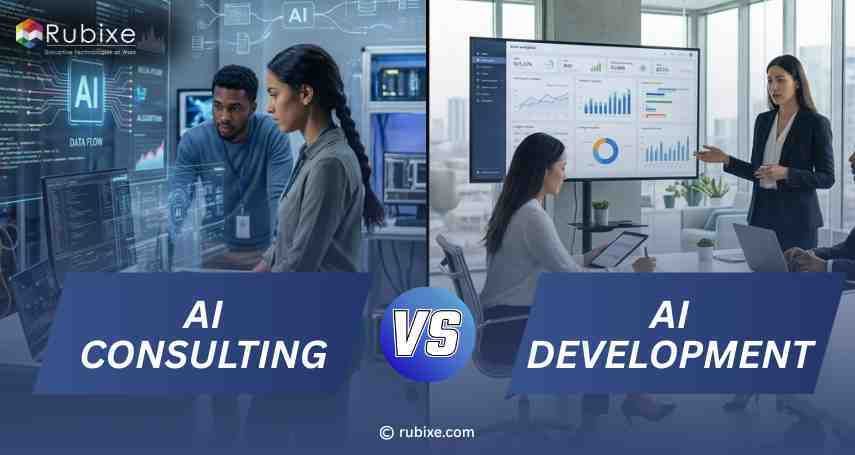
AI Consulting vs AI Development: Core Difference
The simplest way to understand this:
AI Consulting = Decides WHAT and WHY
AI Development = Builds HOW
Many businesses skip the first step and go straight to development.
When this happens, teams often face problems like:
-
Building features that are not needed
-
Spending budget without clear returns
-
Struggling to measure success
This is why understanding the core difference is critical.
|
Aspect |
AI Consulting Company |
AI Development |
|
Main Focus |
Business strategy and planning |
Technical implementation |
|
Purpose |
Identify what to build and why |
Build how it works |
|
Starting Point |
Business problem or goal |
Defined AI requirement |
|
Key Role |
Advisor / Strategist |
Developer / Engineer |
|
Core Activities |
Use case identification, data assessment, and roadmap creation |
Model building, training, testing, deployment |
|
Skill Set |
Business understanding, data analysis, and ROI planning |
Programming, ML frameworks, system integration |
|
Output |
AI strategy, feasibility report, roadmap |
AI models, applications, and deployed systems |
Why Businesses Confuse These Two
There are three common reasons:
1. “We Just Need AI.”
Many companies think AI itself is the solution.
But AI is only useful when applied to the right problem.
For example, a business may want to use AI for customer support. But if their main issue is slow response time due to a lack of staff, a simple chatbot or process improvement might solve it without complex AI.
2. Vendor-Driven Decisions
Some vendors push development directly because it’s easier to sell. Strategy takes time. Development brings faster billing.
As a result, businesses start building solutions without proper planning.
3. Lack of Data Awareness
Businesses underestimate how important data quality is.
Without proper data:
-
Models cannot learn properly
-
Predictions become inaccurate
-
Results become unreliable
Data is the foundation of AI. Ignoring it leads to failure.
Can We Have Both?
Yes, and in most cases, you should.
The best approach is:
Consult → Plan → Build → Improve
Each step plays an important role:
-
Consult: Understand the problem
-
Plan: Define the solution
-
Build: Develop the system
-
Improve: Optimize based on results
Skipping the consulting phase often leads to:
-
Wrong use cases
-
Budget overruns
-
Low adoption
Common Mistakes Businesses Make
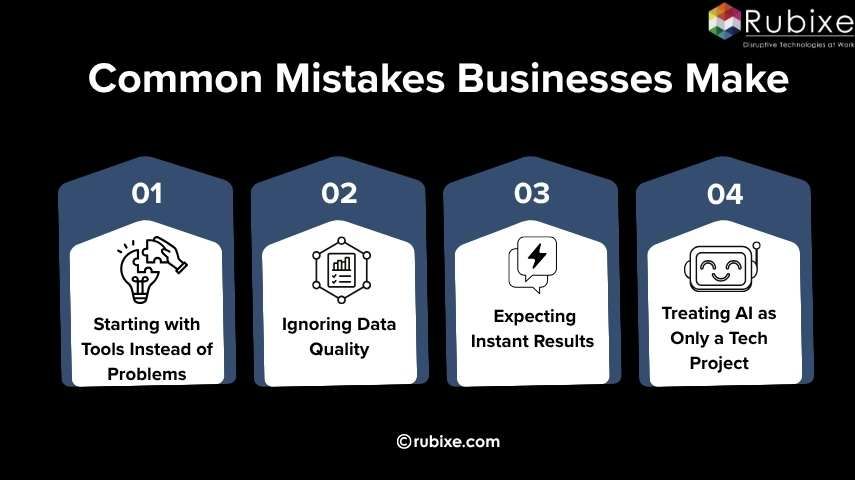
1. Starting with Tools Instead of Problems
Buying AI tools without a clear goal leads to confusion. Tools are only useful when you know how to use them effectively.
2. Ignoring Data Quality
AI depends on data. Poor data = poor results.
Businesses should invest time in:
-
Data cleaning
-
Data organization
-
Data validation
3. Expecting Instant Results
AI is not a quick fix. It needs planning and iteration. Models improve over time as more data becomes available.
4. Treating AI as Only a Tech Project
AI is a business transformation, not just software.
It affects:
-
Decision-making
-
Customer experience
-
Operational efficiency
Ignoring this broader impact limits the value of AI.
What Should You Do Next?
If you are just starting:
-
Focus on understanding your business needs
-
Assess your data readiness
-
Build a clear AI strategy
If you already have a plan:
-
Move to development with defined goals
-
Track performance and improve continuously
You should also ensure that teams across departments are aligned. AI projects often fail when business teams and technical teams do not communicate effectively.
From Strategy to Execution
AI is powerful, but only when used correctly. An AI consulting company ensures that you are solving the right problem and using the right approach.
AI development ensures that the solution is built and works properly.
Both are important. But the order matters.
Start with clarity. Then move to execution.
The Key Takeaway
Don’t just build AI.
Build the right AI - for the right reason.