







AI Services for Better Shopping Experiences in E-commerce
AI services for e-commerce help retailers manage inventory, personalize shopping experiences, use predictive analytics, and improve customer interactions.
Why do online shopping experiences so often frustrate customers?
Endless scrolling, irrelevant recommendations, and checkout friction can turn buying intent into abandonment. As e-commerce keeps growing, success isn’t about the biggest catalogue or the lowest price, it’s about guiding each customer intelligently. AI Services are quietly transforming e-commerce, turning clicks into confidence and visits into lasting loyalty.
- 80% of customers are more likely to buy from brands offering personalized experiences
- AI-driven recommendations contribute up to 35% of e-commerce revenue
- Cart abandonment rates average nearly 70% globally
Why E-commerce Experiences Break So Easily
-
Unexpected cart abandonment: Customers leave purchases midway when the experience feels slow, confusing, or irrelevant, directly impacting conversion rates.
-
Generic or intrusive personalization: Manual or rule-based personalization often falls short, either feeling too impersonal or overbearing, which can frustrate shoppers.
-
Search results that miss intent: Traditional search tools struggle to understand nuanced queries, leading to irrelevant results and lost sales opportunities.
-
Reactive support experiences: Customer service often responds to problems after they arise, rather than anticipating needs, which reduces satisfaction and trust.
-
Limitations of human-driven systems: These challenges arise not from lack of effort, but from the inability of manual processes to analyze behaviour at the scale, speed, and depth that modern e-commerce demands.
Why Traditional E-commerce Models Fall Short
Legacy e-commerce platforms depend on rules, assumptions, and historical averages, making it hard to adapt when customer behavior shifts in real time. Static recommendation logic, one-size-fits-all journeys, delayed responses, and fragmented data create friction instead of flow. In a market driven by impulse and immediacy, this is why Artificial Intelligence Services are becoming essential, not optional.
What AI Services Change in Online Shopping
Artificial Intelligence Services go beyond automation by adding intelligence to every interaction, continuously learning from behavior, context, and outcomes. Instead of asking what customers bought last month, they predict what each customer is likely to want right now and why, transforming the entire shopping experience.
How AI Services Understand Shopper Intent
-
Browsing behaviour and dwell time: AI tracks which pages and products capture attention, revealing genuine interest versus casual browsing.
-
Search queries and refinements: Analysing what shoppers search for and how they refine queries helps identify intent and unmet needs.
-
Cart interactions and drop-off points: Understanding where and why shoppers abandon carts highlights friction points and opportunities to improve conversions.
-
Past purchases and brand affinity: Historical buying patterns and preferences allow AI to anticipate future needs and personalise recommendations effectively.
-
Real-time context (time, location, device): AI factors in situational elements to deliver timely, relevant suggestions across devices and touchpoints.
-
Connected signals for intent understanding: By combining these data points, Artificial Intelligence Services create a continuously evolving model of customer intent far beyond simple keywords or product categories.
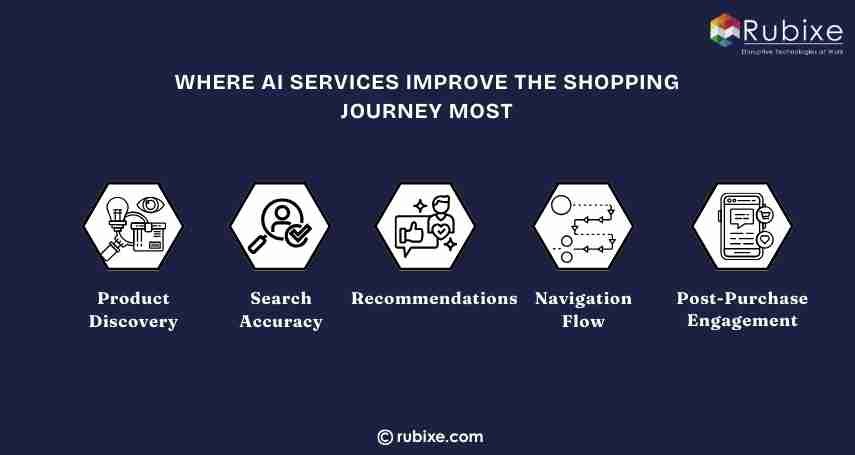
Where AI Services Improve the Shopping Journey Most
-
Product Discovery: Helping customers find what they didn’t know how to search for
-
Search Accuracy: Understanding intent behind vague or conversational queries
-
Recommendations: Adapting suggestions in real time as behaviour changes
-
Navigation Flow: Reducing friction between interest and checkout
-
Post-Purchase Engagement: Suggesting complementary products and support
Why Speed Is the New Currency in E-commerce
Customers expect instant responses, accurate inventory, and immediate support. Artificial Intelligence Services enable real-time decisions across pricing, promotions, inventory, and engagement, giving shoppers the sense of being understood instantly - a subtle advantage that builds loyalty.
Reducing Cart Abandonment With Intelligence
-
Identifying abandonment signals early: AI detects behaviors like hesitation, repeated page visits, or cart inactivity to flag potential drop-offs before they happen.
-
Triggering timely, personalised nudges: Automated, tailored messages or offers guide shoppers back to their carts, increasing the chances of conversion.
-
Adjusting offers based on hesitation patterns: AI dynamically modifies promotions or incentives based on each customer’s behaviour, addressing concerns or indecision.
-
Simplifying checkout steps dynamically: Friction points in the checkout process are reduced in real time, making it easier for customers to complete purchases.
-
Proactive intervention: Instead of reacting after a cart is abandoned, AI anticipates risk and acts intelligently, preventing lost sales and improving overall customer experience.
Conversational AI and Smarter Customer Support
Support is no longer just a cost centre, it’s a conversion tool. AI-powered chat and virtual assistants understand natural language, provide instant, accurate responses, escalate intelligently when needed, and learn from every interaction. When support is proactive and context-aware, customers feel helped, not stalled.
Trust Is Built Through Consistency
-
Standardising decision logic: AI ensures that recommendations, offers, and interactions follow consistent rules, reducing variability across touchpoints.
-
Reducing human error: Automated systems minimise mistakes that can disrupt the customer experience, such as incorrect pricing or inventory updates.
-
Ensuring relevance across channels: Customers receive coherent and timely suggestions, whether they shop on web, mobile, or in-app platforms.
-
Aligning messaging, pricing, and availability: AI synchronises all elements of the shopping experience, so customers see accurate information every time.
-
Building confidence and loyalty: Consistent, reliable experiences foster trust, which drives repeat purchases and long-term engagement.
How AI Services Improve Operational Efficiency Too
Better shopping experiences rely on smarter operations behind the scenes. Artificial Intelligence Services optimise demand forecasting, inventory allocation, dynamic pricing, and promotion effectiveness. ensuring that operations align with real customer demand and making the experience feel seamless rather than chaotic.
Why Data Alone Isn’t Enough
-
Predictive insights: AI analyses trends and patterns to anticipate customer needs, helping businesses act proactively rather than reactively.
-
Behavioural patterns: Understanding how shoppers browse, search, and purchase enables more personalised and relevant experiences.
-
Actionable recommendations: AI transforms insights into concrete actions such as product suggestions, pricing adjustments, or targeted promotions that drive engagement and sales.
-
From noise to clarity: While raw data alone can overwhelm, Artificial Intelligence Services convert it into meaningful intelligence that guides smarter business decisions.
The Role of AI Consulting in E-commerce Transformation
AI success depends on strategy, not just tools. AI consulting helps prioritise the right use cases, assess data readiness, align AI with business goals, and ensure ethical, transparent practices. Without this foundation, AI initiatives risk stalling or underperforming.
How We Support Intelligent E-commerce Experiences
-
AI consulting and readiness audits: Assess current processes, data quality, and organisational goals to ensure AI adoption is practical, strategic, and aligned.
-
Scalable AI services and automation: Flexible AI solutions grow with the business, enhancing operations and customer experiences without overwhelming existing systems.
-
Domain-aligned AI staffing: Expert teams ensure AI applications are tailored to e-commerce needs, maximising impact and relevance.
-
Strong AI cybersecurity frameworks: Robust security protects sensitive customer and business data, maintaining trust while enabling AI-driven insights.
-
End-to-end experience improvement: By integrating these elements, e-commerce brands move from experimentation to measurable results without disrupting current operations.
Avoiding the “Creepy AI” Trap
Customers want relevance, not surveillance. Responsible Artificial Intelligence Services respect data privacy, use explainable decision logic, balance personalisation with consent, and focus on usefulness over intrusion. When AI is transparent and ethical, customers embrace it rather than resist it.
Common Myths About AI in E-commerce
-
“AI replaces human creativity.”
In reality, AI removes guesswork so creativity can thrive. -
“AI is only for large marketplaces.”
Artificial Intelligence Services scale effectively for mid-sized and growing brands. -
“AI personalisation feels robotic.”
Poor implementation feels robotic. Well-designed AI feels intuitive.
Why Waiting Creates Invisible Risk
Brands that delay AI adoption don’t fail overnight; they gradually lose conversion rates, repeat customers, and engagement relevance. Meanwhile, competitors leveraging Artificial Intelligence Services quietly raise the bar, making it harder to catch up later.
The Future of E-commerce Is Experience-Led
-
Product-centric to Customer-centric: Businesses are shifting focus from just selling products to understanding and anticipating individual customer needs, creating more personalised experiences.
-
Reactive To Predictive: Instead of responding to past behavior, Artificial Intelligence Services enable brands to anticipate customer actions and preferences, improving timing and relevance.
-
Static To Adaptive: E-commerce platforms evolve continuously, adjusting recommendations, pricing, and experiences in real time based on changing customer behavior.
-
AI as the engine: Artificial Intelligence Services power this transformation, connecting insights, automation, and strategy to deliver smarter, more engaging shopping experiences.
Customers don’t remember algorithms; they remember how shopping made them feel. AI Services help e-commerce brands create experiences that are effortless, relevant, and trustworthy, turning those feelings into a powerful differentiator in a crowded digital marketplace.