







AI in Education: What Schools Must Know Before AI Adoption
AI in education adoption tips for schools, covering essential tools, integration strategies, ethics, teacher training, classrooms, and assessments.
Let’s be honest. Schools don’t suddenly fail. They just start feeling slow.
Admissions take longer than they should. Teachers spend more time on paperwork than students. And students? They’re already using smarter tech outside the classroom.
That quiet gap is exactly why AI in Education is not a future idea.
It’s a present-day response to pressure schools feel every single day. Not to replace teachers. Not to automate learning. But to make education work better, without burning people out.
Why Schools Are Under Pressure to Change
Education systems today face challenges that traditional methods alone can no longer solve. Growing class sizes, varied learning abilities, and rising expectations from parents and students are creating operational strain.
Key Challenges Schools Face
-
One-size-fits-all teaching models
-
Limited teacher bandwidth
-
Delayed student feedback
-
Administrative overload
-
Unequal access to learning resources
AI in Education helps schools respond to these challenges with flexibility and data-driven support rather than rigid processes.
Why Adoption Is Accelerating Now
The pace of adoption has increased because manual processes are no longer sustainable at scale. Schools manage admissions, enrollment, assessments, compliance reporting, and student support across multiple disconnected systems. As student populations grow and expectations rise, inefficiencies become more visible.
Several factors are accelerating adoption:
-
Increasing demand for personalized learning experiences
-
Administrative workloads are growing faster than staff capacity
-
Data fragmentation across academic and operational systems
-
Pressure to demonstrate measurable outcomes
In this context, AI services are becoming a foundational layer rather than an optional enhancement.
What Is AI in Education?
AI in Education refers to the use of artificial intelligence technologies to support teaching, learning, and school operations. These systems analyze data, recognize patterns, and adapt responses to improve educational outcomes.
Unlike traditional educational software, AI systems learn over time. They adjust content difficulty, identify learning gaps, and support both students and educators with real-time insights.
Core Capabilities of AI in Education
-
Personalized learning experiences for students
-
Automated administrative and academic tasks
-
Intelligent feedback and assessment systems
-
Predictive insights for student performance
-
Scalable support without increasing staff workload
This adaptability is what makes AI increasingly valuable in modern classrooms.
How AI Is Already Being Used in Classrooms
AI adoption in schools is not a future concept. Many institutions are already using AI-driven tools to improve daily learning experiences.
1. Personalized Learning Systems: AI-powered platforms adjust lesson content based on individual student performance. Faster learners move ahead, while others receive additional support without stigma.
2. Intelligent Tutoring Tools: AI tutors provide step-by-step guidance in subjects like math and science, offering explanations tailored to a student’s understanding level.
3. Automated Grading and Feedback: AI reduces grading time by evaluating quizzes, assignments, and even written responses, allowing teachers to focus on instruction.
4. AI Chatbots for Student Support: An AI Chatbot helps students with schedules, assignments, deadlines, and common questions , available 24/7 without adding staff workload.
Operational & Institutional Use Cases
While teaching and learning often take the spotlight, much of a school’s pressure comes from operational complexity. AI addresses these institutional challenges by streamlining admissions, records, and student support workflows.
AI in Admissions and Enrollment Workflows
Admissions is often the first area where schools experience tangible benefits from AI. Intelligent systems reduce manual coordination while preserving human decision-making.
|
Workflow Area |
AI Contribution |
|
Application Review |
Automated data collection, validation, and reviewer assignment |
|
Interview Coordination |
Scheduling automation and real-time notifications |
|
Enrollment Updates |
Personalized status communication and reminders |
|
Record Verification |
Cross-checking documents and academic credentials |
By reducing administrative overhead, AI in education enables admissions teams to focus on evaluation quality rather than process management.
Curriculum Development and Academic Planning
Curriculum design involves aligning learning objectives, content quality, and assessment outcomes. AI supports this process by introducing analytical rigor without constraining creativity.
Schools use AI to:
-
Analyze alignment between objectives and course materials
-
Identify gaps or redundancies across programs
-
Support peer review and content iteration
-
Incorporate performance data into curriculum updates
Rather than dictating content, AI provides visibility that helps educators make informed adjustments.
Student Records and Institutional Data Management
Student data management is operationally complex and compliance-sensitive. AI improves accuracy, traceability, and access control across systems.
Key improvements include:
-
Automated transcript and attendance updates
-
Continuous data validation with discrepancy alerts
-
Role-based access permissions
-
Comprehensive audit logs for regulatory review
This layer of AI in education strengthens institutional trust in data while reducing administrative risk.
Enhancing Student Support Systems
Student support has expanded beyond office hours and email-based communication. AI-powered systems help schools respond consistently while maintaining quality.
Common applications include:
-
Intelligent inquiry routing based on urgency
-
Identity verification during support interactions
-
Automated scheduling and reminders
-
Early performance monitoring and intervention alerts
Many institutions deploy an AI chatbot as the first point of contact, resolving common questions and escalating complex cases to human advisors.
Benefits of AI in Education for Students
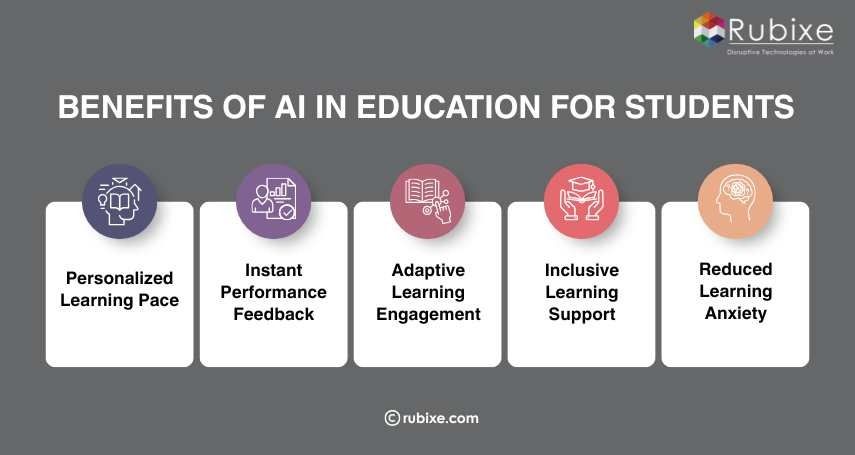 AI adoption matters most where it directly impacts students. When implemented thoughtfully, it improves learning experiences without adding pressure or complexity.
-
Personalized Learning Pace:
AI adjusts lessons based on each student’s understanding, allowing them to learn without feeling rushed or left behind.
-
Instant Performance Feedback:
Students receive immediate insights on their work, helping them correct mistakes and improve without waiting days for responses.
-
Adaptive Learning Engagement:
Learning materials evolve based on student interaction, keeping lessons relevant and maintaining attention.
-
Inclusive Learning Support:
AI tools assist students with disabilities or learning differences through tailored formats, accessibility features, and adaptive guidance.
-
Reduced Learning Anxiety:
Personalized assistance helps students feel supported rather than compared, building confidence over time.
When students feel understood instead of evaluated, learning becomes more effective, consistent, and motivating.
Challenges and Ethical Concerns Schools Must Address
Despite its benefits, AI adoption in education requires careful planning to avoid new risks while solving old problems.
-
Data Privacy and Student Security: Schools must ensure student data is collected, stored, and used securely to protect privacy and comply with regulations.
-
Bias in AI Algorithms: If training data is incomplete or biased, AI systems can unintentionally reinforce inequality in learning outcomes.
-
Over-Reliance on Technology: Excessive dependence on AI can reduce critical thinking if human judgment and teaching oversight are not maintained.
-
Unequal Access to AI Tools: Without inclusive planning, AI adoption may widen the gap between well-funded institutions and under-resourced schools.
To manage these risks, many institutions work with experienced AI consulting partners to build ethical frameworks, governance policies, and secure implementation strategies from the start.
Preparing Schools for AI Integration
Successful AI adoption requires more than tools alone. Schools must build readiness across people, processes, and technology.
Steps for Responsible AI Adoption
-
Assess learning and operational needs: Schools should identify where AI can genuinely improve teaching, administration, or student support before selecting any tools.
-
Upgrade infrastructure and connectivity: Reliable internet, compatible systems, and secure hardware are essential to support AI-driven applications.
-
Train educators on AI tools and ethics: Teachers need practical training to use AI effectively while understanding ethical boundaries and limitations.
-
Integrate AI into curriculum design: AI should be embedded into subjects and workflows rather than treated as a standalone or optional add-on.
-
Monitor outcomes and adapt continuously: Schools must regularly evaluate performance, student impact, and risks to ensure AI remains effective and responsible.
AI in education delivers the best results when implemented as a long-term strategy rather than a quick technology upgrade.
Why Choosing the Right AI Partner Matters
Not all AI solutions are built for education. The right AI products must align with learning goals, compliance requirements, and real classroom needs.
A reliable partner helps schools:
-
Select appropriate AI tools
-
Ensure data security and compliance
-
Measure learning outcomes
-
Scale solutions responsibly
This is where experienced AI consulting support becomes critical.
AI in education is not about replacing classrooms with machines. Schools that adopt AI thoughtfully gain flexibility, efficiency, and long-term resilience.
Choosing the right AI strategy today helps institutions stay relevant, competitive, and student-focused tomorrow. If you are exploring this shift, choose the best AI consulting company that understands education, not just technology.