






AI Application Development Services
AI application development services help businesses build smart apps using data, automation, and AI models to improve processes, user experience, and decisions.
Why do most AI ideas never move beyond prototypes or presentations?
The truth is, building real, scalable AI applications is harder than having the idea itself. AI Application Development Services bridge the gap between vision and execution, turning raw data into intelligent, living systems that deliver measurable business impact.
Why Businesses Struggle to Turn AI Ideas Into Reality
-
Unclear AI Use Cases: Many organisations pursue AI without clearly defining how it solves real business problems, leading to initiatives that fail to deliver measurable impact.
-
Poor-Quality or Fragmented Data: Incomplete, inconsistent, or siloed data prevents AI models from producing accurate insights, undermining their effectiveness.
-
Over-Engineered Solutions with Low Adoption: Complex AI solutions that are hard to use often fail to gain traction among teams, limiting return on investment.
-
Lack of AI-Ready Talent: A shortage of skilled professionals who can develop, implement, and manage AI systems slows down projects and reduces outcomes.
-
Security and Compliance Concerns: AI initiatives must navigate privacy, regulatory, and cybersecurity challenges to protect sensitive data and maintain trust.
-
Tools Without Long-Term Scalability: Investing in solutions that cannot scale with the business leads to wasted resources and prevents AI from delivering ongoing value.
-
The Role of AI Services: Successful AI today is less about individual tools and more about how Artificial Intelligence Services are designed, built, and integrated, ensuring solutions are practical, secure, and aligned with business objectives.
What AI Application Development Really Means
AI application development isn’t about adding intelligence as an afterthought - it’s about embedding it at the core. Artificial Intelligence Services enable applications to learn continuously from data, adapt to user behaviour, predict outcomes, automate decisions, and scale with business complexity. These aren’t static apps; they are evolving, intelligent systems.
How AI Services Redefine Application Behaviour
-
From “If-Then” Logic to Probabilistic Reasoning: AI applications move beyond rigid rules to flexible, data-driven decision-making that can handle uncertainty and complexity effectively.
-
Continuous Learning for Improved Accuracy: Systems evolve, learning from new data and feedback, which prevents them from becoming outdated and enhances long-term performance.
-
Data-Driven Decisions: Real-time insights replace assumptions, enabling faster, smarter, and more reliable business decisions across operations.
-
Personalised User Experiences: Applications adapt to individual user behaviour and preferences, creating tailored experiences rather than one-size-fits-all interactions.
-
Transformational Impact: By combining learning, adaptability, and personalisation, AI application development delivers transformational outcomes, turning ordinary software into intelligent, evolving systems rather than incremental upgrades.
High-Impact AI Application Use Cases
Artificial Intelligence Services power a wide range of applications, from intelligent customer support and chat systems to predictive analytics dashboards, fraud detection platforms, recommendation engines, computer vision tools, process automation, and demand forecasting systems. Behind each of these solutions lies a carefully orchestrated set of Artificial Intelligence Services working seamlessly together.
How AI Services Prepare Data for Intelligence
-
Data Cleaning and Enrichment: Raw data is prepared, standardised, and enhanced to ensure accuracy and reliability, forming a solid foundation for AI applications.
-
Feature Engineering for Meaningful Patterns: Relevant attributes are extracted and transformed to help AI models detect patterns and generate actionable insights.
-
Real-Time Data Pipelines: Continuous data flows enable AI systems to process information instantly, supporting timely decision-making and adaptive learning.
-
Bias Detection and Mitigation: Artificial Intelligence Services identify and reduce biases in data to ensure fair, ethical, and reliable outcomes across applications.
-
Secure Data Handling and Compliance: Robust protocols protect sensitive information while adhering to regulatory and organisational standards.
-
Laying the Foundation for AI: Strong AI application development begins long before model training, ensuring data quality, integrity, and ethical practices set the stage for successful, scalable, and intelligent systems.
Human-Centred AI Application Design
Effective Artificial Intelligence Services prioritise clarity and usability. They deliver explainable outputs instead of black-box decisions, provide interfaces that build confidence, present insights in clear, actionable language, and support human decision-making without replacing accountability, balancing intelligence with practical usability.
How AI Services Make ML Practical
-
Selecting the Right Algorithms: Choosing algorithms that align with the specific business problem ensures models are effective, efficient, and fit-for-purpose.
-
Training on High-Quality, Relevant Data: Models are trained using clean, accurate, and representative datasets to maximise performance and reliability.
-
Preventing Overfitting and Performance Decay: Techniques are applied to avoid overfitting and ensure models generalise well to new, unseen data, maintaining consistent results.
-
Post-Deployment Monitoring: Continuous monitoring tracks model performance in real-world conditions, detecting issues early and maintaining operational effectiveness.
-
Continuous Improvement: AI models are regularly refined and updated with new data to enhance accuracy, adaptability, and long-term value.
-
Delivering Long-Term Impact: By combining careful design, rigorous training, and ongoing optimisation, AI applications provide measurable benefits well beyond their initial launch.
Why Scalability Is a Design Decision
Artificial Intelligence Services designed for scalability use modular architectures, cloud-native deployment, performance optimisation under load, and cost-efficient scaling strategies. This ensures AI applications can grow with the business while protecting long-term ROI.
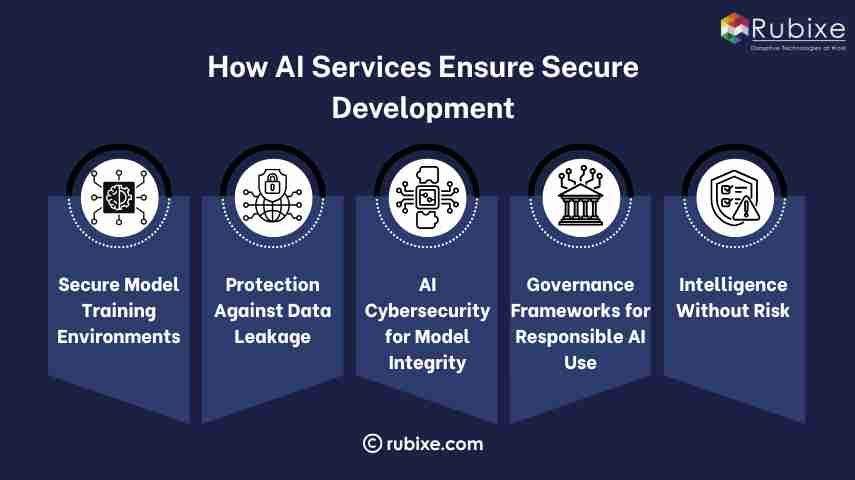
How AI Services Ensure Secure Development
-
Secure Model Training Environments: AI models are developed in controlled, protected environments to prevent unauthorised access and ensure data integrity during training.
-
Protection Against Data Leakage: Measures are implemented to safeguard sensitive information from accidental or malicious exposure throughout the AI lifecycle.
-
AI Cybersecurity for Model Integrity: Continuous monitoring and security protocols protect AI models from tampering, adversarial attacks, or corruption that could compromise outcomes.
-
Governance Frameworks for Responsible AI Use: Clear policies, standards, and accountability structures ensure AI systems are deployed ethically, transparently, and in compliance with regulations.
-
Intelligence Without Risk: By embedding security and governance, AI becomes a trusted asset, turning intelligence into value rather than liability.
Why AI Consulting Matters
Successful AI applications begin with a strong strategic foundation. This means identifying the right problems to solve, aligning AI initiatives with broader business goals, and carefully evaluating data readiness and maturity. By creating realistic AI roadmaps and anticipating potential challenges, organisations can avoid costly missteps and ensure their AI projects deliver meaningful, long-term impact rather than stalling after initial deployment.
How AI Services Drive Real Adoption
-
Gradual Integration into Existing Workflows: AI applications are introduced step by step, ensuring they complement current processes rather than disrupt them, which helps teams adapt smoothly.
-
Training Teams Alongside Technology: Employees receive hands-on guidance and skill development to use AI tools effectively, fostering adoption and reducing resistance.
-
Measuring Outcomes, Not Hype: Success is tracked through clear, data-driven metrics that demonstrate real business impact, rather than relying on promises or trends.
-
Continuous Optimisation After Deployment: AI systems are regularly refined based on performance insights, evolving needs, and feedback to maintain relevance and maximise value.
-
From Novelty to Necessity: By integrating AI thoughtfully, supporting teams, and focusing on measurable outcomes, applications move from being experimental tools to indispensable business assets.
Cross-Industry AI Application Examples
Artificial Intelligence Services are transforming industries in context-specific ways. Healthcare benefits from predictive diagnostics and patient monitoring, finance gains intelligent risk assessment and fraud detection, and retail sees personalised recommendations and demand forecasting.Manufacturing leverages predictive maintenance and quality inspection, and logistics optimizes routes and supply chains. Across all sectors, the common thread is well-designed Artificial Intelligence Services tailored to deliver real impact.
Why AI Staffing Complements AI Services
-
Access to Experienced Data Scientists and Engineers: Partnering with Artificial Intelligence Services provides immediate expertise, bringing skilled professionals who can tackle complex challenges without the delay of internal recruitment.
-
Faster Development Cycles: Leveraging external talent and proven methodologies accelerates project timelines, allowing AI applications to move from concept to deployment more quickly.
-
Reduced Dependency on Internal Hiring: Organisations can scale AI initiatives without overloading internal teams or waiting to fill specialised roles, thereby minimising bottlenecks.
-
Knowledge Transfer to In-House Teams: AI Service providers work alongside internal staff, sharing skills and best practices to ensure teams are capable of managing and maintaining AI solutions long-term.
-
Accelerated Execution Without Bottlenecks: By combining expertise, speed, and knowledge transfer, organisations achieve faster results while building internal capabilities for sustainable AI adoption.
How We Approach AI Application Development at Our Company
AI application development is a strategic journey, not a one-time project. By combining AI consulting to define high-impact use cases, readiness audits to assess data and systems, scalable Artificial Intelligence Services, dedicated staffing, workflow automation, and AI cybersecurity, organisations can build applications that are intelligent, secure, and fully business-ready.
Building Trust Through Responsible AI Services
-
Transparent Decision Logic: AI systems are designed to provide clear, explainable reasoning behind recommendations and actions, helping teams understand and trust the outcomes.
-
Bias-Aware Model Development: Models are built and trained with attention to detecting and mitigating bias, ensuring fair and equitable results across diverse scenarios.
-
Ethical AI Governance: Policies and frameworks guide responsible AI use, promoting accountability, transparency, and alignment with organisational values.
-
Compliance with Data Regulations: AI applications adhere to legal and regulatory standards, such as GDPR, protecting sensitive data and reducing liability.
-
Turning AI Into a Trusted Partner: By combining transparency, fairness, ethics, and compliance, these principles transform AI from a potential risk into a reliable, value-generating partner for the business.
The Silent Advantage of Acting Early
AI leaders often don’t broadcast their advantage; they quietly outperform. Their applications become smarter, decisions happen faster, costs decrease, and customer experiences improve. Competitors usually realise the gap only when it has grown too large to bridge, highlighting how strategic AI adoption creates a subtle but powerful edge.
The Cost of Waiting Is Higher Than the Cost of Building
-
Delaying AI Increases Vulnerability: Waiting to implement AI doesn’t protect a business; it leaves it exposed to market shifts, operational inefficiencies, and missed opportunities.
-
Markets Evolve Rapidly: Consumer expectations, technological trends, and competitive domains are changing at unprecedented speed, demanding agile, intelligent responses.
-
Rising Customer Expectations: Today’s customers expect personalised experiences, faster service, and smarter solutions, requirements that traditional processes struggle to meet.
-
Competitors Adapt Quickly: Organisations that embrace AI early gain a strategic advantage, leaving slower adopters struggling to catch up.
-
AI Services as a Foundation: Far from being experimental tools, Artificial Intelligence Services are now essential for resilience, growth, and long-term competitiveness in any industry.
AI application development isn’t about replacing people or following trends; it’s about creating systems that think, learn, and enable smarter decisions every day. Done right, AI Services turn applications into strategic assets that grow in value over time, helping organisations move beyond pilots and achieve real, lasting impact.