





Why Businesses Are Turning to AI Consulting Services
AI consulting services help businesses make smarter decisions, improve efficiency, and align AI strategies with real-world goals and challenges.

Many businesses invest in AI hoping to save time, reduce costs, and improve productivity. However, without a clear strategy, AI often creates disconnected workflows, poor adoption, and disappointing results. AI consulting services help businesses identify the right opportunities, build a practical roadmap, and ensure AI investments deliver measurable business value.
How AI Consulting Helps Businesses Use AI Effectively
AI consulting services help businesses make sense of artificial intelligence and use it in practical ways. These services guide companies through planning, building, and using AI tools that can improve how they work.
AI consulting services help businesses use artificial intelligence in practical and measurable ways.
Instead of adopting random AI tools, they assess business goals, existing workflows, and operational challenges before creating a practical implementation roadmap. This structured approach helps organizations improve efficiency, automate repetitive tasks, and achieve measurable business outcomes.
A strong AI consulting strategy focuses on:
-
Solving real business problems
-
Improving operational efficiency
-
Automating repetitive tasks
-
Supporting faster decision-making
-
Creating scalable AI solutions
This helps organizations avoid costly mistakes and ensures AI investments deliver real value.
Signs Your Business Needs AI Consulting Support
A business should consider AI consulting services when it:
-
Wants to explore AI Opportunities: Before investing in AI, businesses should understand whether they are ready for implementation. If your organization is facing operational challenges, managing large amounts of data, or struggling to choose the right AI tools, AI consulting can provide the guidance needed to move forward with confidence.
-
Has Lots of Data, But No Clear Strategy: When there’s valuable data available but no roadmap on how to use it effectively.
-
Needs Help Choosing the Right Tools: To identify and implement the best AI technologies for specific business goals.
-
Is looking to Automate Processes: To streamline repetitive tasks or enhance decision-making through automation.
-
Faces Complex Business Challenges: When solving problems requires advanced, data-driven insights and intelligent solutions.
Core Areas Every AI Consulting Strategy Should Cover
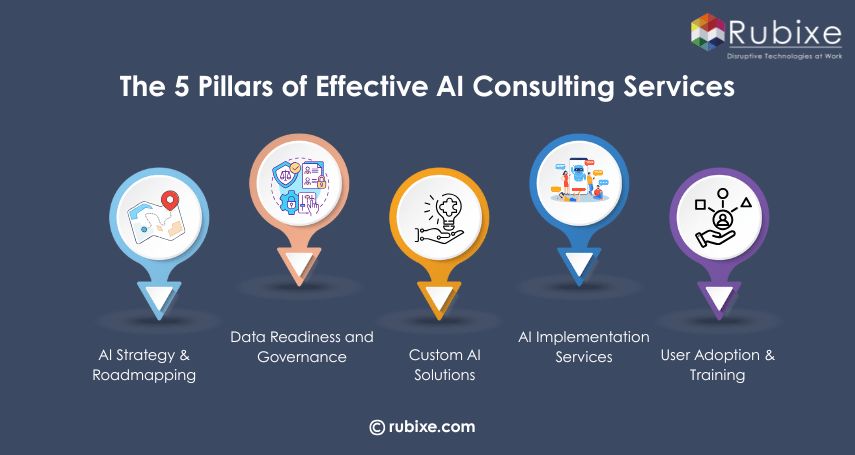
1. AI Strategy & Roadmapping
Every successful AI project starts with a strong foundation. Before selecting AI tools or building models, businesses need a clear strategy, reliable data, proper implementation, and employee readiness. These core areas ensure AI delivers measurable business value instead of becoming another technology investment.
Before jumping into models and automation, a strategy must be developed. This includes:
-
Business problem alignment
-
Feasibility analysis
-
Prioritized use case identification
-
ROI forecasting
2. Data Readiness and Governance
No AI solution is better than the data it’s built on. Consultants help you:
-
Audit and cleanse data
-
Integrate disparate data sources
-
Create data lakes or pipelines
-
Set up compliance frameworks (GDPR, HIPAA, etc.)
3. Custom AI Solutions
Whether you need intelligent automation or real-time analytics, custom AI solutions are built for your context:
-
Chatbots for 24/7 support
-
Image recognition in manufacturing
-
Demand forecasting in retail
-
AI-driven fraud detection in banking
-
NLP for legal document review
4. AI Implementation Services
Even the best model has no value unless it’s integrated into workflows. Implementation includes:
-
Model deployment (on-premise, cloud, or hybrid)
-
Integration with ERP/CRM platforms
-
MLOps setup for versioning and monitoring
-
End-user dashboards and APIs
AI implementation services ensure that your model becomes a business tool, not just a prototype.
5. User Adoption & Training
People are at the heart of every AI initiative. The best AI consulting companies also:
-
Run training programs for non-technical staff
-
Help C-suite executives understand AI implications
-
Guide ethical and responsible AI adoption
-
Ensure organization-wide readiness for change
What Makes a Great AI Consulting Company?
Choosing the right AI consulting company is one of the most important decisions in an AI journey. Beyond technical expertise, businesses should look for a consulting partner that understands industry challenges, aligns AI with business goals, and delivers measurable results.
-
Deep Technical Expertise: Strong knowledge of AI, machine learning, data science, and related technologies to build tailored solutions.
-
Business Understanding: The ability to align AI strategies with a company’s goals, industry needs, and ROI expectations.
-
Custom Solutions: Avoiding one-size-fits-all approaches by designing AI systems that fit the client’s unique challenges and workflows.
-
Strong Data Capabilities: Experience in handling data collection, preparation, and governance to ensure high-quality inputs for AI models.
-
Ethical and Regulatory Awareness: Understanding and applying responsible AI practices that comply with laws like GDPR, HIPAA, or industry-specific standards.
Industries Using AI to Improve Operations
Many industries are turning to AI consulting to stay competitive, streamline operations, and unlock new value. Key sectors include
-
Healthcare: For predictive diagnostics, personalized treatment plans, medical imaging analysis, and hospital workflow optimization.
-
Finance: To detect fraud, automate risk assessment, enhance customer service with chatbots, and improve algorithmic trading.
-
Retail & E-commerce: For personalized recommendations, inventory forecasting, customer behavior analysis, and dynamic pricing.
-
Manufacturing: To optimize supply chains, implement predictive maintenance, and improve quality control through AI-powered inspections.
-
Logistics & Transportation: For route optimization, fleet management, demand forecasting, and autonomous delivery planning.
-
Telecommunications: To enhance network performance, predict outages, automate customer support, and reduce churn.
Key Benefits of AI Consulting Services
According to McKinsey, nearly 78% of organizations now use AI in at least one business function. Businesses with a clear AI strategy are more likely to achieve measurable improvements in productivity, decision-making, and operational efficiency.
-
Faster Time-to-Value: AI consultants speed up implementation using proven frameworks, tools, and best practices, helping you see results sooner.
-
Cost-Efficiency: Avoid unnecessary spending on the wrong technologies or misaligned strategies by leveraging expert guidance.
-
Scalability: Build AI solutions that can grow seamlessly across teams, departments, or global operations as your business evolves.
-
Risk Mitigation: Ensure compliance with data privacy laws and reduce the risk of bias or ethical issues in AI models.
-
Business Alignment: Keep AI initiatives focused on measurable impact and real business value, not just hype or trends.
Businesses Without AI Consulting vs Businesses With AI Consulting
|
Without AI Consulting |
With AI Consulting |
|
Unclear AI strategy |
Structured implementation roadmap |
|
Random AI tool adoption |
Goal-driven AI solutions |
|
Poor system integration |
Connected operational workflows |
|
Difficulty measuring ROI |
Defined business KPIs |
|
Higher implementation risks |
Scalable AI deployment |
Common Questions Around AI Consulting Services
-
What does an AI consulting firm do?
They help businesses plan, design, implement, and scale AI solutions tailored to their goals and operations. -
Do I need AI consulting if I already have a tech team?
Yes, consultants bring specialized AI expertise and strategic insight that complement your existing resources. -
How do I know if my business is ready for AI?
If you have data, a specific problem to solve, and a goal to improve efficiency or decision-making, you're likely ready. -
Is AI consulting only for large enterprises?
No, small and mid-sized businesses also benefit from AI consulting, especially when they need guidance to get started. -
How long does it take to see results from AI projects?
It varies, but with the right approach, many businesses start seeing measurable outcomes in a few months.
Frequently Asked Questions About AI Consulting Services
Is AI consulting only for large companies?
No. Small and medium-sized businesses also use AI consulting to automate tasks, improve workflows, and reduce operational costs.
How long does AI implementation take?
It depends on project complexity, but many businesses start seeing measurable improvements within a few months.
Can AI consulting improve customer experience?
Yes. AI solutions can automate support, personalize recommendations, and improve response times.
Do businesses need technical knowledge before using AI?
No. AI consultants guide businesses through planning, implementation, and optimization.
AI is no longer just a future technology- it has become a practical business tool. However, successful AI adoption requires more than selecting the latest tools. It starts with understanding business challenges, creating a clear strategy, and implementing solutions that deliver measurable value.
AI consulting services help businesses reduce risks, improve efficiency, and build scalable AI solutions aligned with long-term business goals. Organizations that invest in the right strategy today will be better prepared to innovate, compete, and grow in the years ahead.